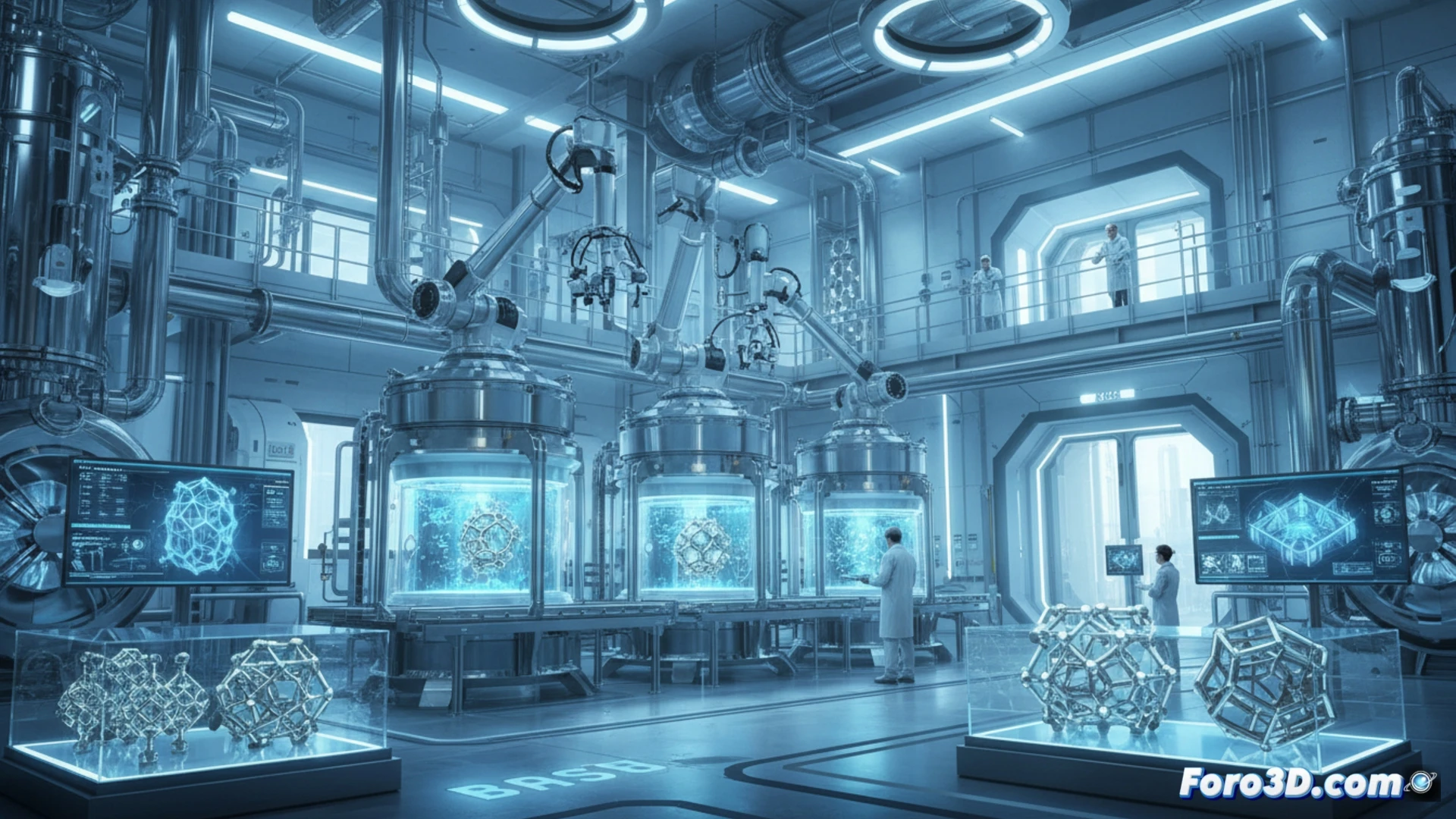
BASF has marked an industrial milestone by inaugurating the world's first plant dedicated to the manufacture of catalysts using 3D printing. This fusion between additive manufacturing and traditional chemical engineering allows the production of catalysts with highly customized designs. The key lies in the ability to create complex internal geometries, digitally optimized to guide the flow of reagents, which translates into greater efficiency, selectivity, and durability in critical chemical processes.
Simulation as the core of advanced catalytic design 🧠
The true breakthrough is not the printing itself, but the simulation and digital modeling process that precedes it. Before physically manufacturing the catalyst, engineers can design and virtually test structures with labyrinthine internal channels, gradual porosities, and shapes impossible to achieve with conventional methods. This allows precise simulation of fluid behavior, contact points, and heat and mass transfers. Thus, the catalyst's performance is optimized for a specific reaction, maximizing conversion and minimizing unwanted byproducts, in a clear example of data-based intelligent chemical manufacturing.
Towards tailor-made and more sustainable chemical processes 🌱
This achievement consolidates a paradigm shift: moving from standard catalysts to custom solutions for each industrial process. Sectors such as energy, petrochemicals, or environmental protection will be able to request catalysts designed specifically for their needs, improving the economy and sustainability of their operations. BASF's plant symbolizes the future of chemical manufacturing, where digital simulation and additive production converge to create functional materials with unprecedented precision and adaptability.
How can process simulation optimize the design and manufacturing of 3D-printed catalysts to maximize their efficiency and industrial scalability?
(PS: Simulating industrial processes is like watching an ant in a maze, but more expensive.)