The JD Power 2026 vehicle reliability study crowned Lexus as the most reliable brand, with an index of only 151 problems per 100 cars. This result consolidates its leadership in the premium segment for the fourth consecutive year. The report reveals a critical trend: owners' main complaints no longer focus on traditional mechanical components, but on infotainment systems and the vehicle's embedded technology, a field where design and 3D simulation are now indispensable tools.
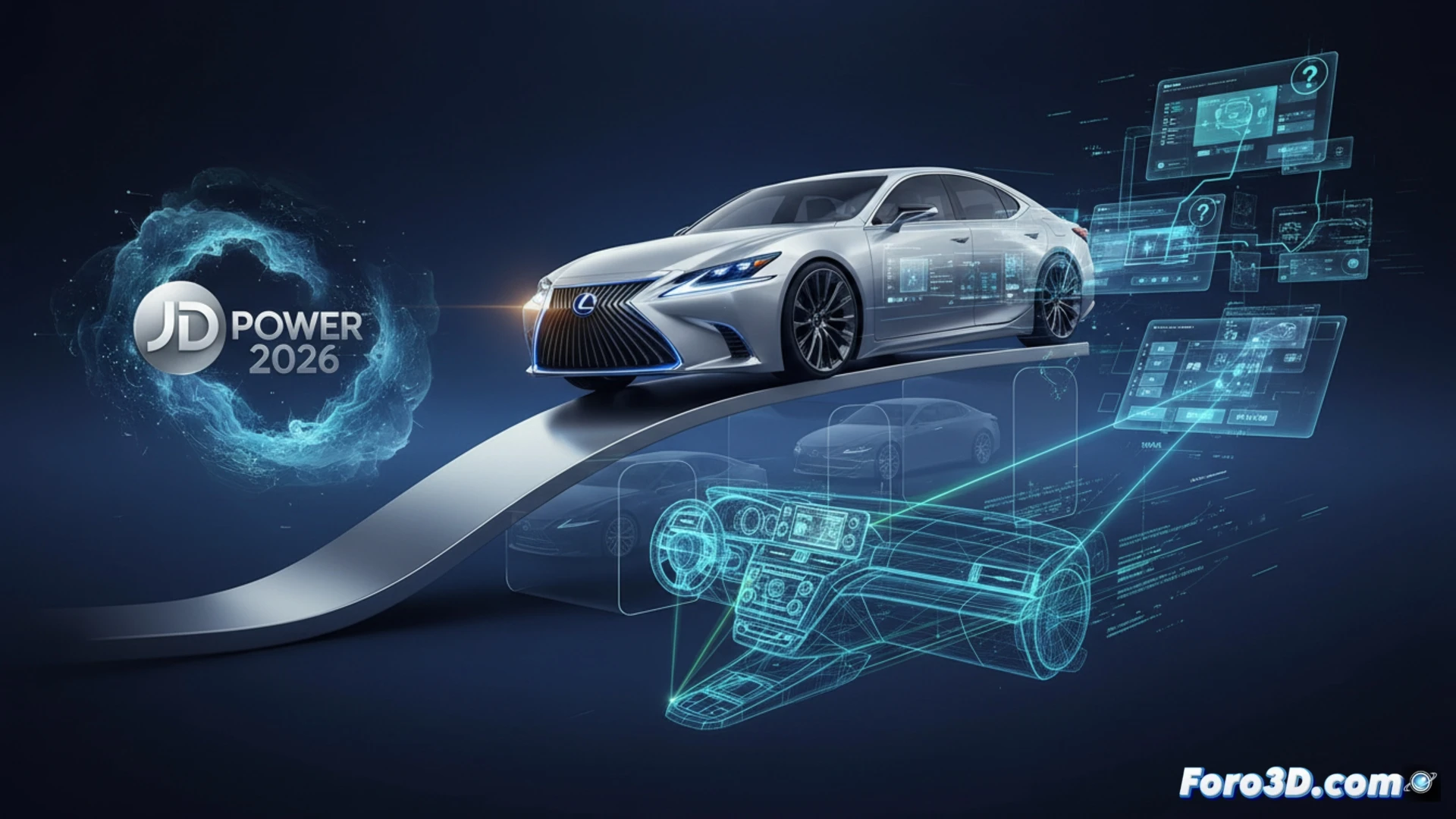
3D Engineering and Simulation: Keys to Anticipating Failures in Embedded Systems 🔍
The problems reported in touch screens, connectivity, or voice assistants are not mere software errors. They are the result of complex interactions between electronic hardware, firmware, thermal dissipation, and the physical interface with the user. This is where 3D modeling and multidisciplinary simulation become crucial. Through virtual prototypes and finite element analysis, engineers can predict critical overheating points in ECUs, evaluate the integrity of solder joints on circuit boards subjected to vibration, or simulate data flow in the vehicle's CAN network long before manufacturing a physical component. This anticipation capability is what allows brands like Lexus to refine their designs to achieve greater robustness and reliability from the conceptual phase.
Reliability is Now Designed in the Virtual World 💻
Lexus's leadership in reliability, with the IS model as its flagship, is not accidental. It is the reflection of an engineering philosophy that integrates advanced simulation as a pillar of development. In a modern automobile, where electronics is the new mechanical core, the battle for quality is no longer fought only on the assembly line, but in digital design environments. The ability to model and virtually stress-test each complex system is, today, the best guarantee to reduce those PP100 and deliver to the user a technological experience as solid as the vehicle's own chassis.
How does the integration of 3D modeling and simulation systems influence the reduction of reliability problems reported by studies like JD Power's? 🏆
(P.S.: car electronics are like family: there's always a fuse that blows)