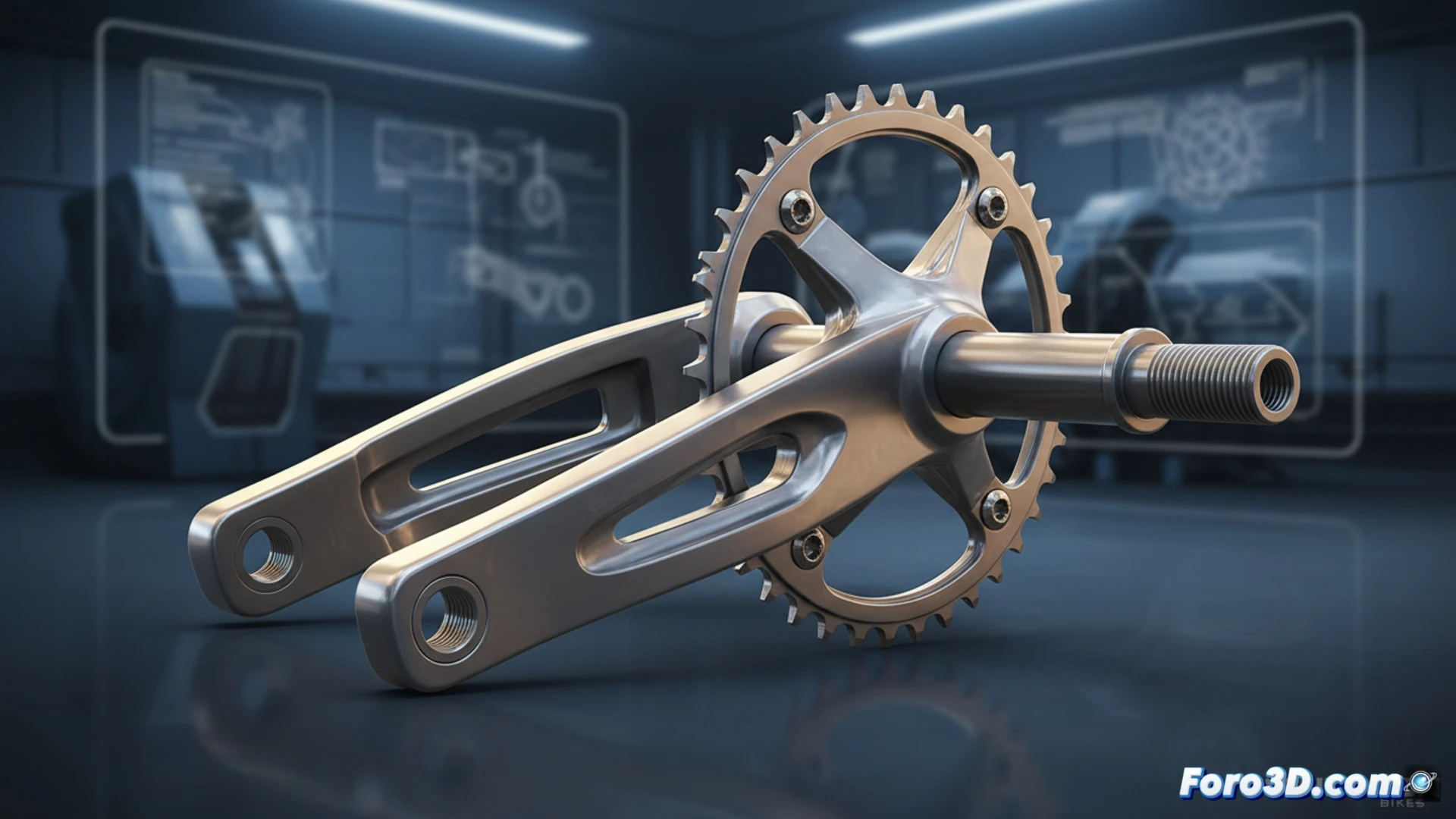
Atherton Bikes takes a technological leap by presenting its new titanium cranks manufactured via 3D printing for Downhill and Trail disciplines. This is not a prototype, but a final component with a lifetime warranty, demonstrating the maturity of additive manufacturing in highly demanding applications. The brand thus consolidates its position at the forefront, using 3D printing to create geometries impossible to achieve with forging or traditional machining, resulting in lighter, stiffer, and more durable parts.
Technical Advantages: Generative Design and Titanium Properties 🧠
The core of the innovation lies in the synergy between software-assisted generative design and the intrinsic properties of titanium. 3D printing allows optimizing material distribution only where needed, creating complex internal structures that reduce weight without compromising stiffness or strength. Titanium, with its excellent strength-to-weight ratio and natural ability to dampen vibrations, is the ideal material. The additive manufacturing process by powder bed fusion ensures a monolithic part without weak joints, maximizing structural integrity to withstand the impacts and extreme loads of mountain biking.
A Milestone in Advanced Manufacturing for Cycling 🚀
This launch marks a turning point. It's no longer about using 3D printing for rapid prototypes, but for series production of high-value critical components. This redefines the boundaries of cyclist product design, directing the industry toward extreme customization and unprecedented topological optimization. Atherton Bikes is not just selling a crank, but validating a new manufacturing paradigm where geometric complexity is free and final performance is the only priority.
How does 3D printing in titanium allow optimizing the internal geometry of Atherton Bikes cranks to surpass the limits of strength and weight in mountain biking?
(PS: A good printable model is like a good friend: it doesn't need supports.)