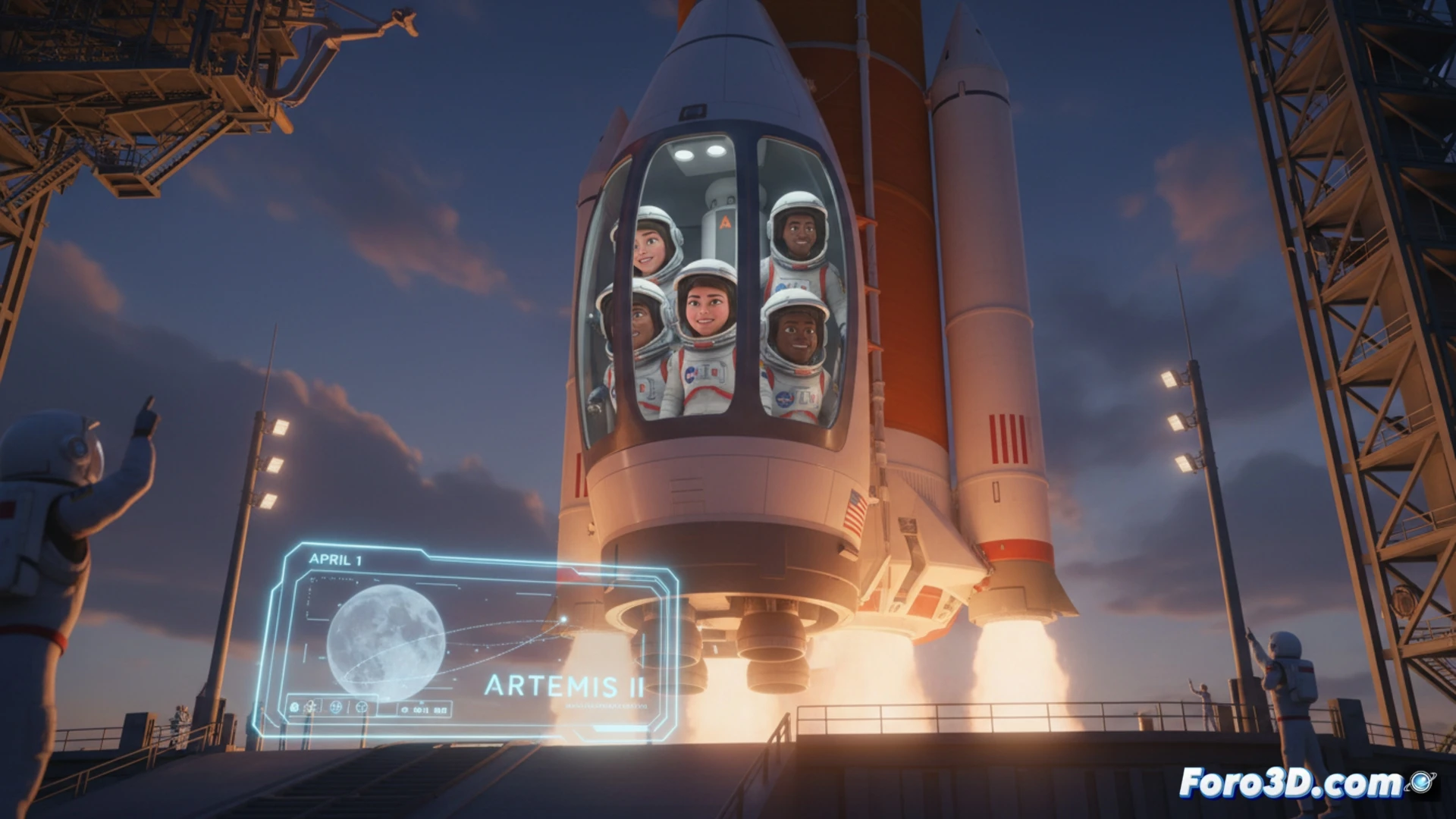
The upcoming launch of Artemis II, the first crewed mission beyond low Earth orbit in decades, is not just an engineering achievement. It is also a triumph of scientific visualization. Before the SLS rocket lifts off from Florida, every phase of the mission has been modeled, simulated, and analyzed in 3D environments. These tools are vital for planning the complex free-return trajectory around the Moon and for communicating the magnitude of this feat to the world.
Modeling, Simulation, and Analysis of a Critical Mission 🚀
3D visualization is the backbone of Artemis II planning. Engineers use extremely precise digital models of the SLS rocket and the Orion capsule to simulate stress during launch and flight. The free-return trajectory, a complex path that uses lunar gravity to propel the spacecraft back to Earth, is visualized and calculated in specialized systems. These simulations allow for risk analysis, maneuver optimization, and crew training in virtual scenarios. Additionally, visualizations generated from telemetry data will be crucial for following the mission in real time and making informed decisions.
Beyond Engineering: Outreach and Visual Legacy 👨🚀
The power of these tools transcends the control room. 3D recreations and data visualizations enable the public to understand a mission of overwhelming complexity. We can see the lunar orbit, Earth from afar, and the delicate dance of the spacecraft in space. This visual legacy not only documents a historic milestone but also inspires future generations of scientists and engineers, showing the path that scientific visualization charts for the next frontier.
How are 3D scientific visualization techniques used to simulate and analyze critical trajectories and radiation risks in the crewed Artemis II mission around the Moon?
(P.S.: if your manta ray animation doesn't excite, you can always add documentary music from Channel 2)