Arm breaks its business model after 35 years and launches its first own processor, the AGI CPU, designed for data centers and AI. This strategic move introduces a direct competitor to Intel and AMD in the high-performance segment. For the 3D sector, it promises radically superior energy efficiency and more than double the performance per rack, which could redefine the economics of render farms and large-scale simulation.🚀
Technical specifications and potential in 3D workflows⚙️
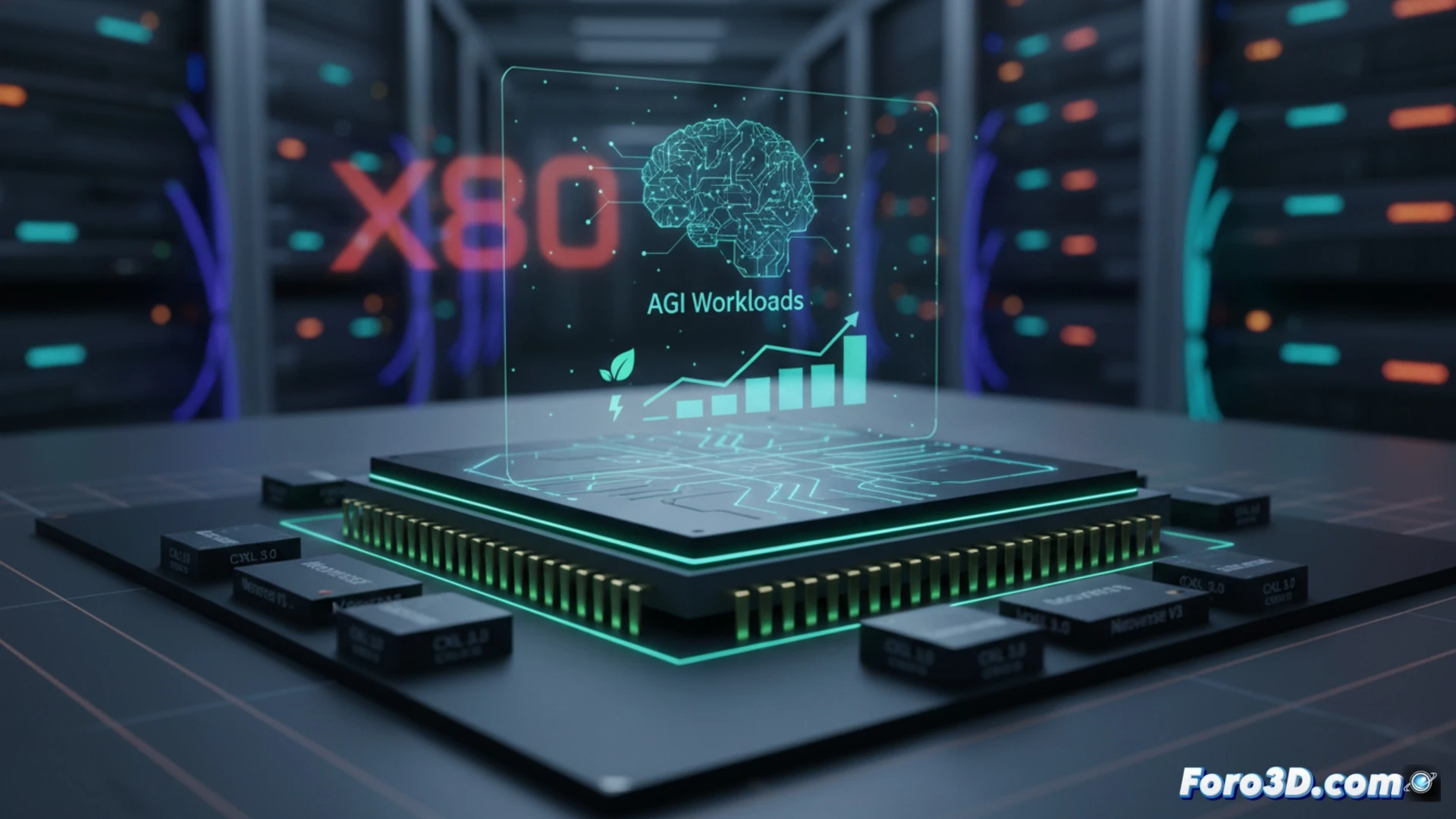
Based on Neoverse V3 and with up to 136 cores, the AGI CPU is built for massive parallelism. Technologies like PCIe Gen 6 and CXL 3.0 ensure enormous bandwidth for GPUs and unified memory. In rendering (CPU-based like Arnold or V-Ray) and complex physical simulations, the high core count is key. Its greatest promise lies in training generative AI models for creating textures or geometry, and in render servers where efficiency per watt translates directly into lower operational and thermal costs.
Efficiency vs. ecosystem: the adoption challenge⚠️
Although its advantage in performance per rack over Xeon or Threadripper is overwhelming on paper, its adoption in 3D will depend on the software. Applications must be optimized for the Arm architecture. It is not a chip for workstations in the short term, but a solution for cloud infrastructure and farms. Its success could force AMD and Intel to prioritize efficiency, benefiting the entire sector in the long term.
Can the new Arm AGI CPU processor become the most energy-efficient option for 3D rendering and simulation in render farms and professional workstations?
(PS: Your CPU heats up more than the Blender vs. Maya debate)