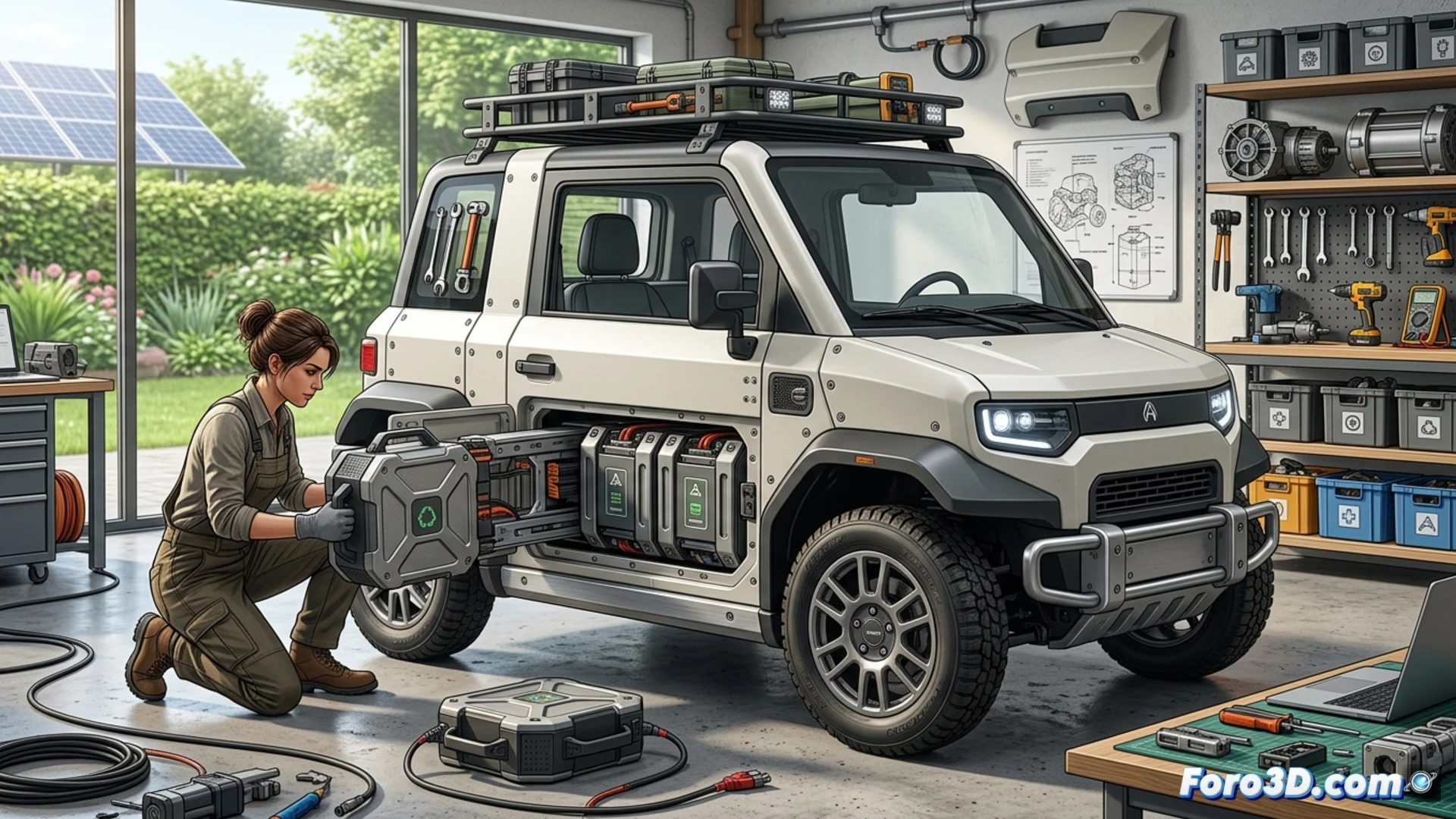
A team from Istanbul Technical University presents the Aria EV, an electric vehicle that challenges current complexity and obsolescence. Its core is a modular design, prioritizing reparability and sustainability through standardized components and a manually swappable battery system. This approach, born from open-source philosophy and design for durability, seeks to empower users and reduce waste, marking a distinct path in the evolution of the electric car.
Modularity and simulation: the crucial role of computer-aided 3D design 🛠️
The viability of the Aria EV lies in an architecture conceived and validated through 3D design and computer-aided engineering tools. Parametric 3D modeling was essential to define precise modular interfaces, ensuring perfect coupling of battery packs and other standardized components. Computer simulation allowed analysis of assemblies, repair workflows, and battery swap ergonomics, optimizing every anchor point and the location of the integrated toolbox. Without these tools, achieving such extreme reparability would be unfeasible.
A design paradigm: sustainability as a technical requirement from modeling ♻️
The project transcends mere anecdote and points to an accessible paradigm shift. It demonstrates that current 3D design tools allow prioritizing the full lifecycle and low complexity as engineering parameters. Against sealed vehicles, the Aria EV shows that accessible electric mobility can be modeled and simulated, where ease of repair is not an add-on, but the guiding principle of the design process, opening the door to truly sustainable mobility.
How can modular 3D design and the use of open repositories of parts revolutionize the sustainability and reparability of electric vehicles, as demonstrated by the Aria EV project?
(P.S.: at Foro3D our cars have more polygons than horsepower)