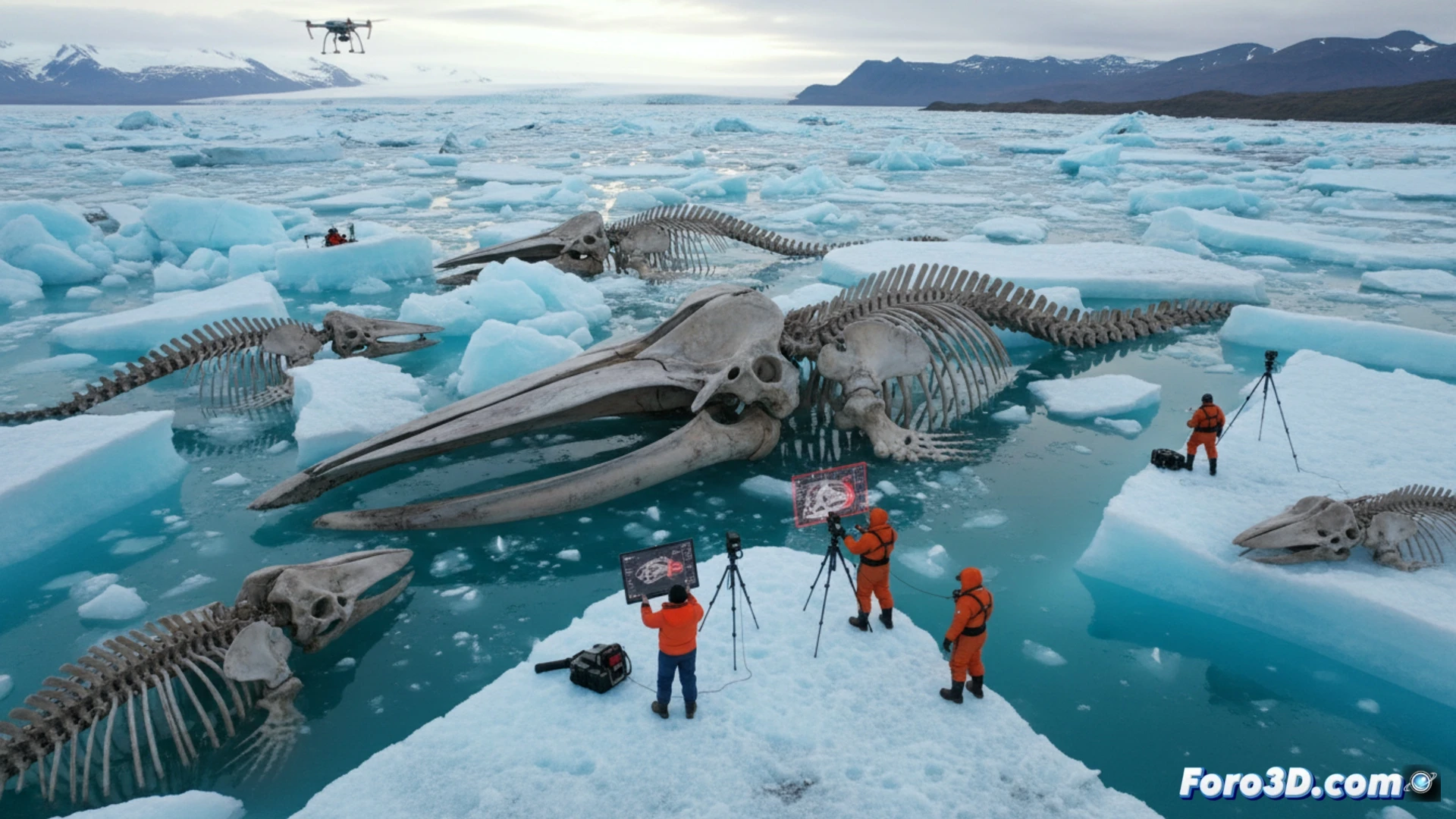
The accelerated retreat of an Arctic glacier has uncovered a marine terrace with an exceptional concentration of prehistoric whale skeletons. This discovery, announced by a Russian expedition, offers a unique window into extreme paleogeographic changes. Given the fragility of these remains and the lack of a peer-reviewed academic study, the immediate application of 3D digitization technologies becomes a scientific priority to virtually preserve this heritage before its possible degradation.
Photogrammetry and laser scanning: safeguarding a fragile heritage 🛡️
Photogrammetry and terrestrial laser scanning are indispensable tools in this context. They allow capturing with millimeter precision the morphology and arrangement of the bones in situ, generating textured 3D models and dense point clouds. These digital assets are crucial for multiple purposes: they enable remote and collaborative scientific analysis, facilitate the creation of physical replicas for museums, and, above all, act as a perpetual archive of the site in its current state. This documentation is vital, as the climate change that exposes them also threatens to alter or destroy the site.
Digital preservation as a legacy against climate change 🌍
This discovery underscores a new reality: climate change is a double-edged sword as an archaeological and paleontological agent. While it unveils hidden treasures, it also accelerates their disappearance. Digital archaeology ceases to be an option to become an ethical responsibility. The creation of 3D models of these skeletons will not only serve for their study but will ensure that this heritage, rescued by a planet in crisis, endures beyond the ice and remains as a legacy for future generations of researchers.
How can 3D photogrammetry and laser scanning save the crucial information from the prehistoric whale skeletons exposed by the thaw before they degrade irreversibly?
(P.S.: and remember: if you can't find a bone, you can always model it yourself)