Apple is betting on additive manufacturing for its future products. According to reports, the company is actively exploring 3D printing of aluminum for structural components like the iPhone chassis. This research, developed with academic partners such as the Bauhaus University of Weimar, combines traditional casting techniques with additive processes. The goal is to create more complex, lightweight, and resistant metal structures, improving the durability and efficiency of its devices.
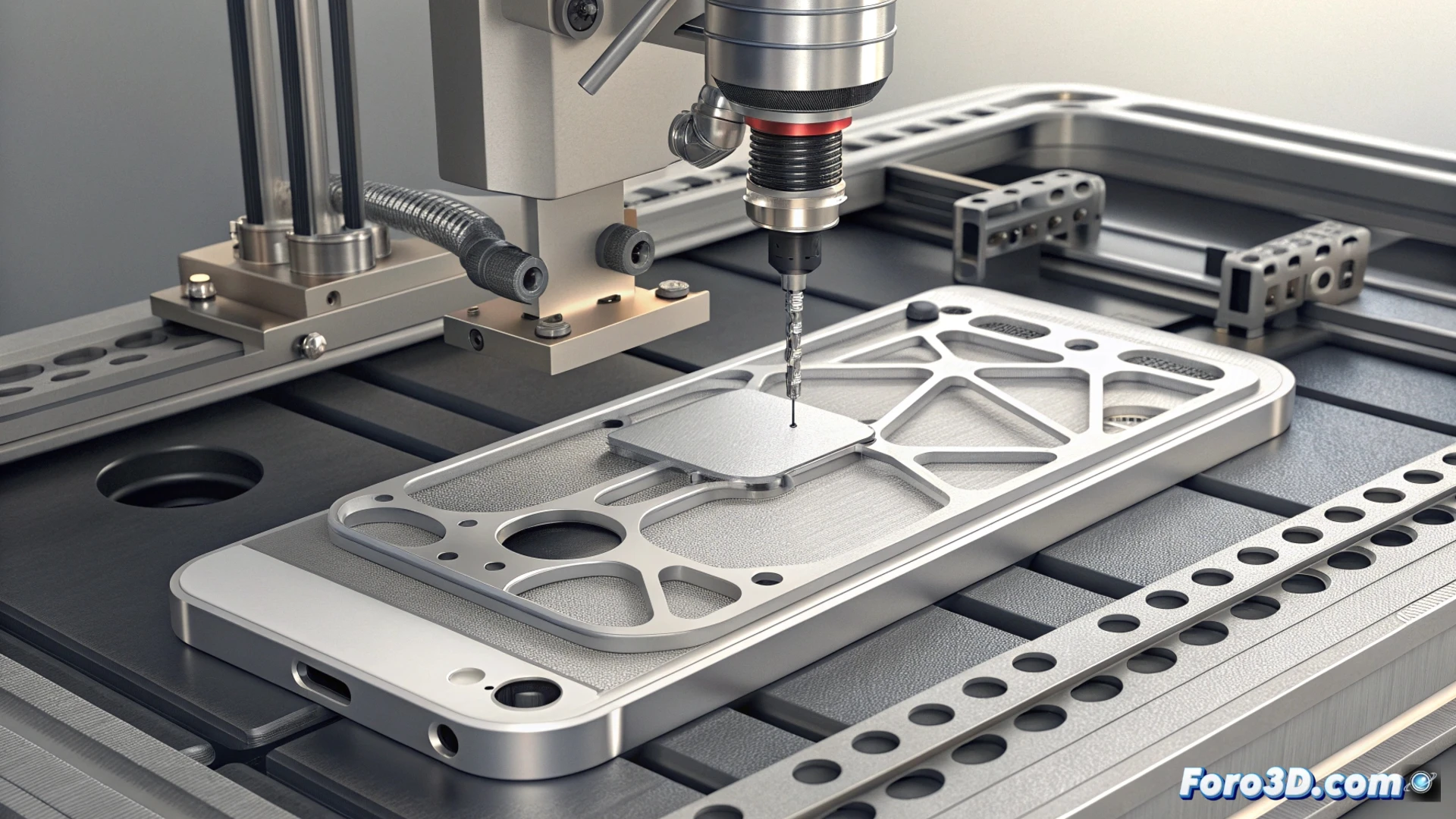
Fusion of casting and 3D printing: a hybrid process 🔬
The technology Apple is researching is not pure metal 3D printing, but a hybrid process. It starts with a preform or mold created through additive manufacturing, which is then used in a traditional casting process. This synergy allows achieving complex internal geometries and topologically optimized, impossible to obtain with machining or conventional casting. The result is structural components with a superior strength-to-weight ratio, since the material is deposited only where it is strictly necessary. However, scaling for mass production faces significant challenges in manufacturing speed and cost per unit, limiting its industrial viability on a large scale for now.
Impact on the industrial design cycle ⚙️
This innovation represents a paradigm shift in the design of electronic products. By freeing geometric restrictions, design teams can prioritize functionality and material efficiency over ease of manufacturing. This shortens the development cycle, enabling faster functional prototypes and more optimized final designs. For the industry, it is a step toward more sustainable manufacturing, with less material waste and potential for more durable and lightweight products.
Could direct 3D printing of aluminum revolutionize the design and manufacturing of mass consumer products like the iPhone? 🚀
(P.S.: Designing a product in 3D is like being an architect, but without having to worry about the bricks.)