Artificial intelligence is putting the infrastructure of big tech companies to the test. Apple, with its Private Cloud Compute service based on servers with M2 Ultra chips, faces serious efficiency problems, with an average usage of 10% and idle hardware. Its rigid architecture and refusal to undertake a costly restructuring have led it to an agreement with Google to host the new Siri models. This technical-commercial move reveals the complexity of scaling computing hardware for intensive AI workloads.
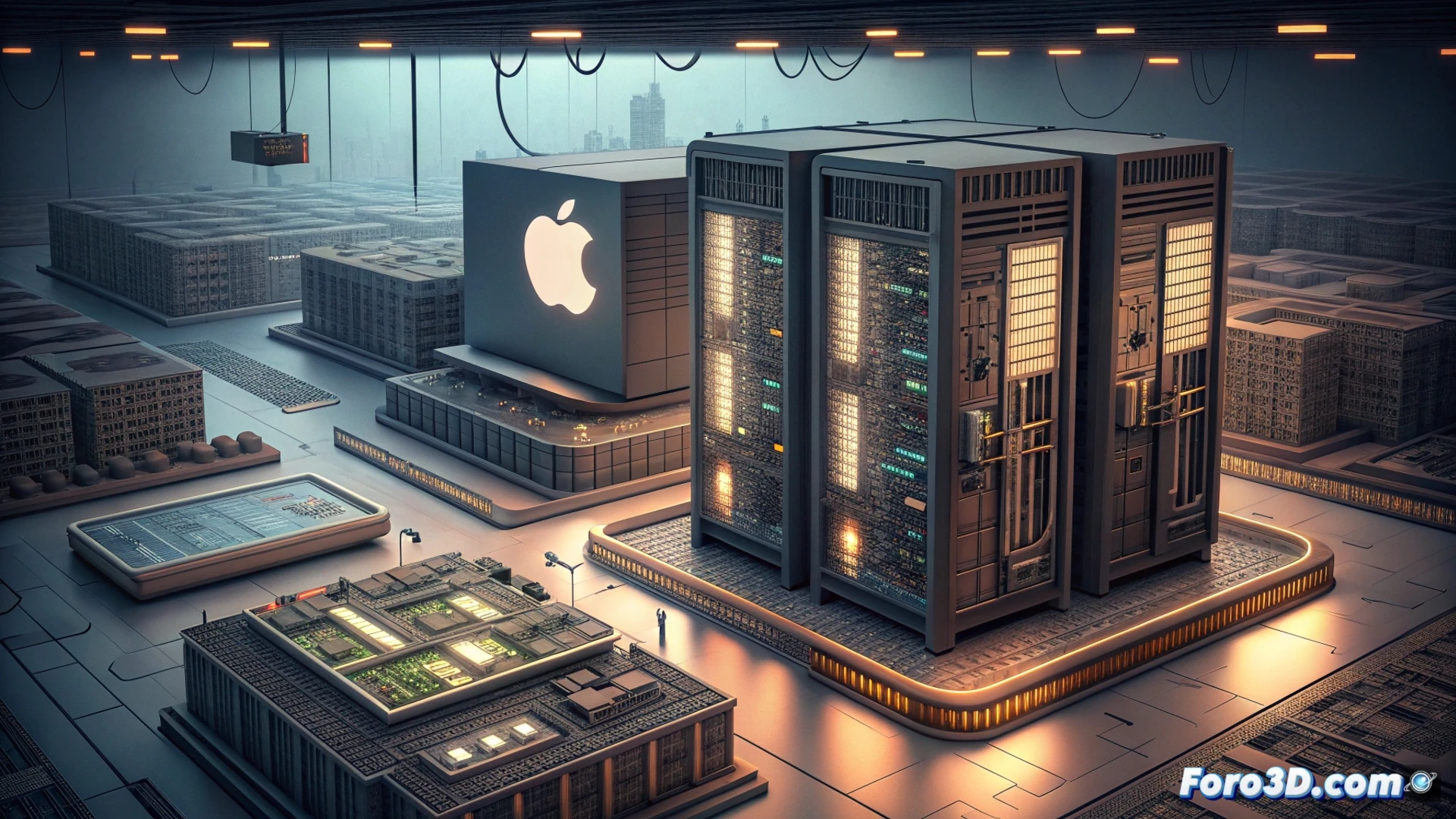
Competing architectures: M2 Ultra in servers vs. Google's farms 🤔
The core of the problem is the hardware's suitability for the workload. Apple adapted its M2 Ultra chips, designed for efficiency in end devices, to a server environment. However, for large language models (LLM), efficiency in massive parallelization and scalability are critical. Google, with years of experience in TPUs and GPUs in its data centers, has optimized its infrastructure for training and inference of models like Gemini. This difference is analogous to rendering a complex 3D scene: a single powerful chip (M2 Ultra) can have bottlenecks in massively parallel tasks, where a render farm (Google's architecture) scales linearly. Apple's internal fragmentation prevents flexible resource redistribution, a fatal problem in high-performance computing.
Lesson for professional computing: specialization and scalability ⚙️
This case underscores a key principle in hardware for intensive workloads: the architecture must follow the application. Forcing a consumer solution (M chip) into a server environment for AI shows a lack of specialization. For 3D professionals and high-performance computing, the lesson is clear: investment in infrastructure must be scalable and dedicated to the task. Efficiency does not only depend on silicon, but on a software and hardware ecosystem designed to scale flexibly and economically, something Apple is learning and Google already masters.
Can Apple's approach with Private Cloud Compute redefine hardware requirements for 3D AI inference against Google's traditional model of massive data centers?
(PS: remember that a powerful GPU won't make you a better modeler, but at least you'll render your mistakes faster)