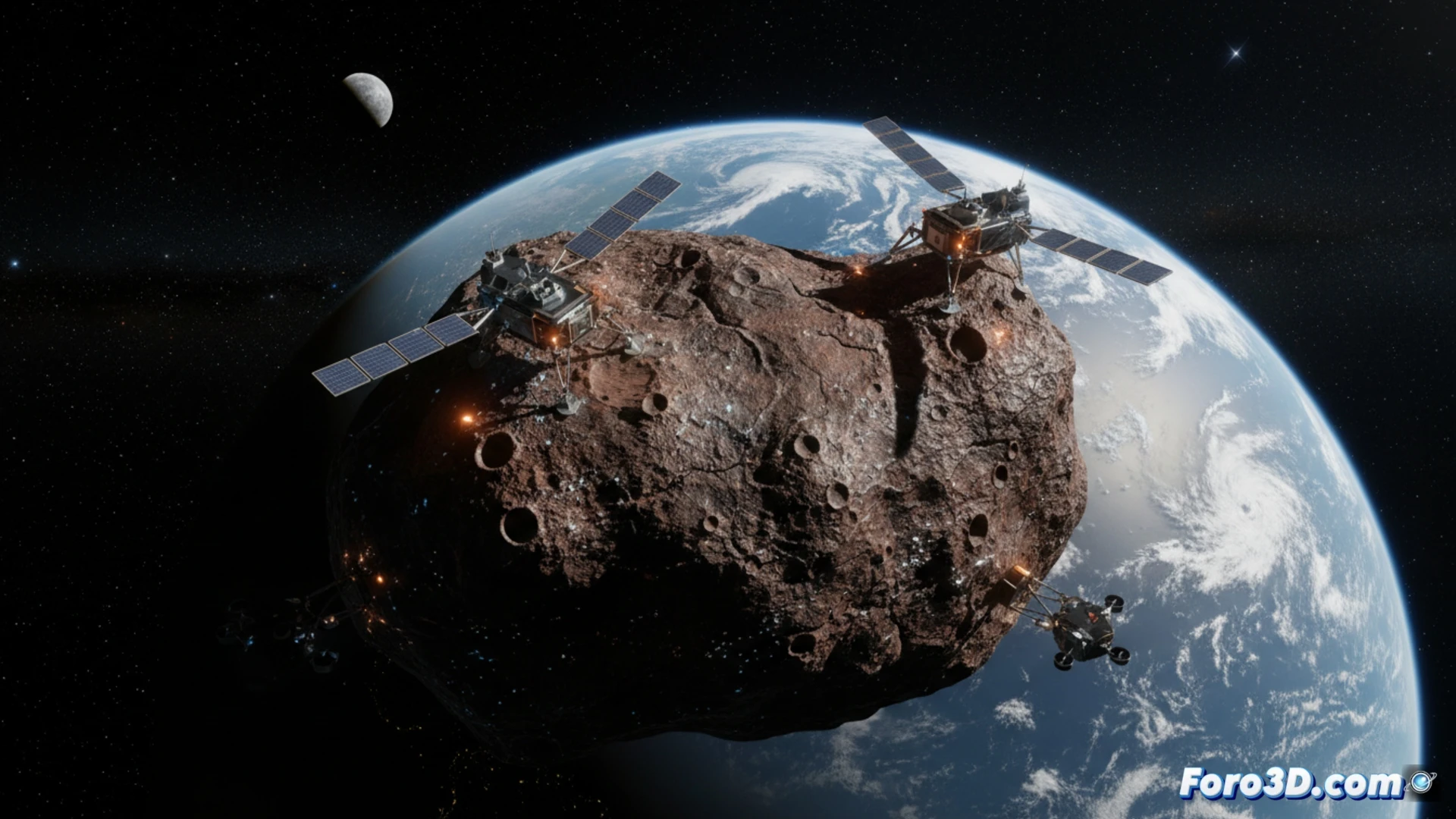
In 2029, the asteroid Apophis will offer a unique spectacle by passing just 32,000 km from Earth. Taking advantage of this opportunity, the company ExLabs will lead the ApophisExL mission, launching in 2028, to land two modules on its surface. The main objective is to capture detailed images, a treasure trove of data that will serve as the basis for generating precise 3D models, revolutionizing our understanding of these celestial bodies and allowing this milestone to be shared with the public in an immersive way.
From raw data to scientific model: the 3D workflow 🛠️
The images and topographic data collected by the landing modules and accompanying spacecraft will be processed using photogrammetry and computer vision techniques. This process builds a georeferenced 3D mesh of Apophis's surface, textured with real images. These models are not just visualizations; they are critical scientific tools. They will enable measuring craters, analyzing regolith, simulating gravity conditions, and planning future maneuvers. Additionally, coordination with other missions, such as the European Ramses, requires 3D trajectory simulations to avoid interferences and ensure collective success.
Beyond science: immersive outreach of a unique event 🌍
The true power of these 3D models transcends the laboratory. They enable creating unprecedented educational and outreach experiences. We will be able to virtually land on Apophis, appreciate its irregular 400-meter shape, and understand the scale of its historic close approach. Scientific visualization thus acts as an essential bridge, transforming complex data from a high-risk space mission into comprehensible and fascinating visual narratives for all of society.
What software do you recommend for visualizing animal tracking data? 🚀