With the release of Pixar's Hoppers, the protagonist robot beaver joins a peculiar animated tradition. Despite its iconic image, beavers have been secondary characters with few exceptions. Their representation has oscillated between Disney's early tenderness and the expressive absurdity of series like The Angry Beavers. We review their technical and artistic evolution, from the shorts of the Golden Age to Pixar's new digital challenge, analyzing how the animated personality of this rodent has been constructed.
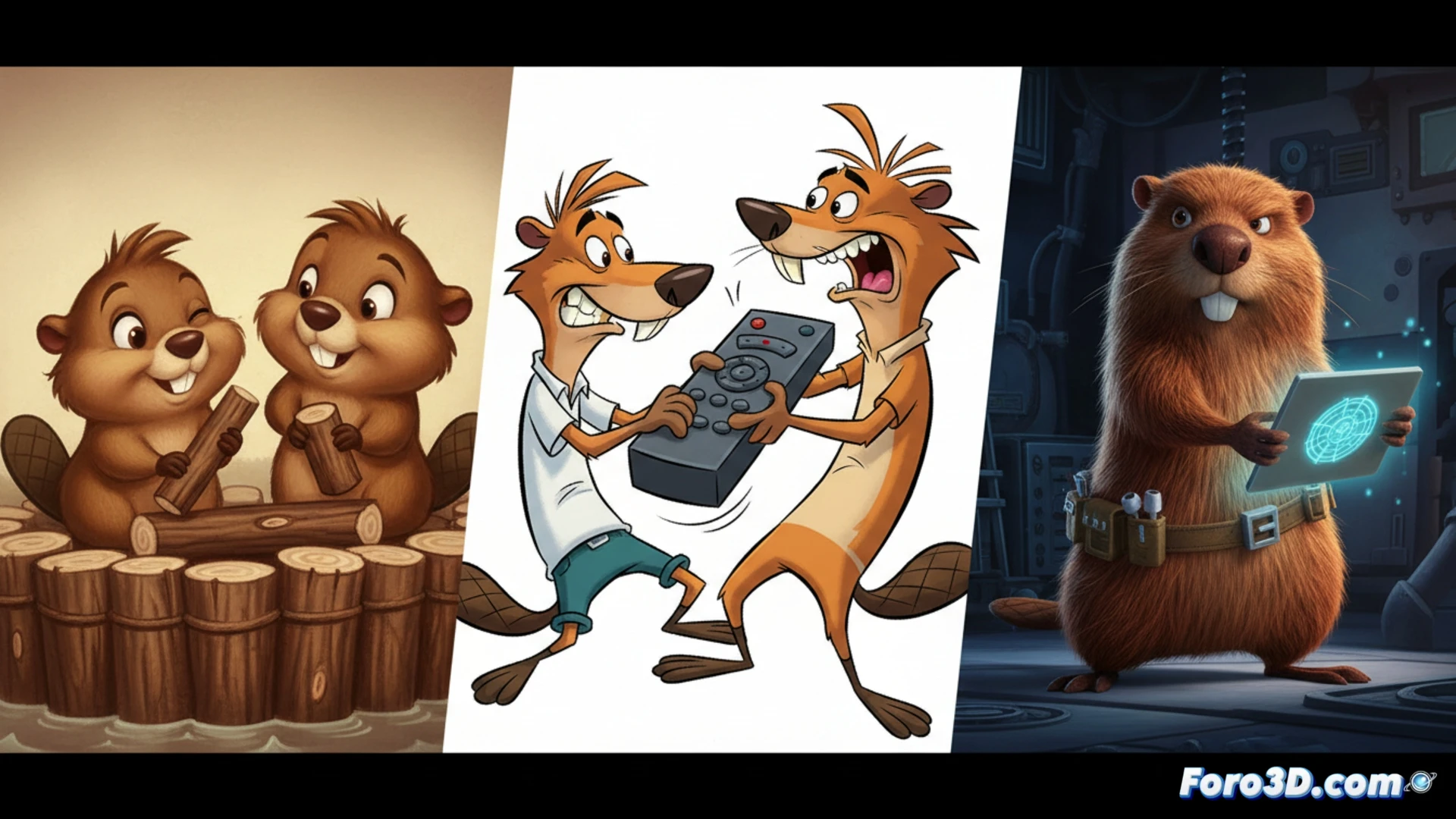
Design and animation: from classic expressiveness to intentional absurdity 🎨
Classic animation laid the foundations with distinct approaches. The short The Eager Beaver by Chuck Jones is a study of rhythm and squash-and-stretch, giving the character a frenetic and comic energy. In contrast, Walter Lantz's Buck Beaver showed a more static but memorable design, based on a mischievous personality. The great innovation came in the 90s with The Angry Beavers. Its creator, Mitch Schauer, chose the beaver for the absurdity of its anatomy, exaggerating teeth and tail to enhance its attitude. The series' limited animation was compensated with an angular design and hyperbolic poses, breaking with the predominant sweetness. Each studio resolved the challenge of animating its unique physique, from Disney's fluidity to Jones' expressionist key poses.
Hoppers and the legacy: evolution or reinvention? ⚙️
Pixar's beaver represents the technological synthesis of this heritage. Hoppers, as a robotic character, allows exploring an articulated mechanic that, ironically, might seek the organic quality of the old animation principles. The challenge is no longer just to bring the animal to life, but to integrate its essence into a mechanized design while maintaining warmth and humor. Its creation reflects decades of artistic solutions, from the simplicity of shorts to current emotional complexity, proving that even a marginal character can have a rich technical history behind it.
How has beaver character animation evolved, from classic cartoons to the realism of Pixar's Hoppers, to capture its animal essence and unique expressiveness?
(P.S.: Animating characters is easy: you just have to move 10,000 controls to make them blink.)