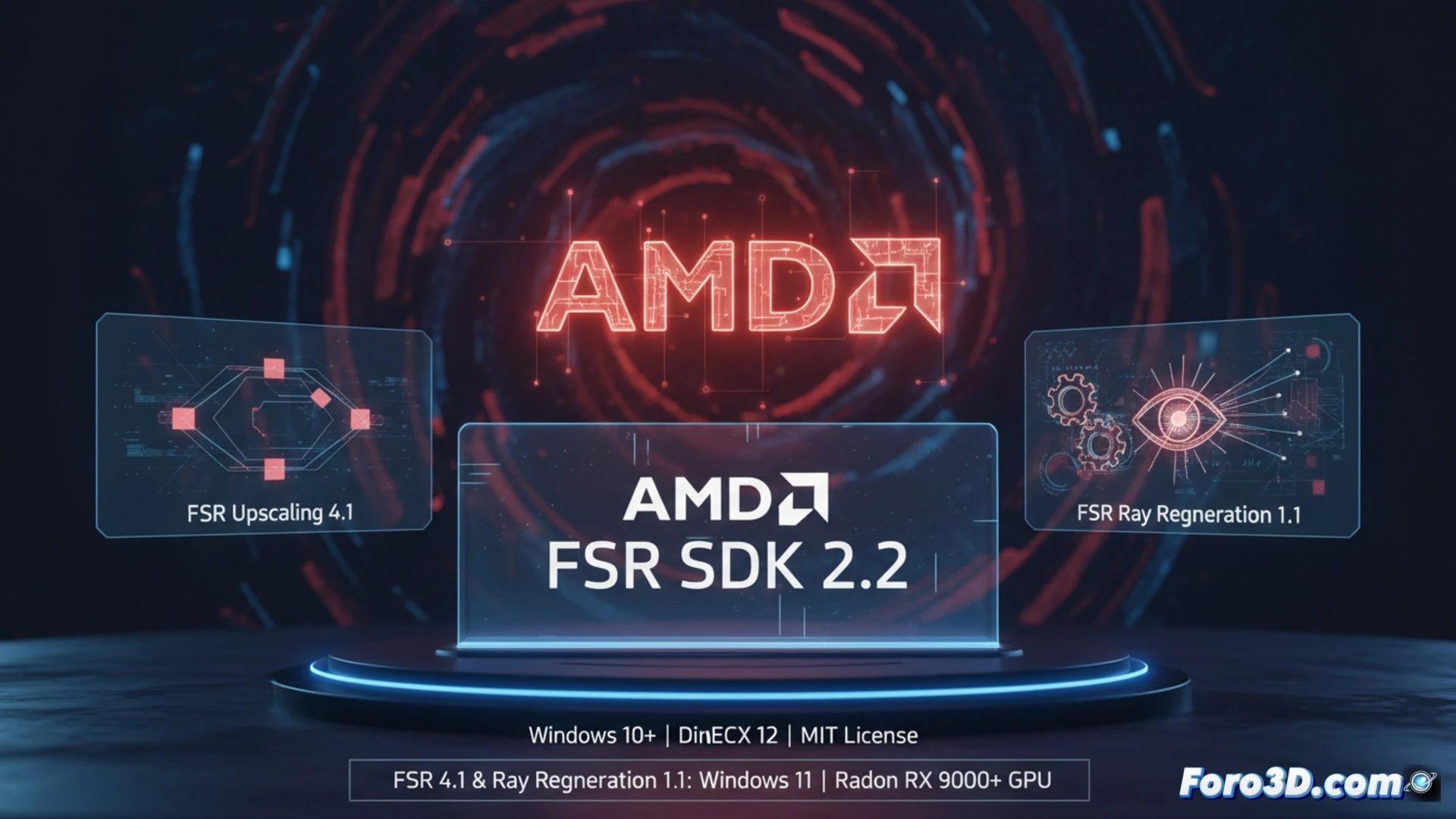
AMD has restructured and enhanced its graphics development kit with the release of the FSR SDK 2.2. This move unifies the brand under the name of its most popular technology, FSR Upscaling, which now reaches version 4.1 with performance improvements. The big novelty is the Redstone suite, which introduces three neural rendering tools: frame generation, radiance caching, and an AI ray resampler. This SDK, under MIT license, seeks to democratize access to cutting-edge graphics for developers. 🚀
Technical analysis of the new Redstone tools 🔬
The Redstone technologies represent a qualitative leap. FSR Frame Generation promises to increase smoothness through frame interpolation. FSR Radiance Caching optimizes global illumination in real time, a traditionally very costly calculation. The star is FSR Ray Regeneration 1.1, an AI resampler that reconstructs ray traces from sparse samples, reducing computational load. However, its adoption has a high requirement: both FSR 4.1 and Ray Regeneration require Windows 11 and an AMD Radeon RX 9000 Series GPU, initially limiting its use to cutting-edge hardware.
Democratization of advanced graphics and implications ⚙️
This release consolidates AMD's bet on AI in the graphics pipeline. By offering these tools under a permissive license (MIT), AMD facilitates their integration and competes directly with proprietary solutions from other manufacturers. For studios, it means access to cutting-edge techniques that can reduce development times and performance costs. The RX 9000 hardware barrier is temporary, but it marks a clear direction: the future of real-time rendering lies in specialized neural acceleration.
How does the unification of the FSR 2.2 SDK affect the workflow and technical decisions of developers of custom graphics engines?
(P.S.: a game developer is someone who spends 1000 hours making a game that people complete in 2)