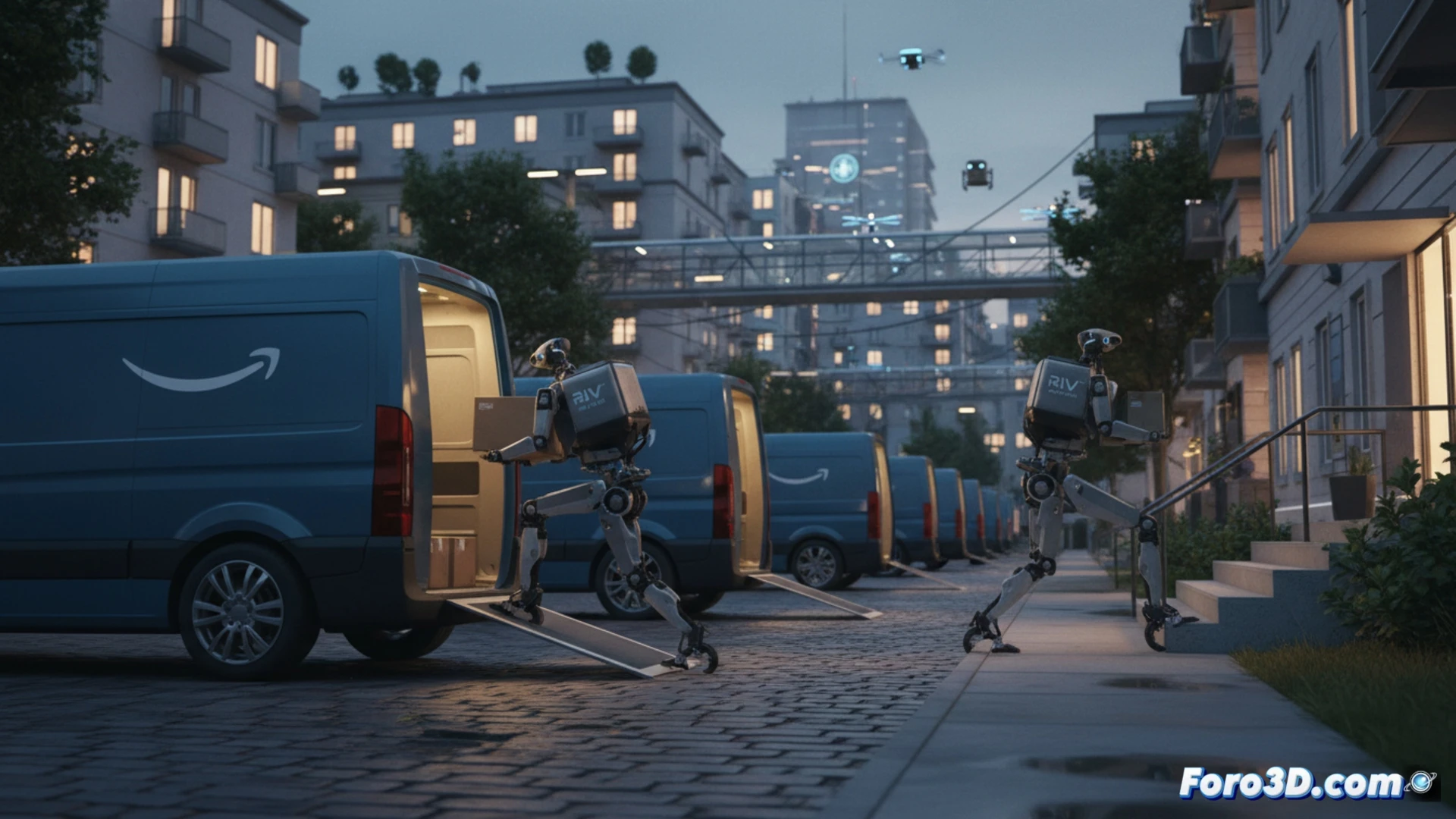
Amazon has acquired the Swiss startup Rivr, manufacturer of autonomous legged and wheeled robots designed for doorstep delivery. This hybrid technology allows overcoming urban obstacles like stairs, addressing the most complex and costly stretch of logistics: the last mile. The strategy combines human transport in vans with delegating nearby deliveries to the robot, multiplying efficiency per route and reinforcing the total automation of the company's logistics operations.
3D Simulation: the virtual testing ground for autonomous logistics 🧪
The successful integration of these robots into dynamic urban environments largely depends on 3D simulation and visualization. Before any physical deployment, it is crucial to digitally model routes, testing millions of interactions with unpredictable obstacles, from stairs to pedestrians. 3D simulation tools allow optimizing hybrid routes, calculating the optimal point where the delivery person releases the robot and it completes the final delivery. This virtual process validates navigation, the robot's stability on different terrains, and the efficiency of the entire system, greatly reducing costly real-world errors and accelerating implementation.
Beyond delivery: a logistics ecosystem modeled in 3D 🗺️
Amazon's acquisition of Rivr is not just a hardware purchase, but the assimilation of a system that must fit into a larger logistics ecosystem. Here, 3D visualization becomes the strategic tool for designing workflows where humans, vans, and robots collaborate. Modeling this ecosystem in a unified digital environment allows anticipating bottlenecks, optimizing the loading and unloading of robots in vehicles, and ultimately designing the logistics of the future, where physical artificial intelligence and virtual planning are inseparable.
How could Amazon's acquisition of Rivr redefine logistics workflows and design requirements in additive manufacturing for hybrid robotics components?
(P.S.: visualizing logistics flows is like watching ants... but with less order and more budget)