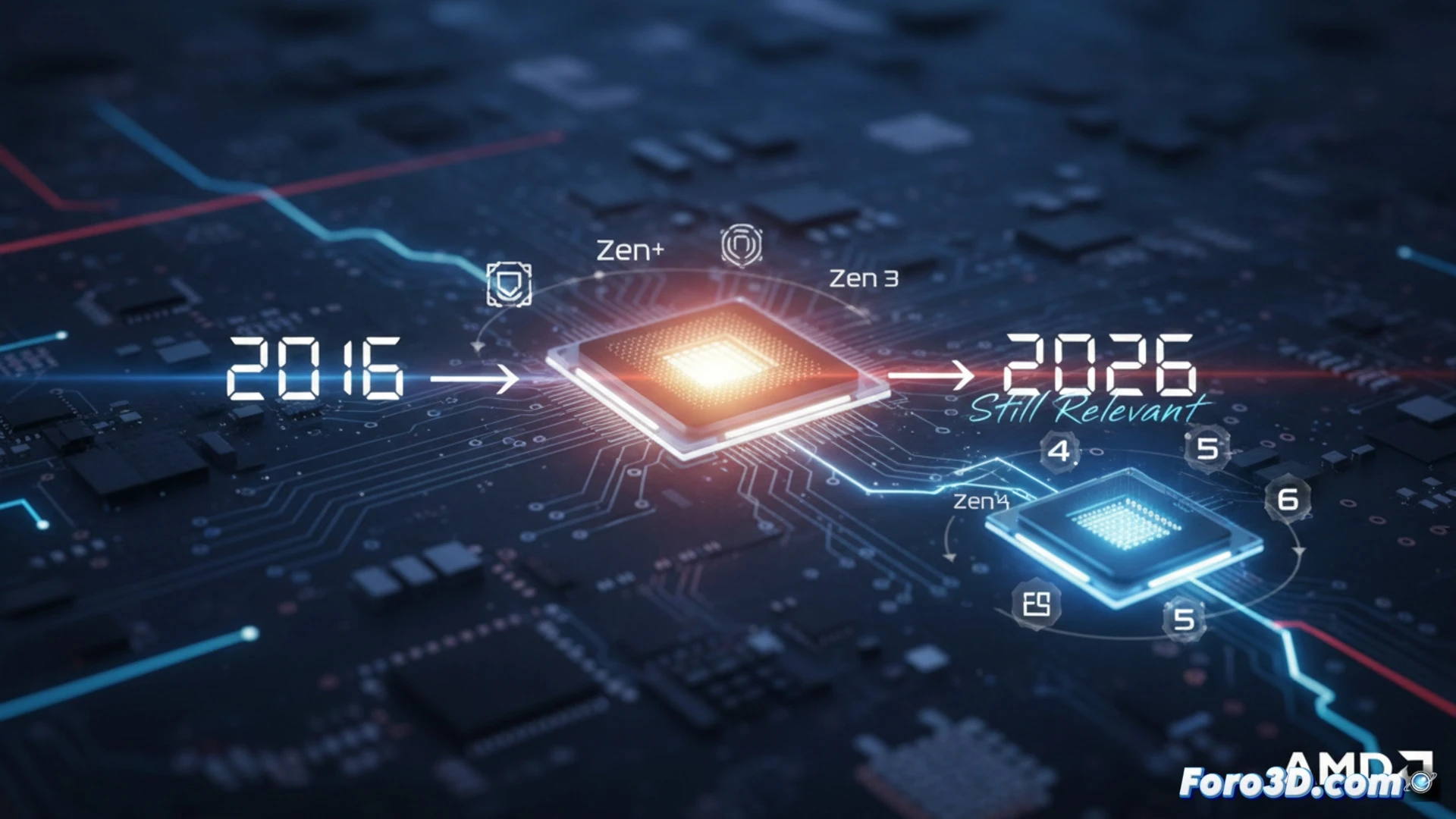
AMD celebrates a decade of its AM4 socket, an unprecedented milestone in the industry. Its longevity strategy, now transferred to AM5, promises to support multiple generations of CPUs, from Zen 4 to Zen 6. For 3D professionals, this is not just a press release, but a crucial guide for planning hardware investments. The possibility of upgrading only the processor within the same motherboard represents significant savings and a strategic advantage to maintain competitiveness in rendering and simulation. 🎯
Impact on 3D workflow and upgrade planning 📈
In 3D production environments, where render time and preview speed are critical, the scalability of AM5 is a valuable asset. A user can start with a Ryzen 7000 (Zen 4) and, without changing the motherboard, jump to future Zen 5 or Zen 6 to gain cores and efficiency. This protects the initial investment in DDR5 memory and a high-end motherboard, allowing performance improvements to be directed straight to the CPU. For studios that rely on applications like Blender, Maya, or Unreal Engine, this predictability facilitates budgeting and reduces costly downtime from complete platform changes.
Beyond marketing: stability as a professional advantage ⚙️
The true advantage for the 3D sector is the ecosystem's stability. A durable platform allows fine-tuning and optimizing a specific system, from cooling to RAM configuration, knowing that the base will remain. This contrasts with forced change cycles, where each upgrade implies reinvesting and reconfiguring from scratch. AMD's philosophy turns the motherboard from a consumable piece into a lasting foundation, prioritizing long-term return on investment and operational efficiency in projects lasting months or years.
Can AM5 repeat AM4's longevity success and become the definitive base for 3D workstations over the next decade?
(PD: Your CPU heats up more than the Blender vs. Maya debate)