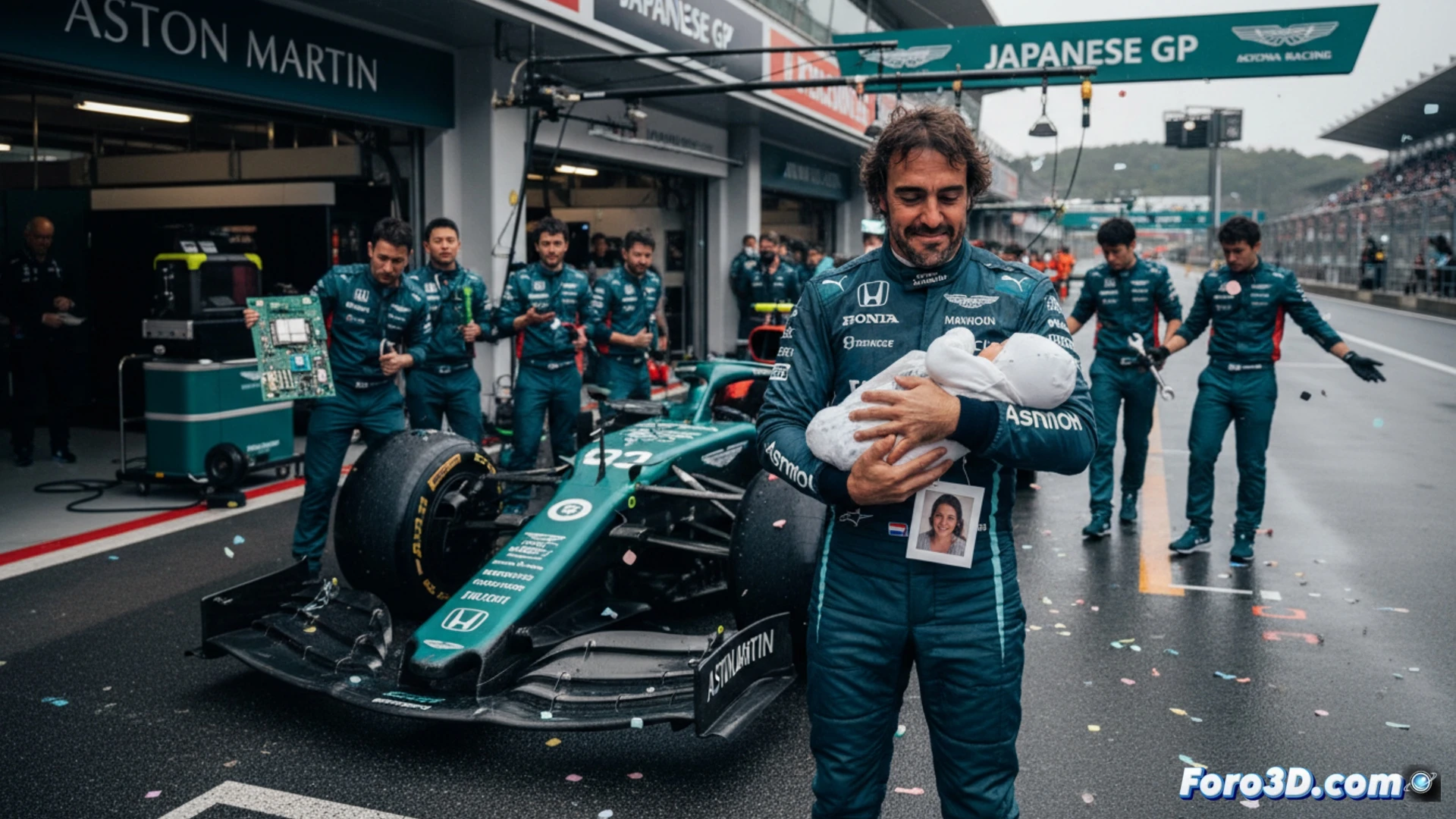
Fernando Alonso returned in Japan with the joy of being a father, but also with the harsh sporting reality. The driver confirmed that the latest updates to the Aston Martin AMR26 have not improved its performance, describing a car with low performance and vibration problems. This situation underscores a complex technical challenge where 3D technology emerges as an indispensable tool for diagnosis and internal communication within the team.
Digital twins and simulation: diagnosing the race car's vibrations 🛠️
The problems mentioned by Alonso, such as vibrations and the lack of effectiveness of the new parts, are ideal for analysis using digital twins. A hyperrealistic and dynamic 3D model of the AMR26 allows simulating the behavior of each component under stress. Through finite element analysis (FEA), deformations and unwanted resonances can be visualized. Additionally, computational fluid dynamics (CFD) in 3D helps visualize the actual airflow over the car, comparing it with the theoretical design to identify aerodynamic load losses that explain the lack of performance.
Beyond design: visual communication in the team 🗣️
3D technology is not only for the engineer. For a driver like Alonso, being able to interact with a clear 3D visualization of telemetry data and simulations is invaluable. These tools facilitate precise communication between the driver and the technicians, transforming subjective sensations into visualizable objective parameters. Thus, 3D becomes the common language to accelerate the understanding of failures and prioritize solutions in the frantic race of F1 development.
How could 3D modeling and simulation accelerate the diagnosis and solution of the Aston Martin AMR26's performance problems?
(PS: reconstructing a goal in 3D is easy, the difficult part is making it not look like it was scored with the leg of a Lego doll)