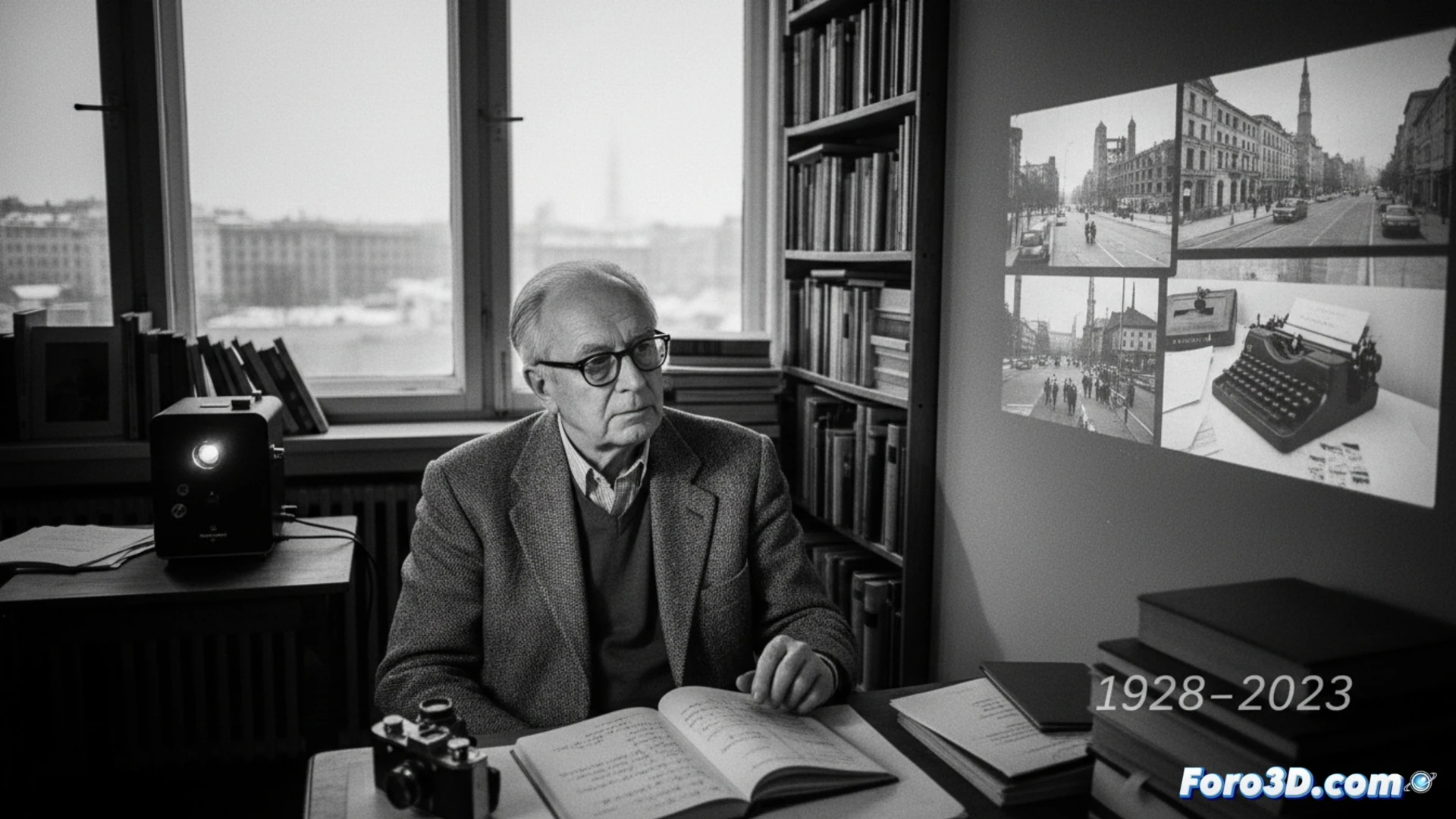
The recent death of Alexander Kluge at the age of 94 closes the vital chapter of an essential pioneer. Foundational figure of the New German Cinema, Kluge was a total intellectual whose cinematic and literary work was built on a constant question: how to tell the complexities of history and memory. His method, a collage of fiction, documentary, and essay, not only defined a style but anticipated key concerns and techniques for contemporary visual narrative.
Montage as Conceptual Previsualization 🎬
Kluge operated as a montage artist of realities. His technique of interweaving short stories, film footage, photographs, and theoretical reflections created a complex and open narrative fabric. This approach can be understood as an analog form of previsualization (previs) or conceptual storyboarding. Before 3D tools allowed testing multiple sequences and spatial relationships, Kluge was already experimenting with the juxtaposition of layers of meaning. His work is a direct antecedent of the non-linear and multiformat narratives that today are explored with pre-production software and immersive environments, where the story is built through the association of modular content blocks.
Legacy for Digital Creators 💡
Kluge's legacy transcends cinema to challenge any creator of visual narratives. His insistence that form is content, and that breaking linearity can reveal deeper truths, is a vital principle for the digital era. In a context of image overabundance, his method teaches thinking in terms of montage, layers, and context, crucial skills for both the 3D artist and the interactive experience developer. Kluge reminds us that the most advanced technology must serve a critical gaze and a willingness to experiment with storytelling.
What do you think about this advancement?