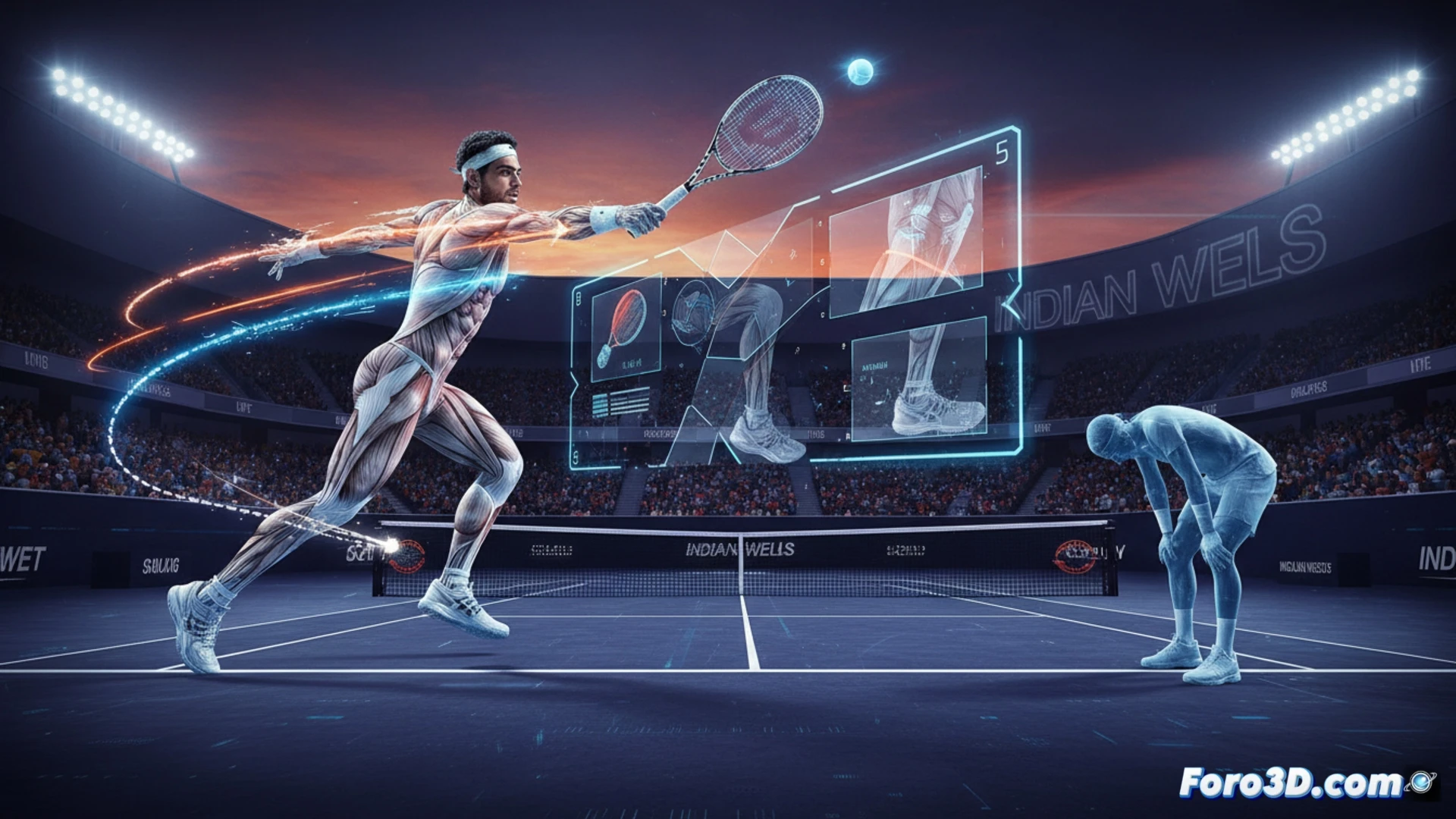
In the Indian Wells tournament, Carlos Alcaraz executed a point that encapsulates his overwhelming tennis. Facing a high defensive ball from his rival, the Spaniard did not hesitate. He moved explosively to his left, shifted his weight onto his right leg, and unleashed a topspin backhand with devastating power and depth. The ball not only grazed the line but its spin and speed left the opponent paralyzed, giving up on chasing it. This sequence, viral on social media, is the perfect example for a technical analysis through 3D reconstruction.
Biomechanical and vectorial deconstruction in a 3D engine 🔬
The true understanding of this point lies in a technical breakdown. Using a 3D engine, we could reconstruct the scene with millimeter precision. First, we would analyze the biomechanics of Alcaraz's shot: the hip angle in the rotation, the arm acceleration, and the exact point of impact. Then, we would trace the ball's vector trajectory, showing its initial speed, the curve imposed by the topspin, and the bounce point near the line. Simultaneously, we would model the opponent's position and movement, calculating his reaction time and the exact moment when the visual data, processed in his brain, told him the point was lost. This 3D visualization offers invaluable value for coaches and broadcasts.
3D technology as a bridge between spectacle and technique 🌉
This case illustrates how 3D technology transcends mere spectacular visualization. It transforms the sports anecdote into a quantifiable object of study. By breaking down the play into layers of spatial and motion data, we not only admire the feat but understand the sum of physical and technical decisions that made it possible. For forums like this, it represents the perfect symbiosis between elite sport and digital tools, allowing deep analysis that previously only existed in theory, and which we can now visualize, manipulate, and learn from.
How can 3D analysis be used to decompose and quantify the biomechanical effectiveness of a winning tennis shot, like Alcaraz's at Indian Wells?
(P.S.: 3D tactical simulation never fails, players on the court do)