The Indian space startup Agnikul Cosmos has marked a milestone in additive manufacturing by successfully testing Agnite, a complete rocket engine printed in 3D as a single piece. Manufactured in Inconel in just seven days, this approach reduces costs to one-tenth and completely eliminates welds and complex assemblies. This achievement demonstrates the disruptive potential of metal 3D printing for the aerospace industry, where structural integrity and efficiency are critical.
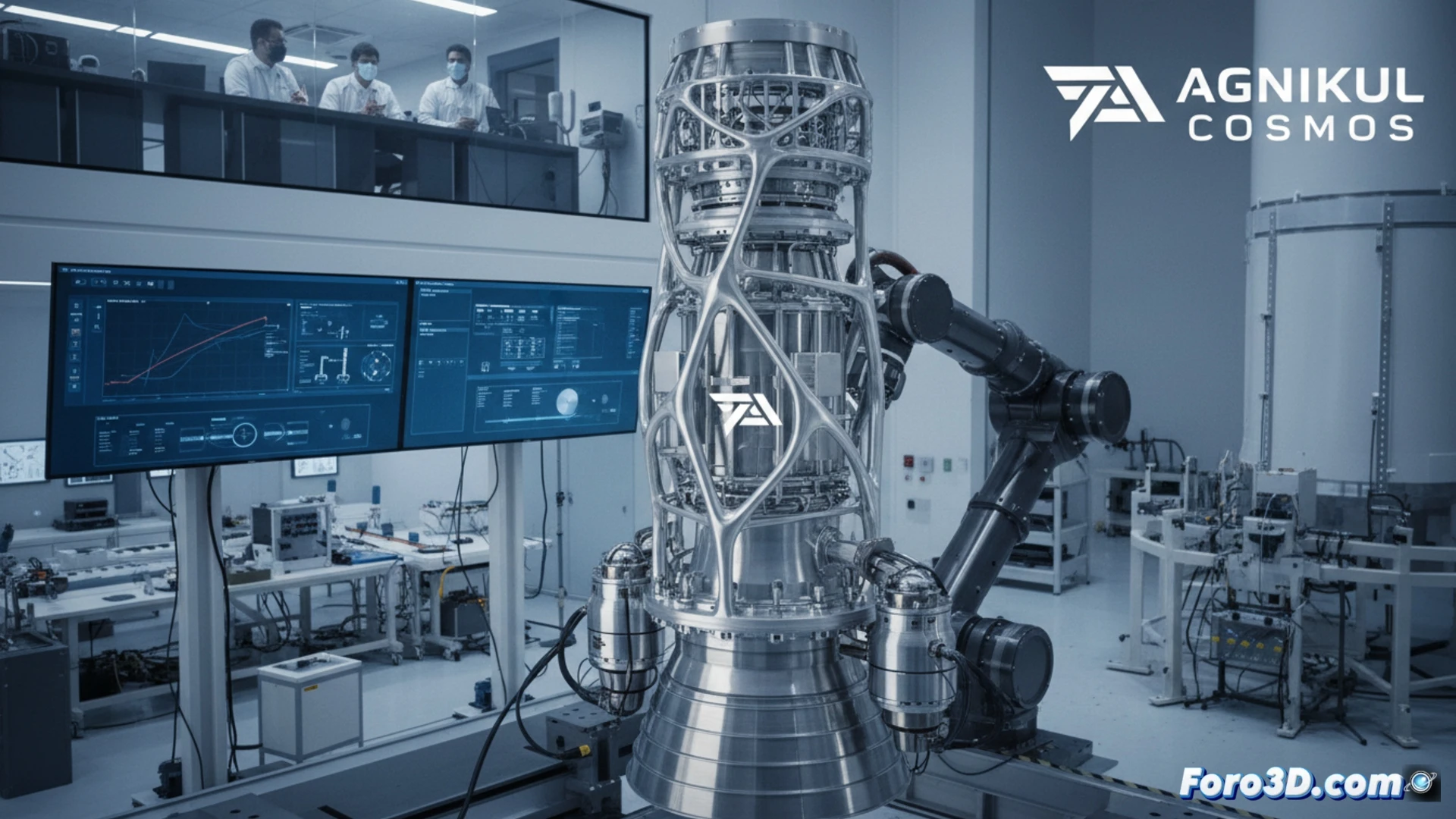
Additive manufacturing in Inconel: elimination of assemblies and electric pumps 🚀
The core of the innovation lies in a patented design that enables the manufacture of the complete engine, with all its internal ducts and complex geometries, as a single component in Inconel using metal 3D printing. This process not only greatly streamlines production but also eliminates weak points like welds, increasing reliability. Additionally, the Agnite engine uses electric pumps to feed the fuel, unlike traditional turbopump systems, which simplifies the design and facilitates reusability, aligning with the need for rapid manufacturing and testing cycles.
Lessons for industrial 3D printed design 💡
Agnikul's case is a paradigmatic example for any industrial 3D printing designer. It shows how rethinking a product as a single additively manufacturable piece can revolutionize timelines, costs, and performance. It's not just about replicating a traditional design, but redesigning it by leveraging geometric freedoms and part consolidation. This approach is crucial for high-performance applications where reducing components and increasing reliability are priorities.
Would you print it in resin or FDM?