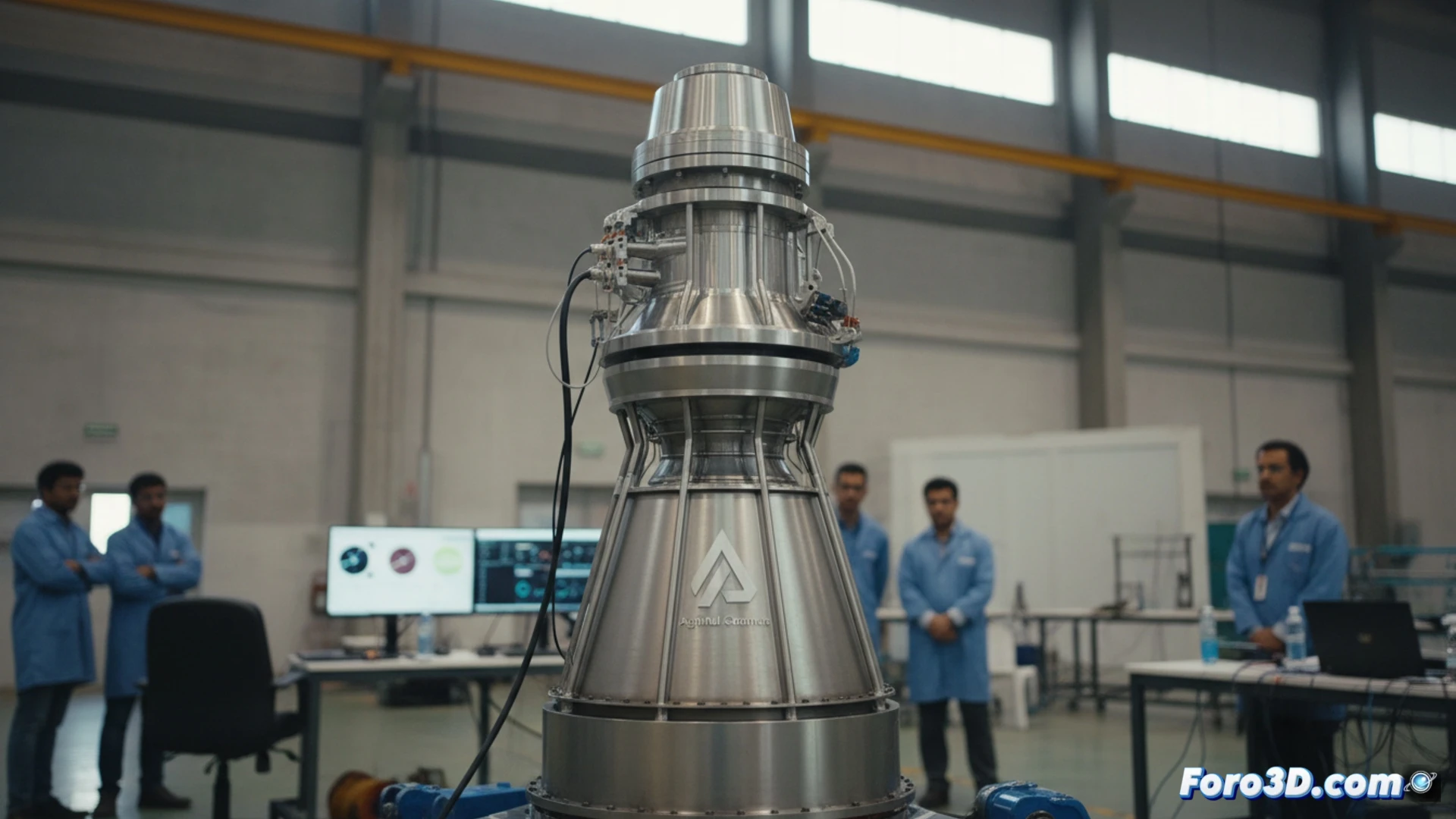
The Indian startup Agnikul Cosmos has marked a milestone in additive manufacturing by successfully testing Agnite, a rocket engine completely 3D printed in a single piece. Manufactured in Inconel in just seven days, this approach reduces costs to one-tenth compared to traditional methods. This achievement not only validates technical viability but radically redefines timelines and the economics of space propulsion production, positioning metal 3D printing as a fundamental pillar for the new aerospace era.🚀
Technical advantages of the monolithic piece and agile manufacturing⚙️
The core of the innovation lies in its patented monolithic design. By printing the entire engine in a single operation with Inconel, a high-strength superalloy, all welds and complex assemblies are completely eliminated. This not only minimizes potential failure points and improves structural integrity but also greatly speeds up the manufacturing process, going from months to one week. Additionally, the engine uses electric pumps, a design that favors reusability. This case demonstrates how 3D printing enables integrating functionality, optimizing weight, and simplifying the supply chain in an unprecedented way.
Redefining the limits of what can be printed in industry🏭
Agnikul's success transcends the space sector, serving as an example for advanced manufacturing. It demonstrates that high-performance critical components, previously the exclusive domain of subtractive manufacturing techniques and intensive assembly, can now be printable files optimized. This milestone accelerates the path toward rapid rocket reusability and poses a future where design and production agility, enabled by additive manufacturing, will be the key competitive factor in high-demand industries.
Would it need supports or would you orient it differently?