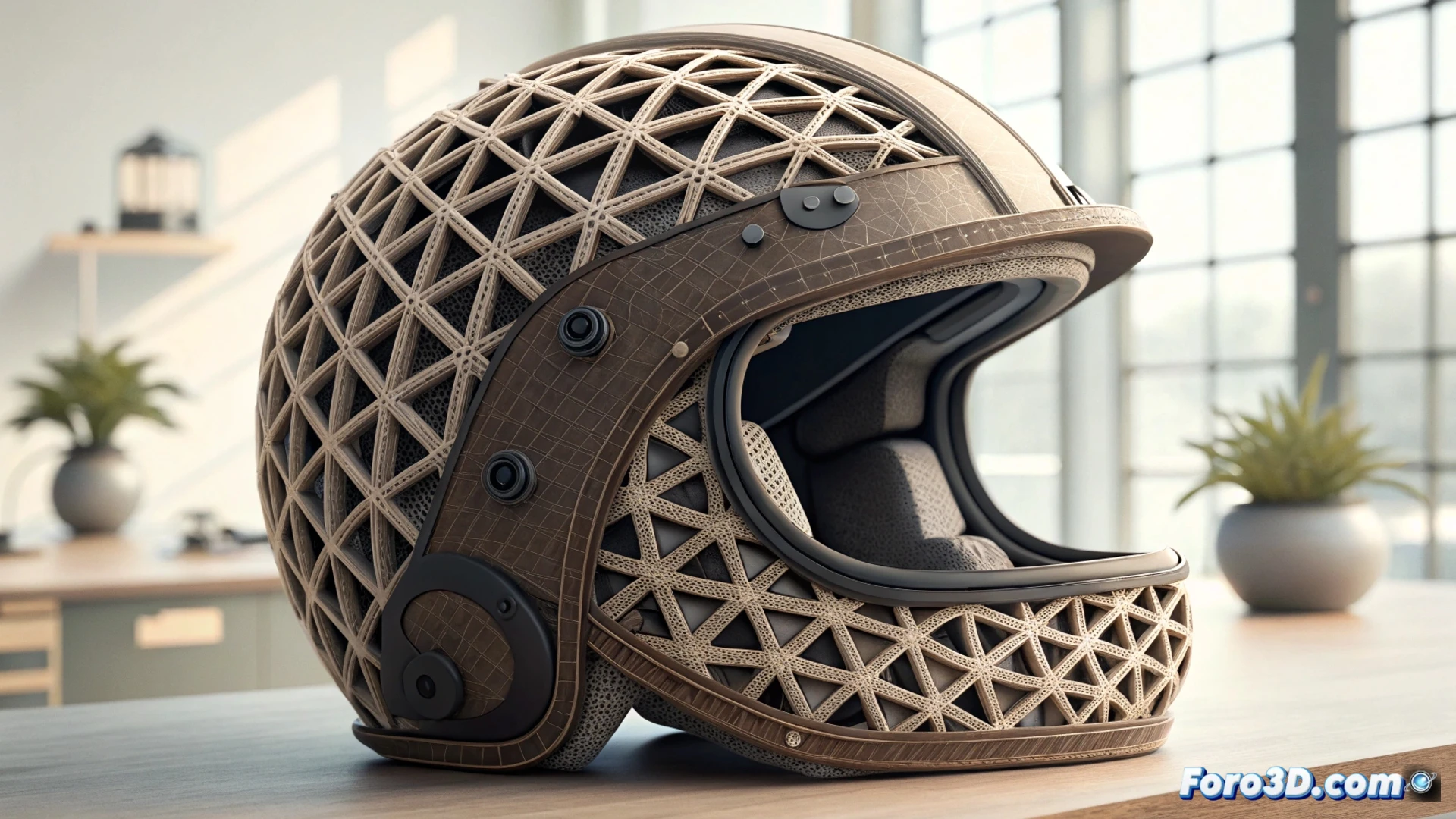
The German company RPM has revolutionized the design of explosive ordnance disposal helmets by replacing traditional foams with a 3D-printed lattice padding. This approach allows customizing properties such as stiffness and damping in different areas of the head, improving protection, reducing weight, and enhancing ventilation. The case is an excellent example of how additive manufacturing enables the creation of ergonomic and customized devices that adapt to the human body, a fundamental principle in the field of prosthetics and orthotics.
Customized Lattices and Data-Based Quality Control 🧠
The core of the innovation lies in the lattice structure, whose geometry can be varied to provide a different mechanical response in each area of the helmet, analogous to how an orthopedic orthosis requires different levels of support and flexibility. To ensure the reliability of these critical components, RPM manufactures on Farsoon industrial systems and uses the amsight software for continuous data analysis during production. This monitoring, scientifically supported by the Fraunhofer IPA Institute, allows detecting deviations in real time and ensuring complete traceability, an indispensable requirement for both safety equipment and medical devices.
Reliability, the Pillar of Customization ⚙️
The project underscores that the true power of customization through additive manufacturing is only unleashed when accompanied by robust, data-based quality control. The combination of parametrizable lattice design and continuous verification during production sets a new standard for the manufacture of high-performance and safety-critical devices. This paradigm is directly transferable to the prosthetics and orthotics sector, where reproducibility and absolute reliability are equally non-negotiable.
How is additive manufacturing transforming personalized safety in prosthetics and orthotics, beyond high-performance helmets?
(PS: 3D prosthetics are so customized that they even have a fingerprint.)