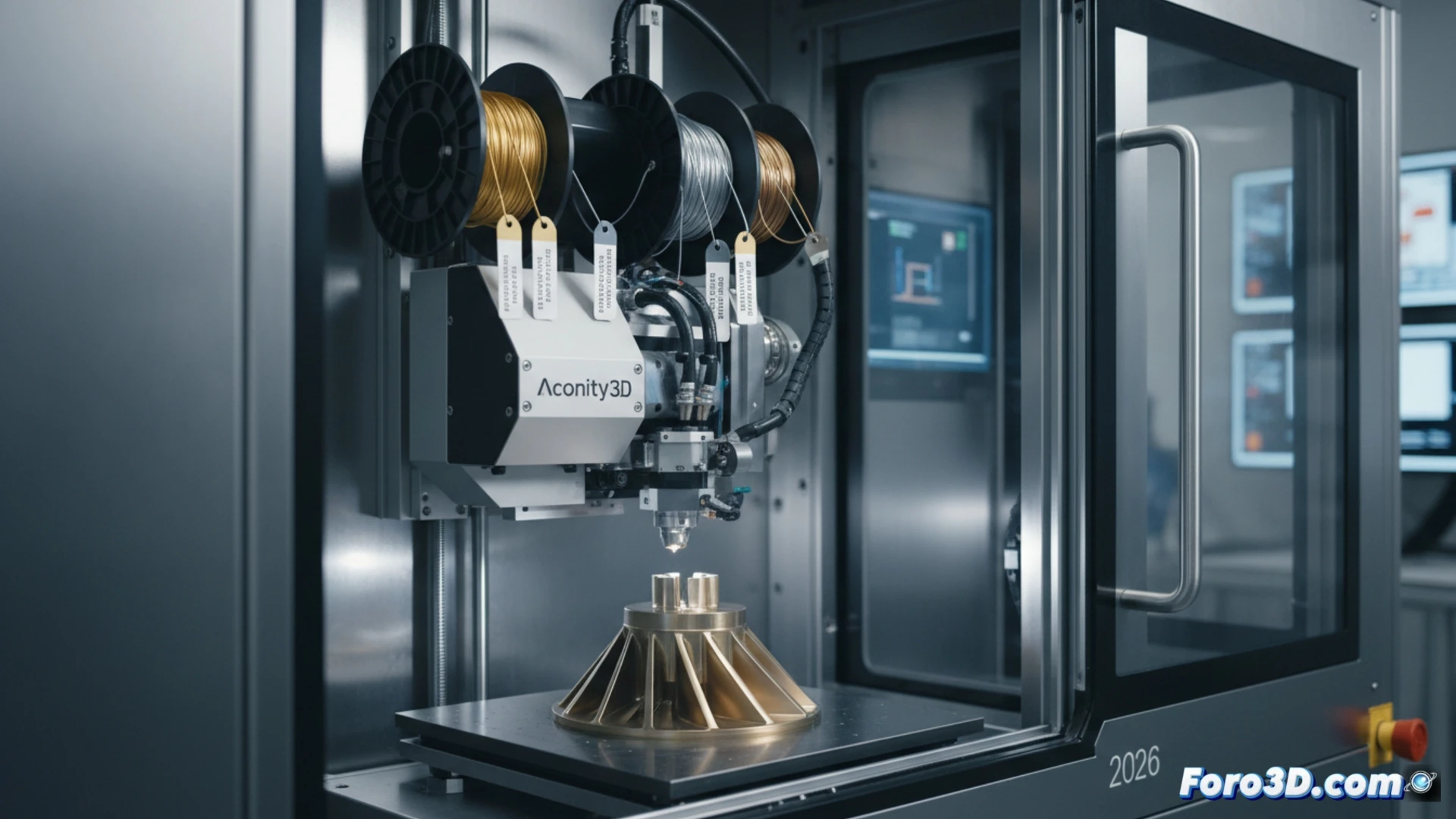
Metal additive manufacturing takes a leap in flexibility with Aconity3D's new development. The German company has presented a multimaterial welding head for its AconityWIRE system, capable of processing up to three wires of different materials in a single build process. Announced in March 2026, this innovation is aimed at production and repair, allowing the creation of components with localized and optimized properties. Integrating this capability directly into the head greatly simplifies the system and workflows.
Overcoming multimaterial complexity in wire DED 🧠
The main barrier to multimaterial manufacturing in directed energy deposition (DED) systems has been operational complexity and rigidity. Traditionally, changing materials required physical modifications to the system or discontinuous processes. Aconity3D's solution integrates multiple wire feeders into a single head, allowing programmable and dynamic switching between materials during printing. This not only shortens development cycles but also opens the door to functional gradients and hybrid structures, such as combining a strong structural core with a corrosion-resistant outer layer in a single piece.
Towards truly functional printable models 🚀
This advancement goes beyond mere production, redefining the concept of printable model in metal. It is no longer just about geometry, but about a file that also defines the material composition in each region to fulfill a specific function. For repair, it allows selective and compatible material deposition, restoring functionality with precision. By democratizing multimaterial complexity, it brings additive manufacturing closer to the promise of optimized components where geometry and material properties are designed together.
How could Aconity3D's new multimaterial head for metal 3D printing influence the design and functionality of 3D printable models in metals?
(P.S.: A good printable model is like a good friend: it doesn't need supports.)