The creation of animated and stylized landscapes finds a powerful ally in Blender's Geometry Nodes. This tutorial focuses on building an abstract sunset scene using procedurally stacked planes. The goal is to master depth generation and controlled organic movement, where the relative displacement between layers is key. Additionally, nodal color management is integrated to achieve a cohesive and atmospheric palette typical of a sunset, all within a completely procedural workflow.
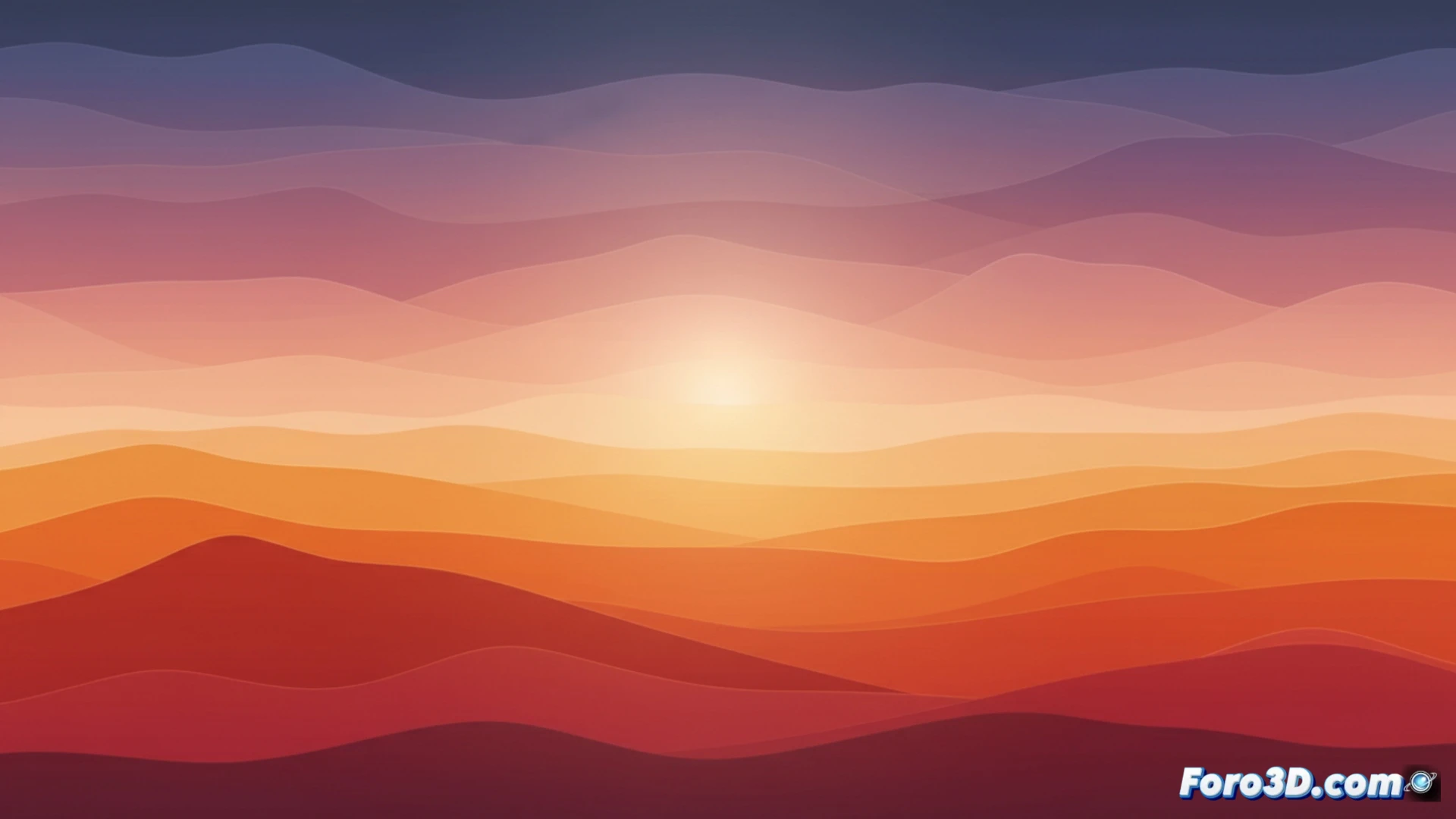
Nodal Construction: Stacking, Displacement, and Color 🧱
The system is based on a plane mesh to which a Subdivide node is applied to increase the geometry. Then, the Realize Instances node is used to properly handle the generated copies. The core is a Repeat Zone node that stacks and displaces each new layer along the Z-axis. Within this loop, the animated offset is controlled: a position value in X or Y is added, multiplied by the iteration index and a temporal factor (using a Scene Time node), creating differential movement between planes. For color, a material based on a procedural gradient is assigned. The index of each layer is mapped to a factor between 0 and 1, which is connected to a ColorRamp node. The colors of this ramp define the sunset palette, from dark tones in the background to bright oranges and yellows in the foreground planes, ensuring harmonic transitions.
Abstraction as a Procedural Result 🌀
This exercise transcends mere landscape replication. The power of the method lies in its algorithmic nature, where minimal adjustments to displacement, scale, or color parameters generate completely different visual results. Absolute control over the offset animation allows for anything from subtle and slow movements to fast and chaotic displacements. By abstracting the forms and relying on the nodal structure, composition, visual rhythm, and chromatic coherence are emphasized. It demonstrates that, by mastering these fundamentals, it is possible to efficiently and replicably produce complex and stylized generative animations.
How can Blender's Geometry Nodes be used to generate animated abstract landscapes that combine artistic control with infinite procedural variation?
(P.S.: Generative art is like having a child who paints by itself. And you don't even have to buy it paints.)