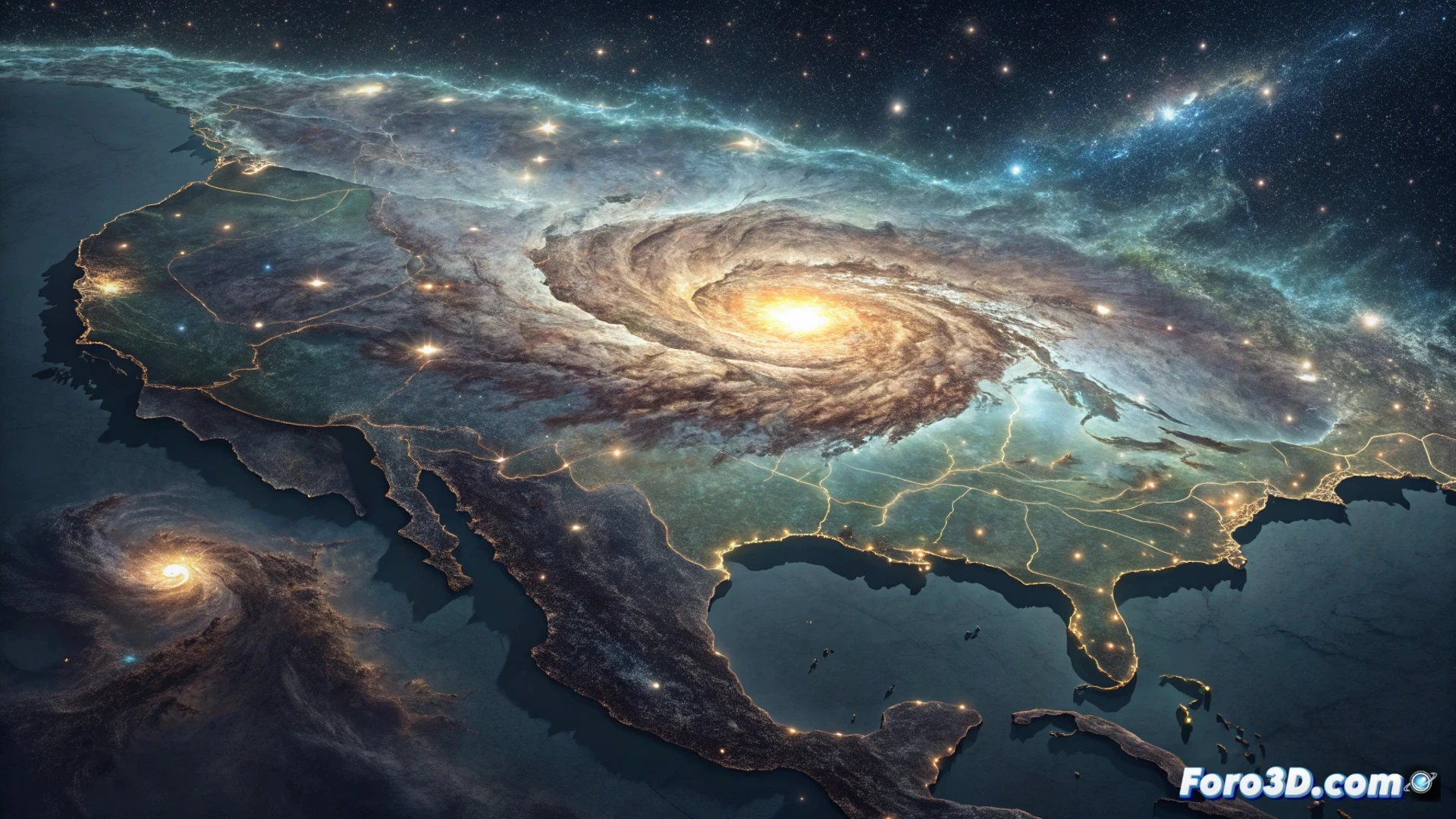
A milestone in cosmological scientific visualization: a team has created a three-dimensional map of the distant universe, approaching the cosmic dawn. The most surprising finding is the visualization of an immense and diffuse fog of light, a luminous sea that envelops the first galaxies. This radiation, emitted by billions of baby stars and black holes, was key to transforming the opaque cosmos into transparent. The 3D map serves as a fundamental tool to explore this era of reionization.
From telescope data to 3D model: mapping large-scale structure 🔭
The creation of this map is a triumph of massive data visualization. Scientists processed astronomical observations, transforming measurements of faint light into spatial coordinates within a cosmic volume. This process allows mapping the distribution of primordial galaxies and, crucially, the diffuse luminosity between them. Visualizing this large-scale structure in 3D, including the sea of light, reveals connections and patterns impossible to discern in 2D images or raw datasets, offering a new dynamic perspective on the architecture of the young universe.
Visualization as a bridge between raw data and deep understanding 🌉
This project underscores the dual role of scientific visualization: it is a research tool and a communication vehicle. The 3D model allows astrophysicists to virtually navigate the primitive cosmos, testing theories on galaxy formation. Simultaneously, it represents a powerful outreach resource, translating abstract phenomena and billions of data into a comprehensible image: a nascent universe bathed by the first collective light of its galaxies, making tangible a fundamental chapter of our cosmic history.
How are redshift data from distant galaxies translated into an interactive 3D model that visualizes the large-scale structure of the primitive universe?
(P.S.: if your manta ray animation doesn't excite, you can always add documentary music from channel 2)