After 400 years on the bed of the Baltic, a Swedish warship intentionally sunk around 1640 has been uncovered near Stockholm. A period of high pressure has lowered the water level to historic lows, revealing this time capsule. Its oak wood is exceptionally preserved thanks to the absence of the shipworm in this sea. However, its exposure to air starts a countdown: wet wood can degrade rapidly when drying. This is where digital archaeology becomes its lifeline.
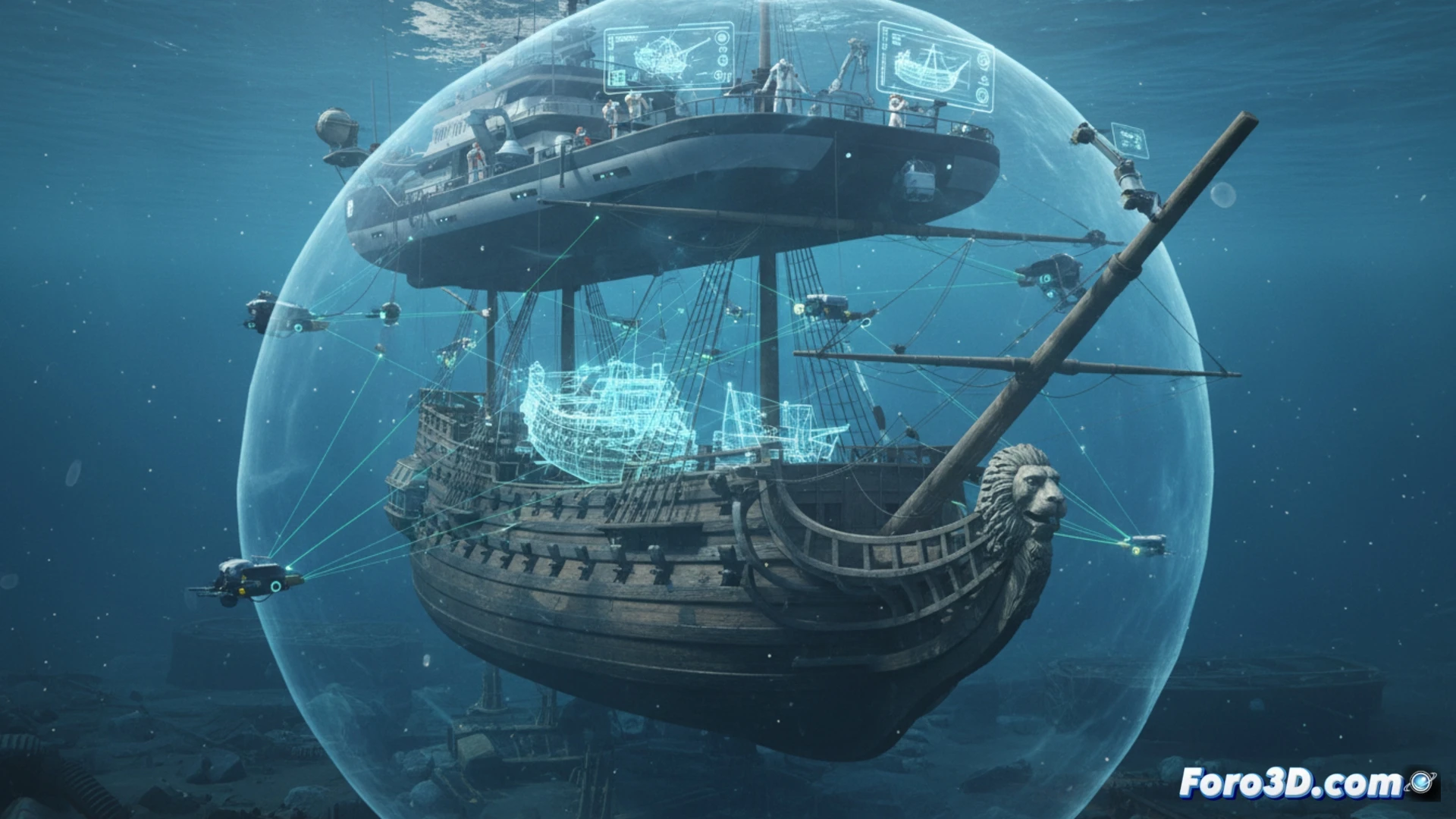
Underwater Photogrammetry: Capturing the Wreck Before It Disappears 🚨
Facing the imminent threat of degradation, researchers from the Vrak Museum of Wrecks are prioritizing 3D documentation techniques. Using underwater photogrammetry and possibly laser scanning, millions of data points from the structure are captured. This process generates an exact digital twin, a millimeter-precise 3D model that will serve as a permanent record. This model not only allows studying 17th-century shipbuilding without touching the fragile original, but also enables virtual reconstructions of its original appearance and function. It is proactive preservation: ensuring that, even if the physical wood succumbs, the ship survives for future research and outreach.
Beyond Physical Rescue: Heritage Lives in the Digital 💾
This case underscores a paradigm shift in underwater archaeology. The goal is no longer just to recover physical objects, often a destructive process, but to document them exhaustively in their context using digital tools. Programs like The Lost Fleet demonstrate that true preservation can be digital. 3D models become analysis tools, interactive outreach spaces, and unalterable archives. The lesson from the Baltic is clear: when time is against you, 3D technology offers the only way to beat decomposition.
What program would you use to virtually reconstruct this site?