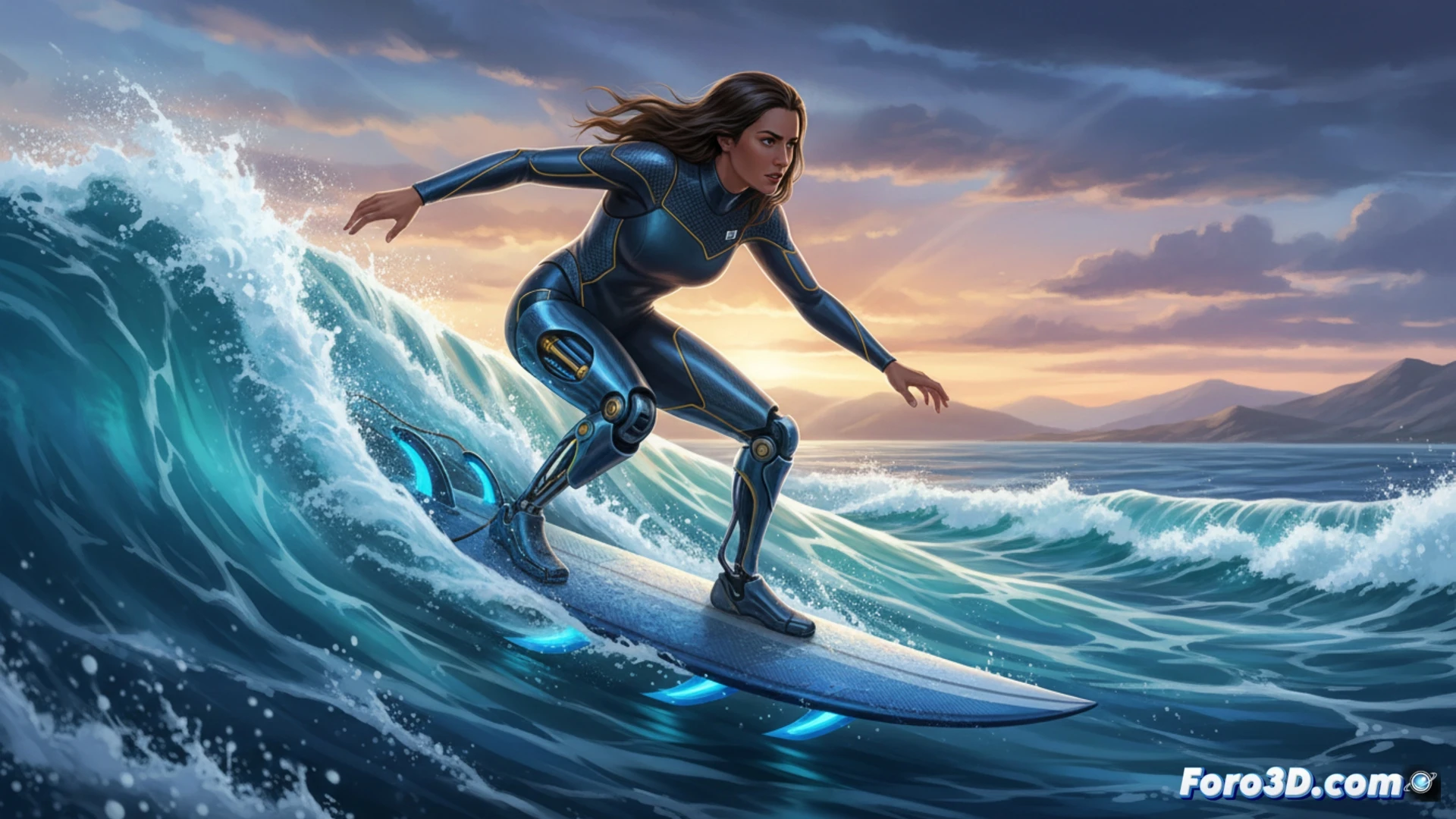
Sarah Almagro's story of overcoming challenges, world champion in adaptive surfing, focuses on a crucial technical challenge: the weight of her prostheses. After an amputation, she uses devices that add up to eight kilos, a significant load for her daily life and elite sport. This case exemplifies the urgent need for innovation in the prosthetic field, where customization, lightness, and extreme functionality are key. Additive manufacturing emerges as the ideal solution to create devices that not only restore function but optimize athletic performance.
From 3D scanning to printing: customization for extreme sports 🤿
The process would begin with a precise 3D scan of Sarah's stump, capturing its unique geometry for a perfect fit that avoids chafing during intense movement. Using 3D modeling, a surf-specific prosthesis would be designed, with drainage channels, board anchors, and an internal lattice structure that reduces weight while maintaining strength. Materials like carbon fiber composites or advanced 3D-printed polymers could drastically lighten the current 8 kg. Additive manufacturing allows rapid iteration of designs, testing geometries that improve hydrodynamics and water response, turning the prosthesis into a true sports extension.
Beyond hardware: technology at the service of quality of life 🏆
The ultimate goal is not just to create a lighter prosthesis, but to improve the user's quality of life and performance. Reducing weight would ease Sarah's demanding physical preparation, decreasing fatigue and injury risk. A personalized 3D design could offer greater comfort and control, allowing her to focus her energy on technique. Cases like hers demonstrate that 3D technology is not just manufacturing; it is an empowerment tool that, combined with iron will, redefines the limits of what is possible in life and high-competition sports.
How do you balance the requirements of structural strength, extreme lightness, and dynamic ergonomics in the 3D design of high-performance prostheses for impact sports like surfing?
(P.S.: 3D prostheses are so customized that they even have fingerprints.)