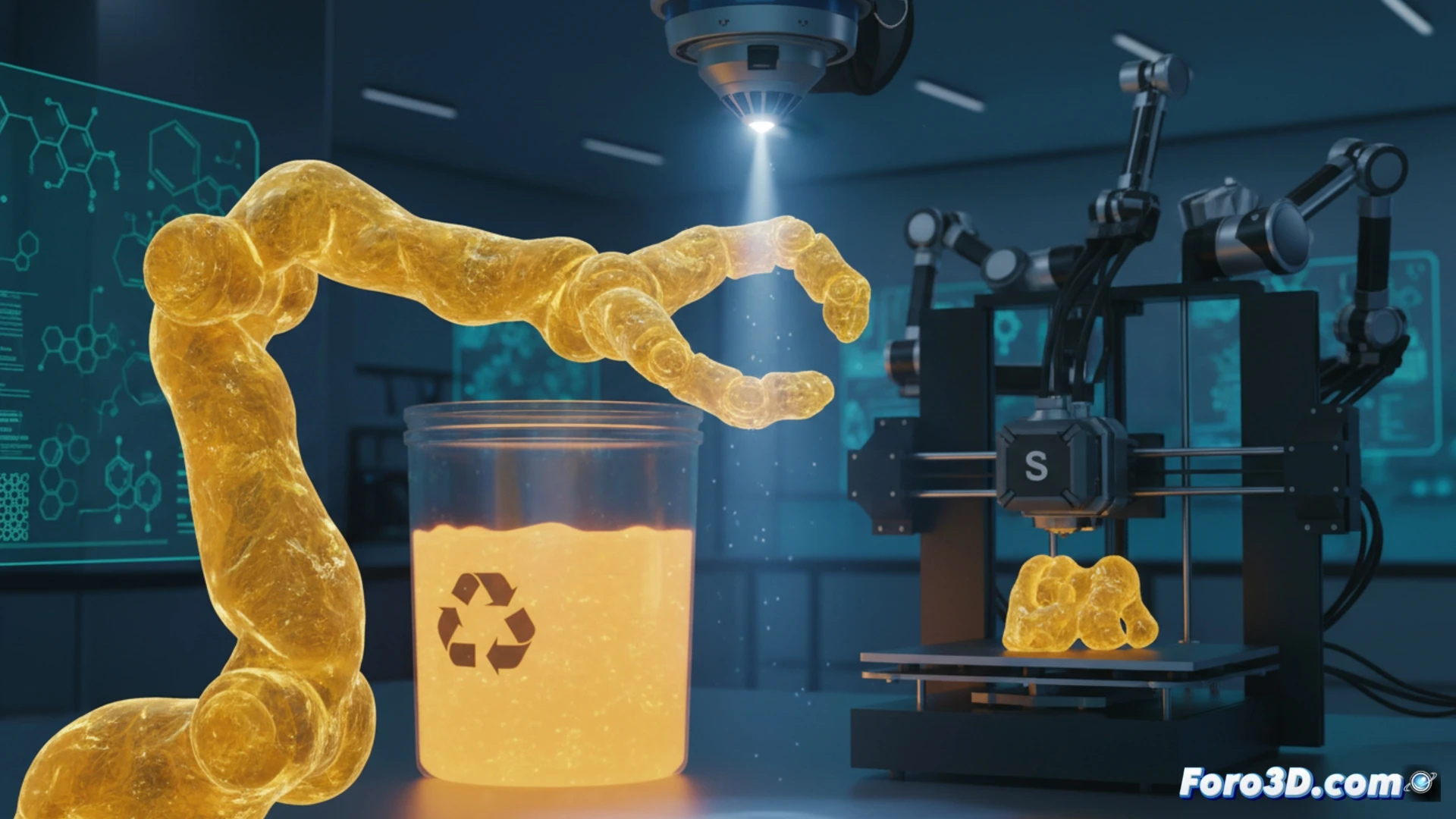
A research team from South Korea has developed an innovative method that combines sustainability and advanced robotics. Their proposal transforms residual sulfur, a byproduct of oil refining, into a base material for manufacturing soft robots through 4D printing. This technique adds the temporal dimension to 3D printing, creating structures that change shape and move autonomously when exposed to external stimuli, eliminating the need for complex motor and gear systems.
The PSN polymer and magnetic control: the technical foundation 🤖
The heart of the advancement is a sulfur-rich polymer called PSN. Its key lies in the glass transition temperature, which allows programming when the material is rigid or flexible. When heated, it becomes moldable to print the initial shape; when cooled, it solidifies. Subsequently, by applying heat or light, the material recovers its programmed shape, executing the movement. For precise control, the researchers incorporated magnetic particles into the compound. Thus, by applying an external magnetic field, the soft robot's movement can be directed and controlled with exact precision, achieving complex and repeatable displacements remotely and without physical contact.
A future of sustainable and delicate robotics ♻️
This innovation presents a double positive impact. On one hand, it adds value to a massive industrial waste, promoting a circular economy. On the other, it opens new possibilities in soft robotics, allowing the manufacture of intrinsically recyclable actuators and robots, capable of interacting with fragile objects or biological environments with a delicacy impossible for traditional rigid robotics. The combination of 4D printing and programmable materials points the way toward more adaptive, sustainable, and safe machines for collaboration with humans.
Can 4D printing with recyclable materials like residual sulfur revolutionize the sustainability of soft robots? 🤔
(P.S.: Simulating robots is fun, until they decide not to follow your orders.)