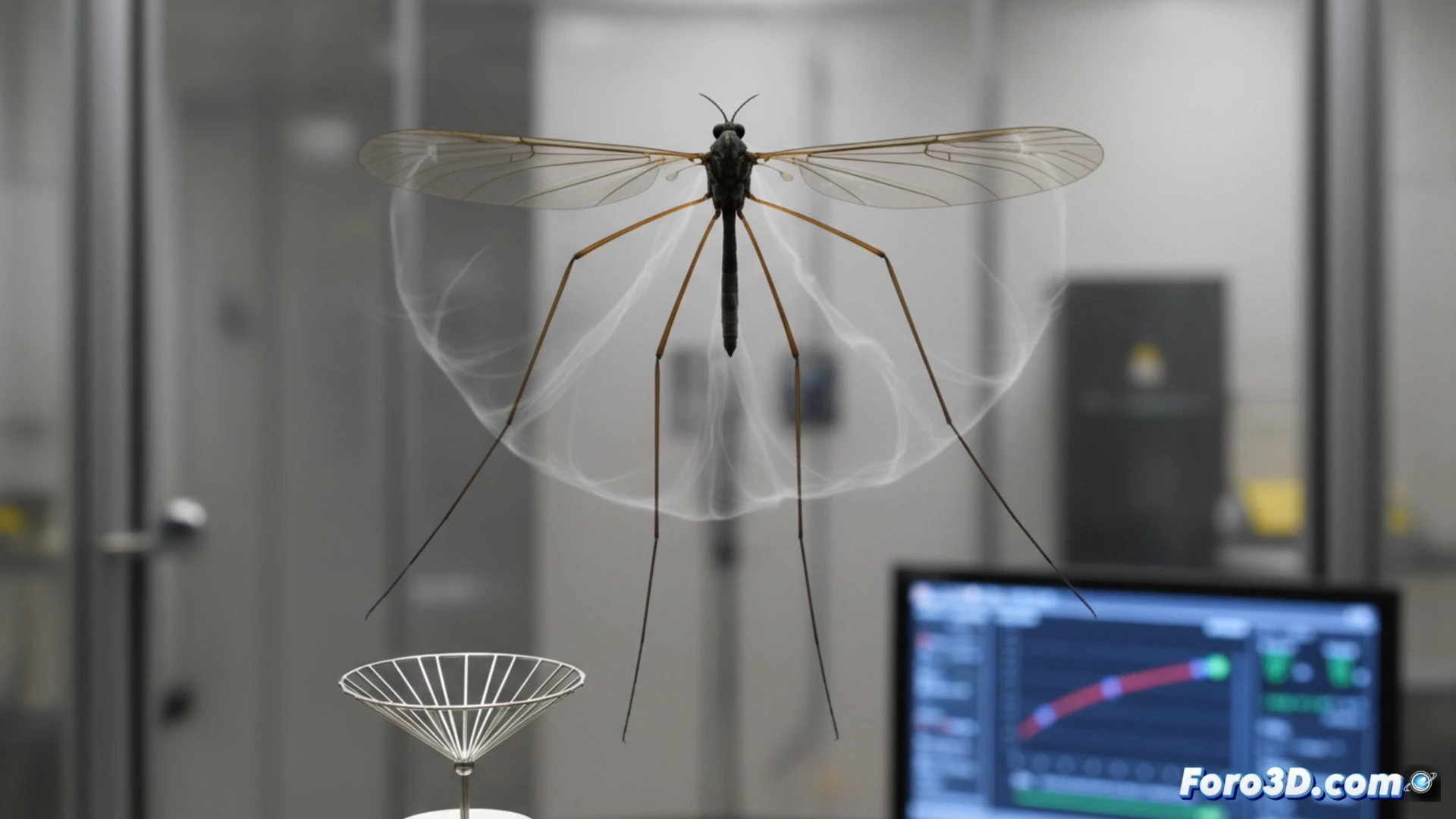
A recent study has used 3D modeling and printing to decipher the unusual flight strategy of the ghost mosquito (Bittacomorpha clavipes). This research, focused on scientific visualization, reveals that the insect does not flap to ascend. Instead, it deploys its long legs forming a conical structure that acts as a parachute, taking advantage of upward air currents. The key to understanding this mechanism has been the physical and digital recreation of the process.
From observation to simulation: an integral 3D workflow 🛠️
The research process is a perfect example of a scientific visualization pipeline. After biological observation, precise 3D digital models of the mosquito were created. These were used to manufacture scale physical models via 3D printing, utilized in wind tunnel experiments. Simultaneously, the digital models enabled running computational fluid dynamics (CFD) simulations to visualize and quantify the airflow around the leg structure. The correlation between physical and simulated data validated the finding: the inverted cone of legs generates adjustable aerodynamic drag that provides free lift.
Bioinspiration visualized: towards efficient microrobots 🤖
The visualization of this phenomenon not only explains a natural mystery but also charts a path for engineering. By understanding and graphically seeing how geometry and air viscosity interact at microscale, low-consumption miniaturized aerial vehicles can be designed. The research is already exploring the use of shape memory alloys to replicate the passive movement of the legs, a design principle born directly from the ability to model and visualize complex data in three dimensions.
How has 3D visualization and scale model printing allowed revealing the complex aerodynamic mechanisms behind the ghost mosquito's hovering flight? 🧐
(PS: fluid physics to simulate the ocean is like the sea: unpredictable and you always run out of RAM)