A recent study has debunked the myth of the great white shark as a solitary hunter. Using cameras attached to their dorsal fins, researchers discovered that these predators form complex social associations, patrolling in groups and sharing information. This finding, beyond its biological relevance, represents a treasure trove of movement and interaction data that calls for interpretation through 3D scientific visualization tools.
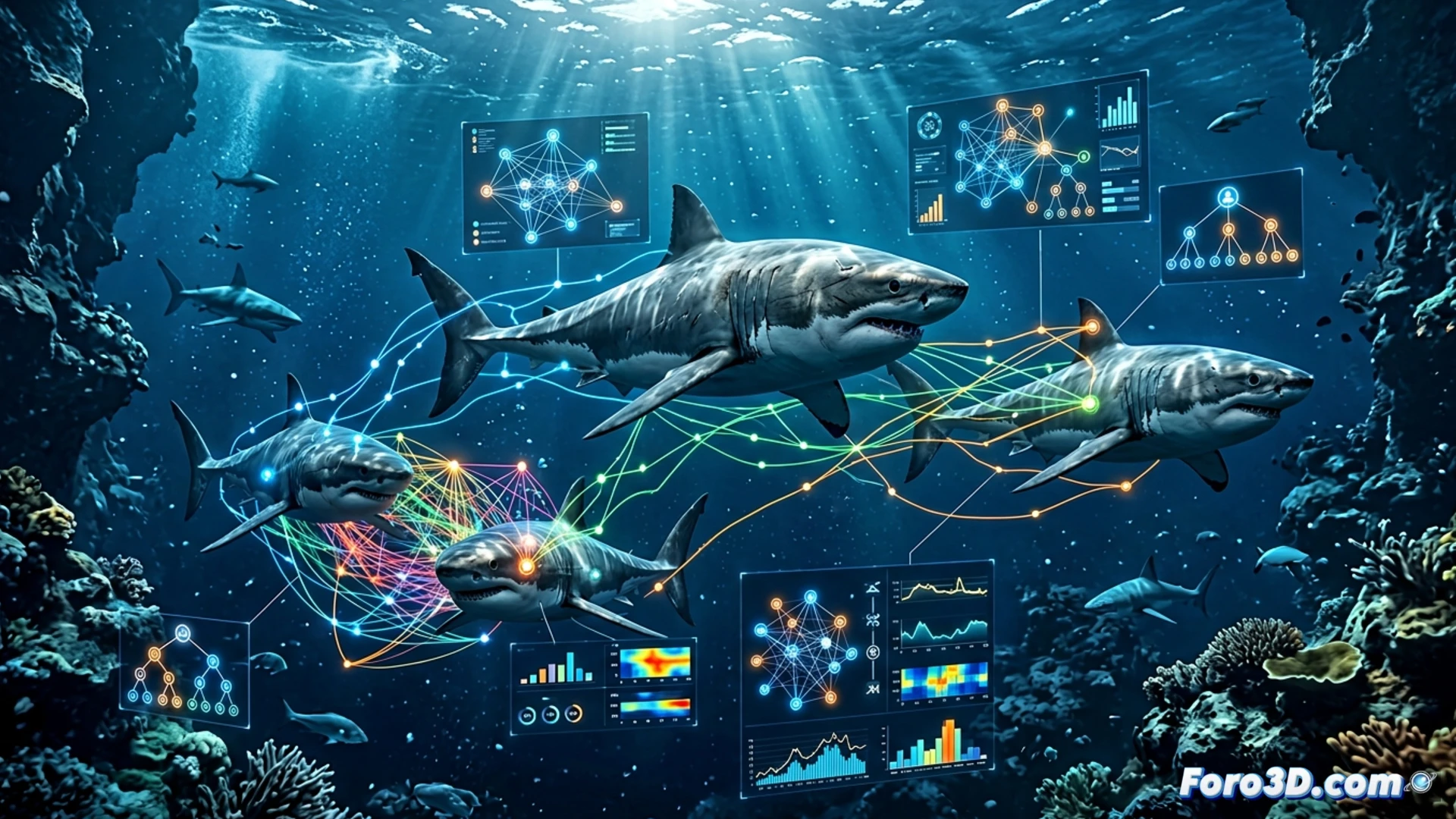
From raw data to immersive experience: modeling proposal 🦈
The richness of this study is enhanced with 3D visualization. First, an anatomically precise model of a great white shark, showing the exact location of sensors and cameras, explains the methodology. Second, a spatiotemporal data visualization would show the group's trajectories, encoding proximity and duration of encounters with colors, revealing non-random patterns. Third, a 3D reconstruction of the marine environment, with realistic bathymetry and lighting conditions, would contextualize these behaviors. Together, these elements transform video sequences and GPS coordinates into an interactive and comprehensible visual narrative.
Visualization as a bridge between science and outreach 🌊
This case exemplifies the power of scientific visualization. It is not just about illustrating a finding, but about creating an environment where the data tells its own story. An interactive model allows researchers to analyze complex spatial relationships and, simultaneously, offers the public an immersive window into a discovery that redefines our understanding of oceanic life, demonstrating that 3D technology is fundamental to modern scientific research and communication.
How can 3D visualization techniques be applied to analyze and represent the complex social dynamics discovered in great white shark behavior?
(P.S.: modeling manta rays is easy, the hard part is making them not look like floating plastic bags)