Science discovers that reef manta rays form complex communities with selective and long-lasting friendships. These findings, obtained through years of tracking, generate a massive volume of spatial and relational data. This is where 3D scientific visualization reveals itself as an indispensable tool, transforming numbers and coordinates into a dynamic and comprehensible model of the social behavior of these species.
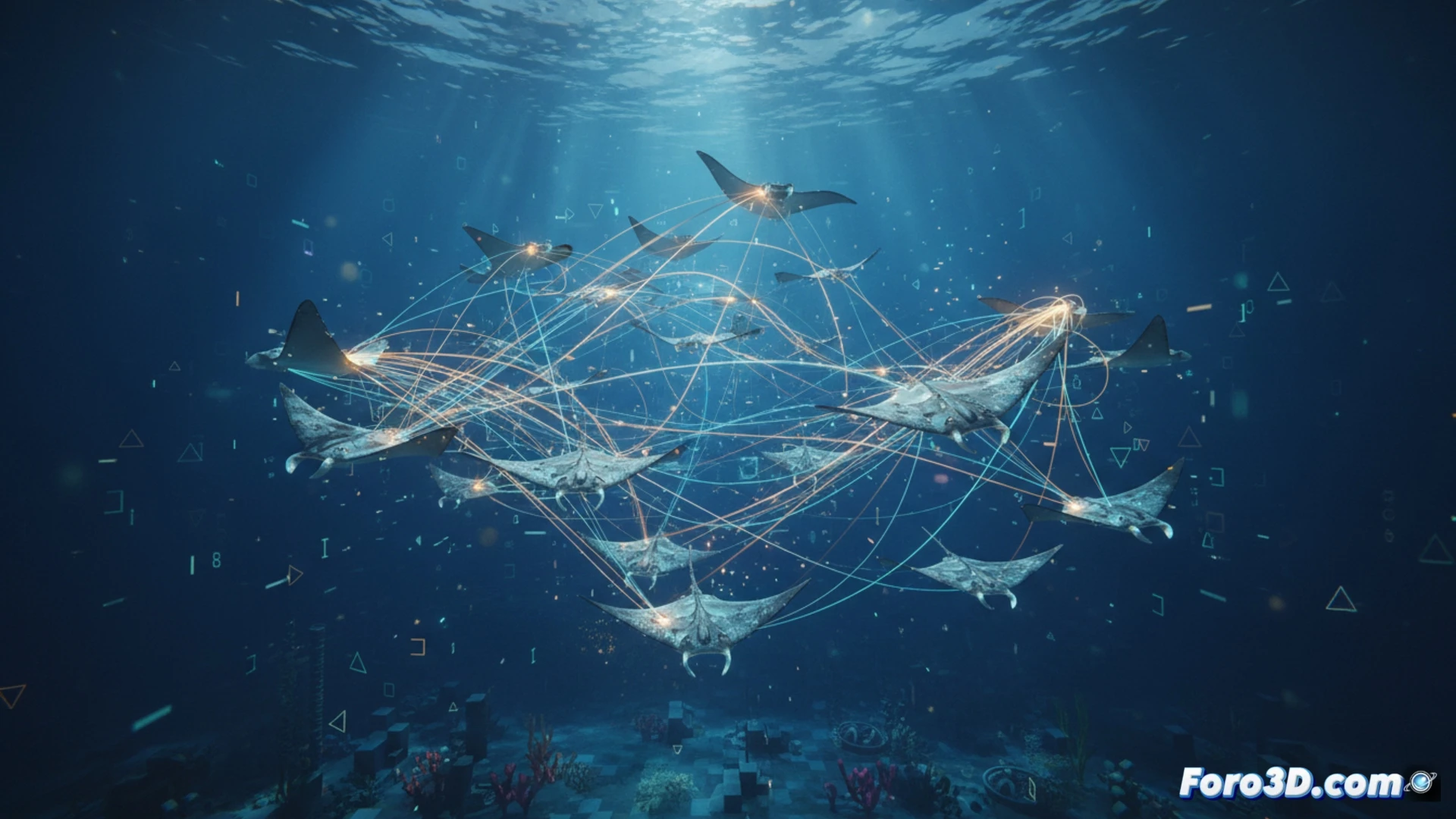
From data to virtual ecosystem: tools for ethology 🐠
Imagine a georeferenced 3D model of a reef, where each manta is an animated agent with its movement history. Trajectories are visualized as paths in 3D space, and social encounters are represented with connectors or particle networks. This virtual reconstruction allows ethologists to navigate the data in first person, identify meeting points, analyze interaction frequency, and test hypotheses about group formation mechanisms. Tools like 3D GIS, game engines, and animation software enable simulating these dynamics with unprecedented precision.
Beyond the paper: immersive scientific communication 🌊
The true power of 3D visualization transcends analysis. An interactive model turns a complex study into an immersive narrative experience. By allowing the public to fly virtually alongside the mantas and observe their bonds, it generates an emotional connection and intuitive understanding impossible to achieve with 2D graphics. Thus, 3D technology not only advances research but also democratizes knowledge, making the surprising social life of the ocean tangible.
How can 3D social network visualization techniques be applied to map and analyze the complex friendship relationships in manta ray communities?
(P.S.: at Foro3D we know that even manta rays have better social bonds than our polygons)