The recent appointments of professors at ETH Zurich stand out for their focus on complex scientific frontiers. Beyond the institutional news, these fields illustrate the critical dependence of modern research on visualization tools. Particle physics, the nanoscale, and epidemiology generate massive and abstract data whose understanding requires converting them into intuitive and three-dimensional visual representations.
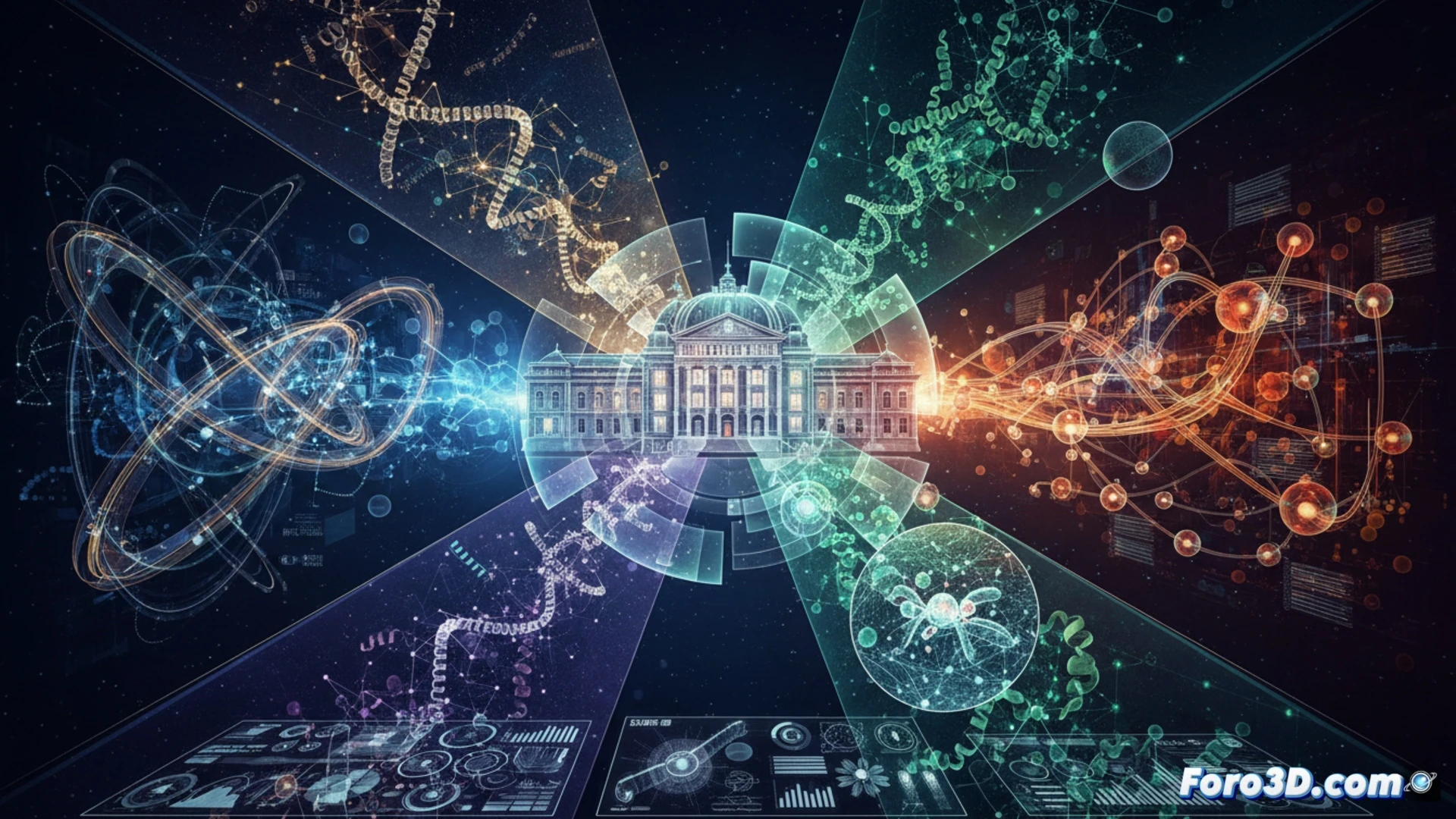
From collisions to models: 3D as the universal scientific language 🔬
Dr. Aarrestad's work at CERN relies on visualizing particle trajectories and collisions in 3D to interpret experiments. In nanomaterials, Dr. Donnelly requires advanced 3D rendering techniques to represent atomic structures and their magnetic properties. For her part, Professor Bütikofer's research in health economics uses maps and 3D models to break down the impact of environmental factors on populations. In all cases, visualization is not just illustration, but an integral part of the discovery method, enabling the identification of patterns and effective communication of findings.
The 3D Forum, bridge between science and its dissemination 🌉
These additions to ETH reinforce that scientific visualization is an essential transversal discipline. For our community, these cases are practical examples of how the modeling, rendering, and visual analysis techniques we discuss here are pillars of scientific progress. 3D visualization thus consolidates as the indispensable bridge between data complexity and accessible knowledge.
How is 3D visualization of complex data transforming research on scientific frontiers such as molecular biology or materials science in leading institutions like ETH Zurich?
(P.S.: at Foro3D we know that even manta rays have better social bonds than our polygons)