Audrey Pascual, with a time of 43.02 seconds, leads the Paralympic slalom in Milan-Cortina 2026. Her advantage of one hundredth over her rival demonstrates the extreme precision of this sport. In this battle where every millisecond counts, 3D technology emerges as a decisive tool. It's no longer just about training on the snow, but about analyzing, simulating, and perfecting every movement in a virtual environment to maximize performance and understand the track at an unprecedented level. 🎿
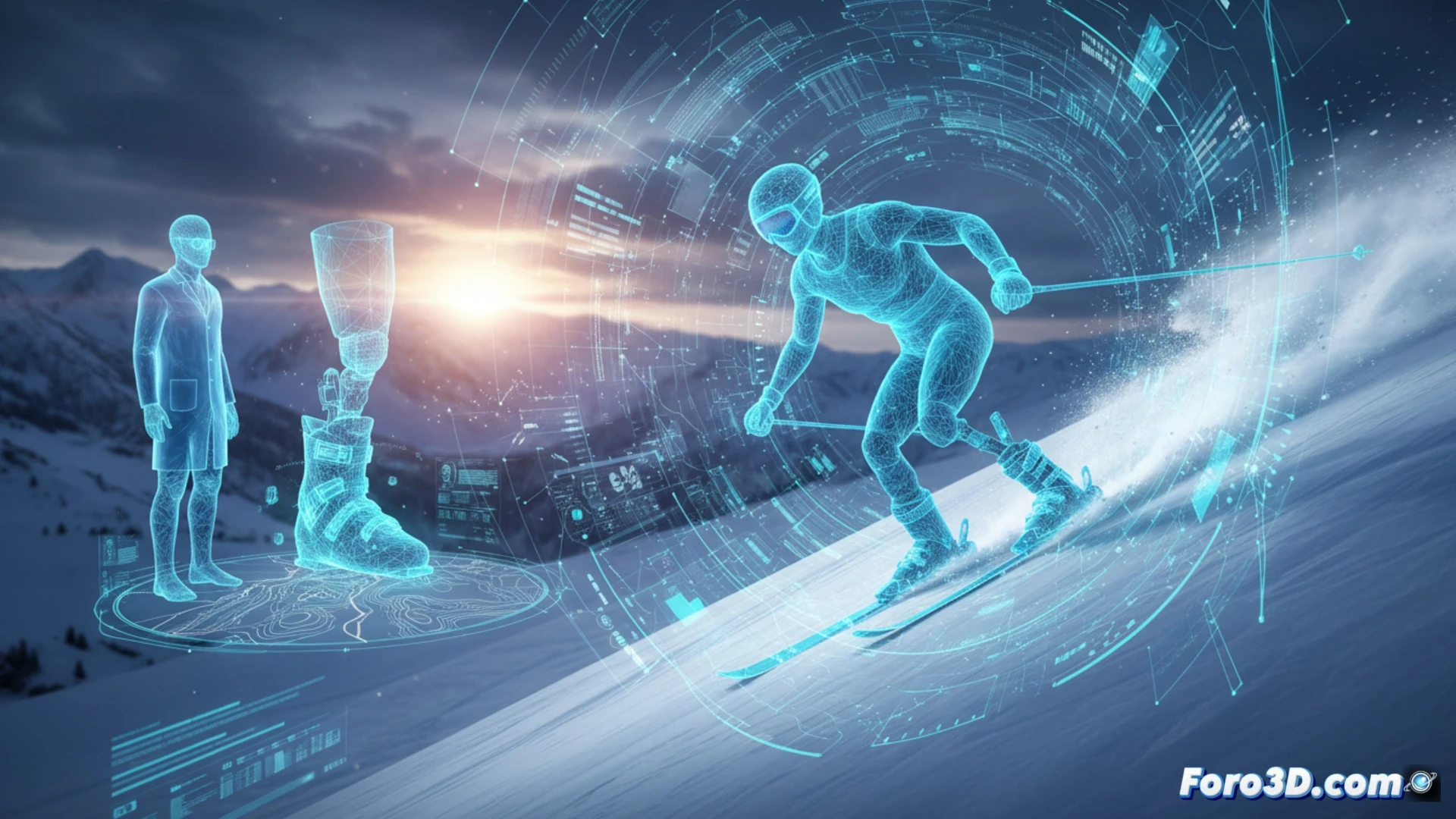
Trajectory simulation and 3D biomechanical analysis 🤖
Through motion capture systems and laser scanning of tracks, an exact digital twin of the competition can be recreated. For an athlete like Pascual, this allows simulating infinite descent lines, testing the effectiveness of each virtual trajectory without physical fatigue. 3D biomechanical analysis breaks down her posture, inclination angles, and pressure on the edges, identifying micro-inefficiencies. Comparing her 3D model with those of her rivals helps technicians design an optimal race strategy, aiming to win those hundredths that separate gold from silver.
Beyond training: immersive visualization for spectators 🥽
This 3D revolution also transforms the fan experience. Imagine visualizing, in real time, a 3D avatar of Audrey competing alongside a virtual replica of Zhang, overlaid on the same digital track to clearly appreciate the differences. Broadcasting platforms could offer interactive virtual tours of the Cortina track, explaining the key points where time is gained or lost. The technology not only helps athletes to be better, but also brings the public closer to the complexity and merit of a sport of the highest precision.
How are 3D printing and body scanning redefining the aerodynamics and personalized equipment fitting for Paralympic skiers to win decisive hundredths?
(P.S.: at Foro3D we know that a 3D simulated penalty always goes in... unlike in real life)