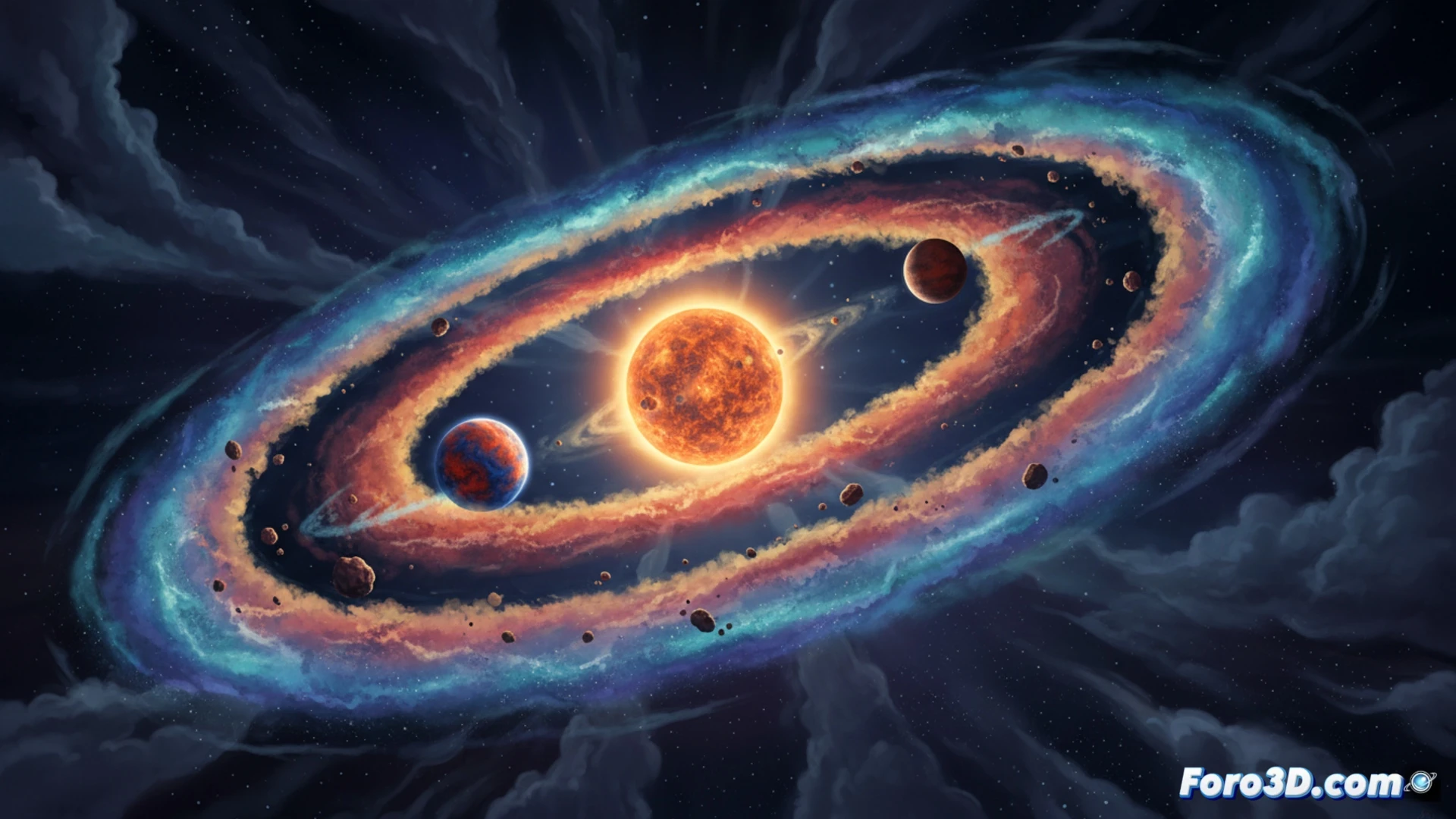
New computational simulations are rewriting the history of our cosmic neighborhood. A scientific visualization model, which employs sophisticated fluid dynamics and N-body techniques, suggests that Mercury, Venus, Earth, and Mars did not form from a single disk of dust and gas, but from two well-differentiated concentric rings around the young Sun. This digital representation resolves in an elegant and visual way several enigmas of planetary composition and position that traditional theoretical models failed to explain.
Data visualization as a theoretical validation tool 🔬
The power of this research lies in the 3D simulation's ability to convert abstract hypotheses into a dynamic and visually comprehensible system. Scientists defined initial parameters, such as the mass and distribution of material in two separate rings, and ran the model to see how it evolved over millions of years. The visualization of the results clearly showed how planetesimals accreted preferentially from their nearest ring, generating planets with distinct compositions. Mars, formed mostly from the outer ring, and Earth, from the inner one with a small external contribution, perfectly matched their real chemical and orbital properties, something impossible to achieve with single-disk simulations.
Beyond theory: the future of visual science 🚀
This case underscores a paradigm shift: scientific visualization is no longer just a tool to illustrate ideas, but a fundamental digital laboratory. The ability to test complex and highly specific scenarios, interactively observing each stage of the process, accelerates discovery and validates models with unprecedented precision. Although this solar system model requires further refinement, it demonstrates that progress in astronomical knowledge will increasingly depend on our ability to create, run, and above all, visually interpret high-fidelity three-dimensional simulations.
How do 3D scientific visualization techniques allow identifying and differentiating the two planetary accretion processes in the new computational simulations?
(P.S.: at Foro3D we know that even manta rays have better social bonds than our polygons)