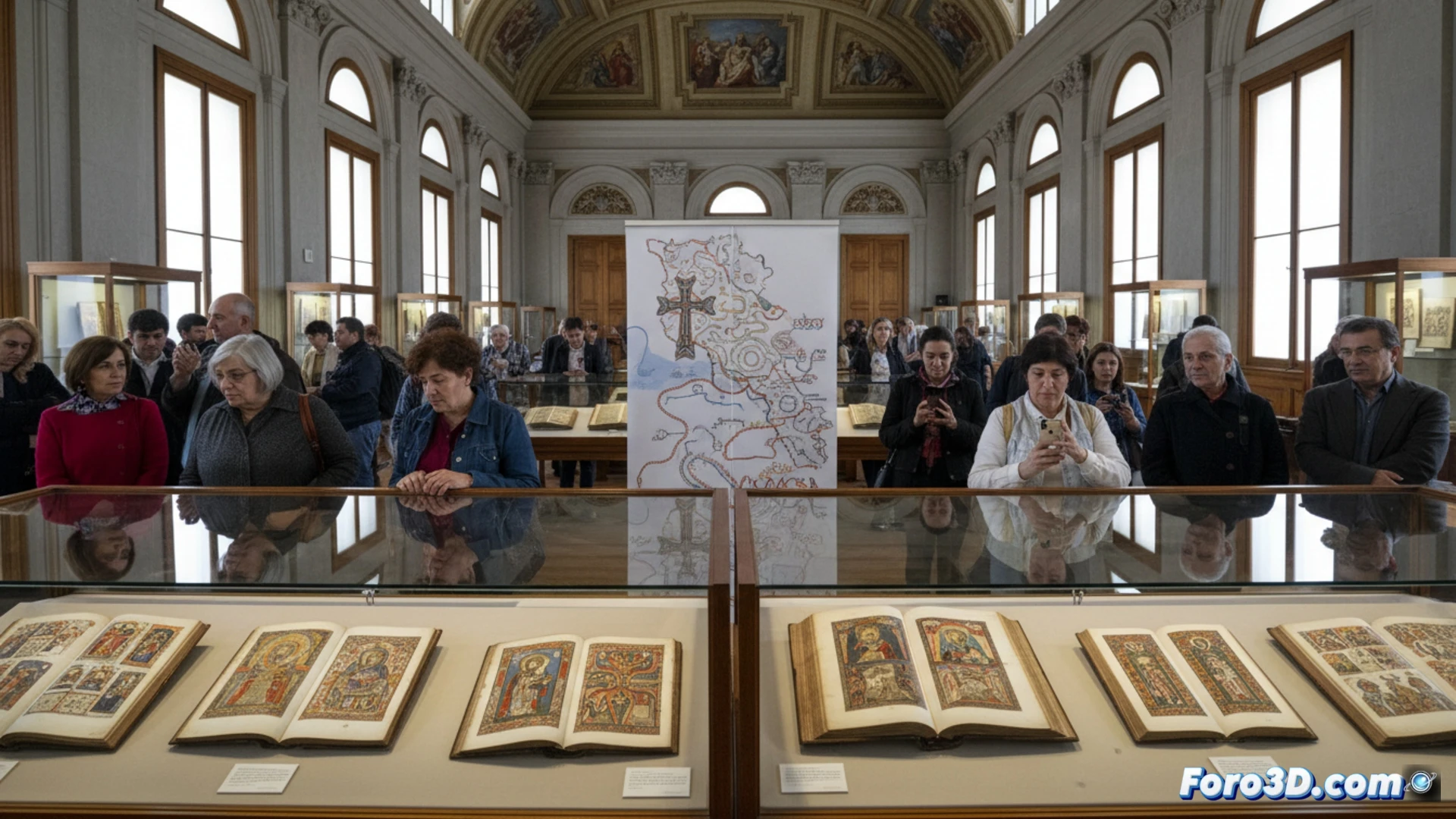
The exhibition of Armenian manuscripts at the National Library highlights the fragility of these treasures. Their long-term preservation is a challenge. Here, 3D technology reveals itself as an indispensable tool. Techniques such as photogrammetry and laser scanning allow the creation of exact digital replicas, ensuring that cultural heritage survives physical degradation and is accessible globally without handling the originals.
Photogrammetry and Digital Twins in Bibliographic Preservation 📐
For manuscripts like those exhibited from the Matenadaran, high-resolution photogrammetry is key. It captures hundreds of images that, when processed, generate a textured 3D model with millimeter precision. This digital twin allows studying details such as the parchment texture, ink depth, or cracks in the miniatures, crucial data for conservation diagnostics. Additionally, the 3D files serve as an indestructible backup and facilitate analysis with virtual raking light to reveal workshop marks invisible to the naked eye, enriching research without risk to the piece.
Beyond the Showcase: Borderless Dissemination 🌍
3D digitization democratizes access. While physical exhibitions have limits of time and location, a scanned manuscript can be integrated into web platforms or virtual reality, allowing interactive inspection from anywhere. This technology does not replace the original but complements it, ensuring its legacy endures and is studied with new tools, making it possible for unique collections, like these Armenian codices, to transcend museum walls.
How can 3D scanning overcome the limitations of traditional photography to document and preserve the texture, relief, and material degradation of historic Armenian manuscripts without physical contact?
(P.S.: Virtual restoration is like being a surgeon, but without bloodstains.)