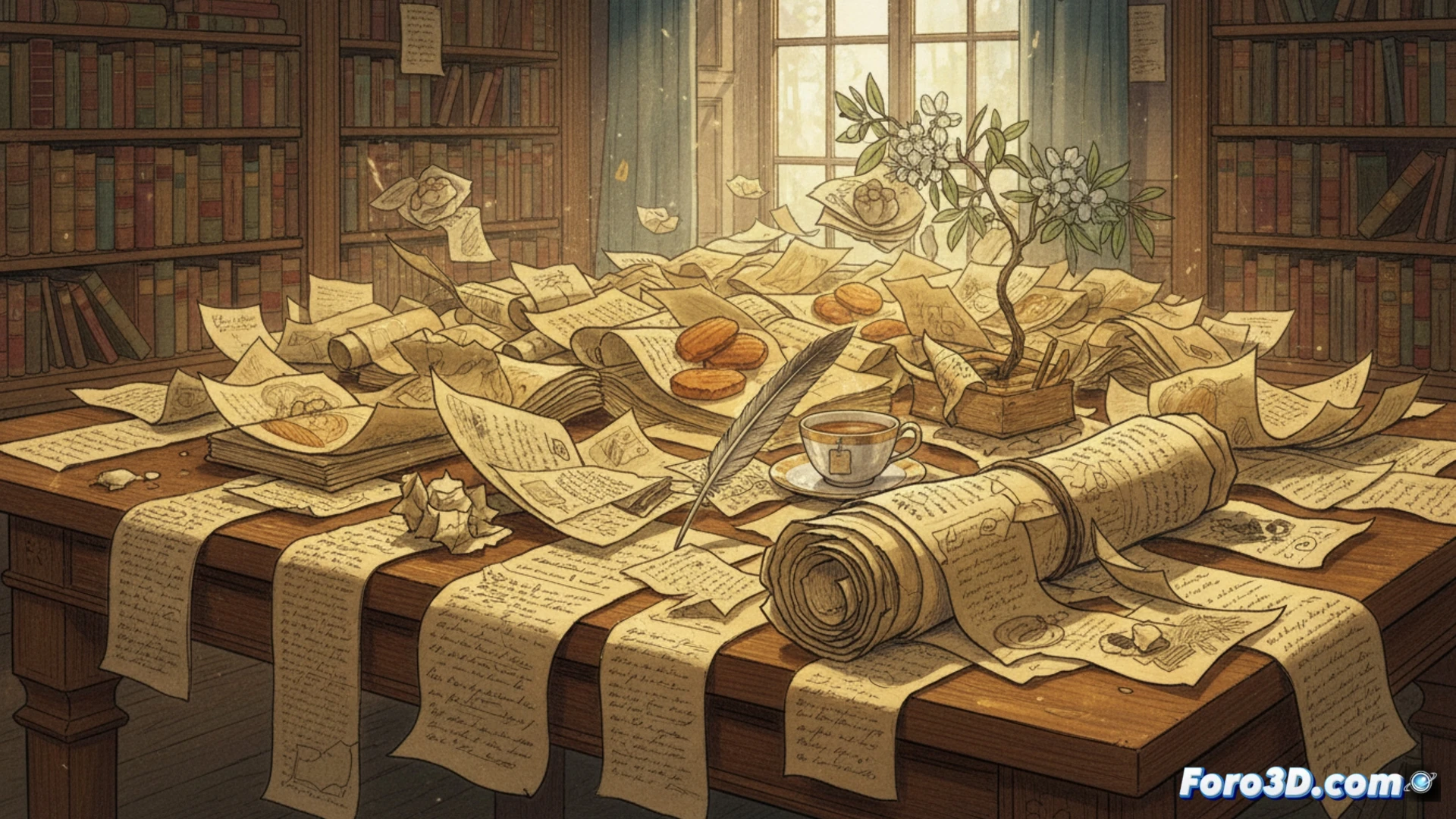
The manuscripts of In Search of Lost Time, with their infinite corrections and overlapping annotations, are a physical labyrinth of Marcel Proust's creative process. Their extreme fragility limits direct access and study. Here, 3D technology emerges as a revolutionary tool for conservation, allowing the digital capture of every detail of these fragile documents without any contact, preserving their current state for posterity and facilitating their analysis.
Photogrammetry and laser scanning: a new stratigraphic reading 🔍
Techniques such as high-resolution photogrammetry and 3D laser scanning allow the generation of exact digital models of each folio. These models are not simple flat images. They capture the microscopic topography of the paper: the indentation of the pen, the texture of corrections with glue, the relief of dried ink, and the different layers of writing. Researchers can apply virtual light filters to enhance textures and separate annotation strata, deciphering the chronological order of revisions in a way that was previously impossible, and obtaining precise degradation metrics.
Preserving the materiality of memory 💾
Beyond physical preservation, these 3D models safeguard the material dimension of the creative act. The physical object, with its marks of urgency and reflection, becomes a globally accessible digital archive. This democratizes research and brings the public closer to the intimacy of the writer's workshop, allowing exploration of the materiality of Proustian memory without risks, ensuring that time, paradoxically, does not take away the trace of its own search.
How can 3D scanning and high-resolution photogrammetry unravel the layers of writing and overlapping corrections in complex manuscripts like those of Proust, without risk of physical damage?
(P.S.: Virtual restoration is like being a surgeon, but without bloodstains.)