The Song of Roland, an 11th-century epic poem, is more than a literary text; it is a primary source that describes a historical event, the Battle of Roncesvalles (778 AD), and its material context. From digital archaeology, this narrative ceases to be just words and becomes the blueprint for a virtual reconstruction project. The proposal is to use the poem's description, contrasted with archaeological evidence, to recreate in 3D the Pyrenean scenario, the weapons, the armors, and the possible fortifications, returning a spatial and tangible dimension to this intangible heritage.
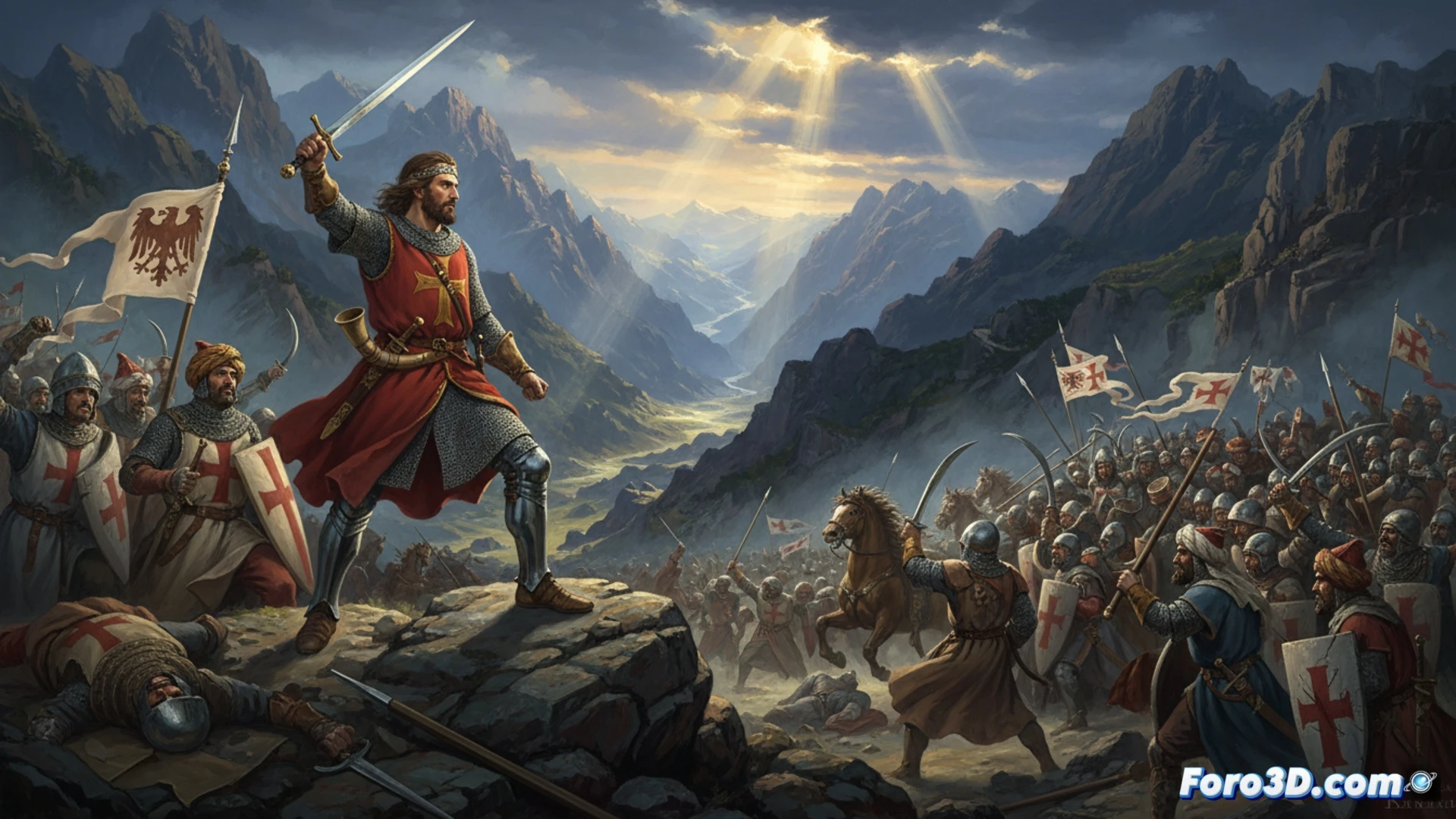
Methodology: from the epic to the volumetric model 🗺️
The process would begin with a meticulous textual analysis to extract spatial and descriptive data from the poem. These would be cross-referenced with archaeological research from the Carolingian era and the Roncesvalles pass itself. Photogrammetry of museum objects (swords of the Joyeuse type, chain mail) would provide real bases. With this data, the terrain would be modeled in 3D using LIDAR cartography, and the objects. The result would be a navigable virtual reality environment that allows visualizing the troop dispositions, the orography of the pass, and understanding tactics and decisions, superimposing layers of historical information on the model.
Beyond visualization: outreach and new knowledge 🔍
This reconstruction is not a mere illustration. It serves as an analysis tool for historians and archaeologists, allowing hypotheses to be tested about the development of the battle. For the public, it is an immersive access door to a foundational event of European culture. Thus, digital archaeology acts as a bridge, transforming a poetic narrative into an experimental space where 3D technology preserves, analyzes, and communicates our past in a profoundly innovative way.
How can archaeological data be integrated with the descriptions from the Song of Roland to create a rigorous and visually impactful 3D reconstruction of the historical site of Roncesvalles?
(P.S.: and remember: if you can't find a bone, you can always model it yourself) 💀