The recent attempted attack in front of the Bank of America in Paris, thwarted at the last moment by the police, represents an ideal case study for the application of 3D forensic technologies. Beyond the news report, the crime scene, with its improvised five-liter device and intact ignition system, contains crucial information. A precise digital reconstruction would allow experts to analyze, preserve, and study the scene with a level of detail and permanence impossible with traditional methods.
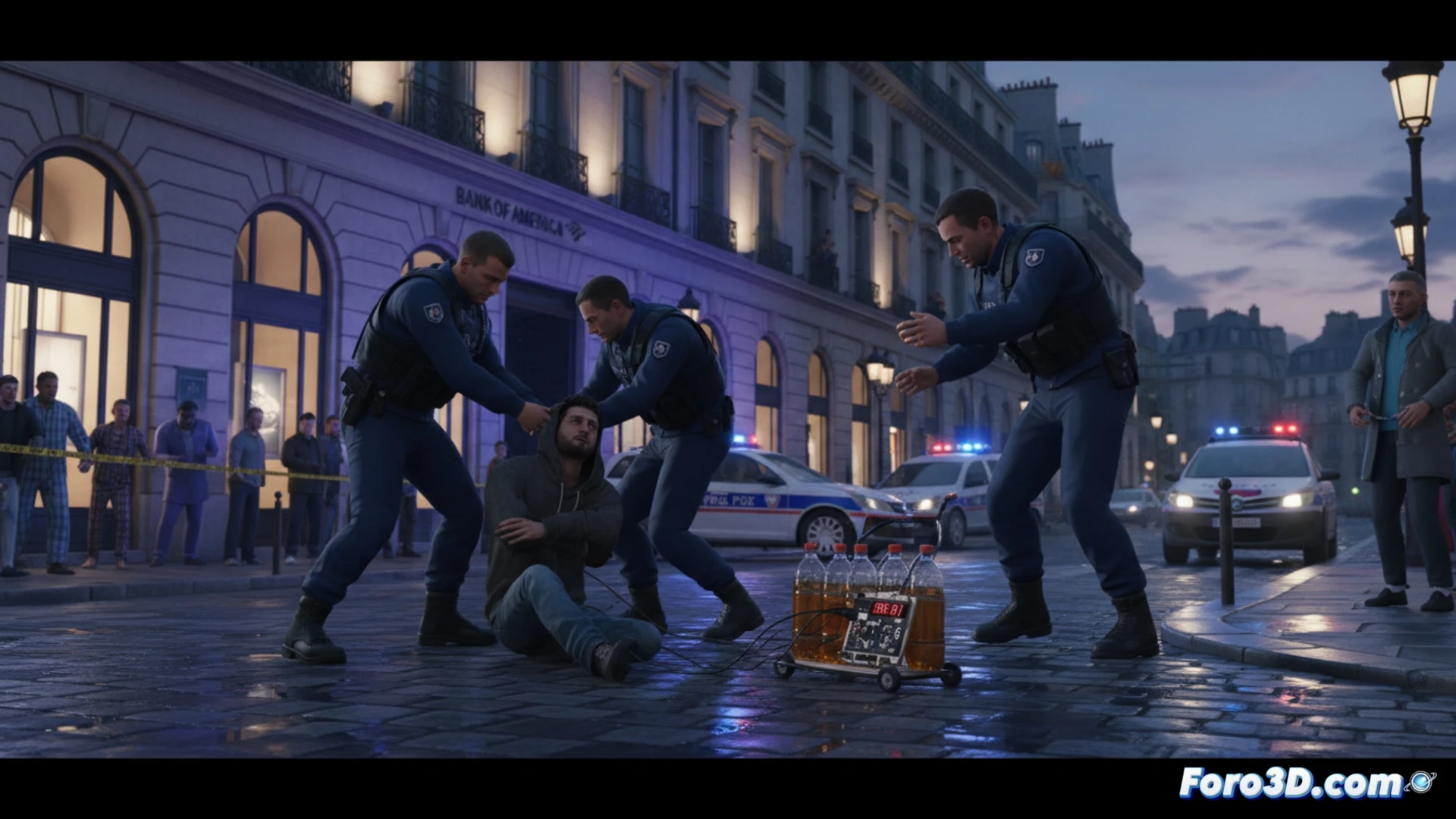
Photogrammetry and LIDAR: Capturing Physical Evidence in 3D 🔍
Immediate documentation using photogrammetry from multiple angles and terrestrial laser scanning (LIDAR) would generate an exact digital twin of the sidewalk, the building facade, and the precise position of the device. This georeferenced 3D model preserves the spatial relationships and dimensions forever. Investigators could perform virtual measurements, analyze potential fragmentation trajectories, and study the device's placement without any risk. This digital asset becomes the objective foundation for all subsequent investigation, accessible to all involved teams.
Simulation and Analysis: From What Happened to What Could Have Happened 💥
The true power of 3D reconstruction goes beyond preservation. By integrating the model into a game engine or simulation software, explosives experts could run fluid dynamics and explosion simulations. This allows evaluating the potential damage radius, pressure on the bank facade, and real risk to pedestrians. This what if scenario analysis is invaluable for assessing the severity of the attempt and preparing more robust security protocols for the future.
Would you combine scanning with photogrammetry?