The recent arson attack on Hatzola ambulances in London underscores the need for maximum precision forensic documentation methods. In such cases, where evidence is ephemeral and the scene is complex due to explosions and residues, photogrammetry and 3D laser scanning become crucial tools. They would allow capturing the exact post-incident state, digitally preserving every detail for a thorough investigation and irrefutable expert analysis.
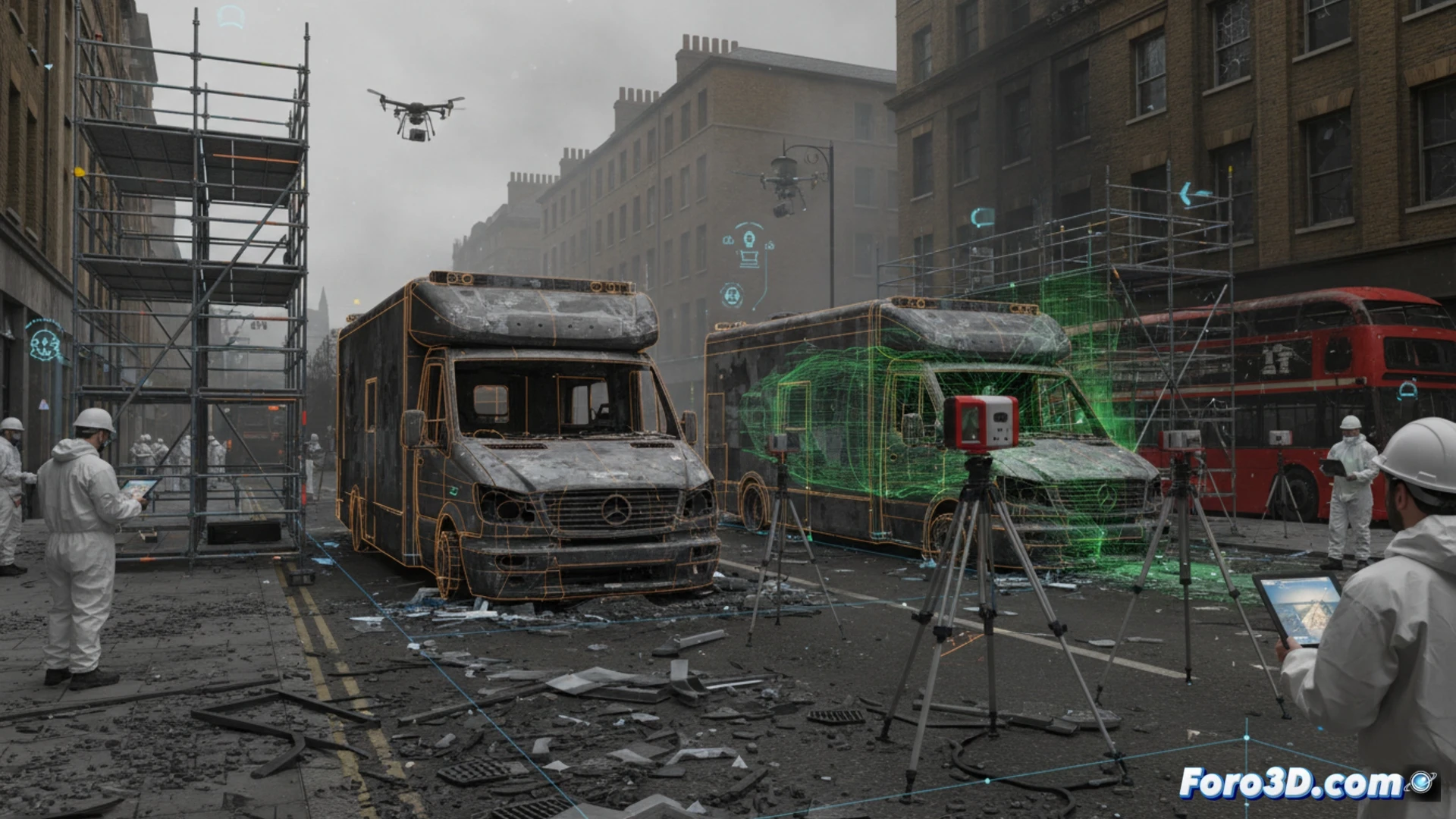
Forensic documentation and fire dynamics analysis using 3D 🔥
A laser scan of the scene would provide a millimeter-accurate point cloud of the parking lot, the charred vehicles, and the structural damage to windows. Combined with photogrammetry of the remains, a textured and georeferenced 3D model would be generated. This digital asset would allow investigators to study burn patterns, determine fire origin points, and simulate flame propagation or the blast wave from oxygen explosions. Additionally, integrating security videos into the 3D model would facilitate spatial correlation of suspects' movements with the physical evidence found.
Preserve evidence and communicate technical truth ⚖️
Beyond analysis, a precise 3D model serves as a permanent objective record, immune to the deterioration of the original scene. This can be vital for presenting technical conclusions clearly in court, allowing judges and juries to virtually tour the scene. In hate crimes, where the social impact is profound, this ability to document and communicate the factual truth with neutral technology is an essential pillar for justice.
Would you place scale witnesses before scanning?