A breakthrough published in Science redefines the limits of additive manufacturing. Researchers have developed a lithographic 3D printing method that allows spatially controlling crystallinity within a single thermoplastic piece. This process, based on ultraviolet light projection, provides unprecedented microscopic control over the material's microstructure in 3D space. The result is the ability to locally adjust properties such as stiffness, transparency, or mechanical behavior in a single printed object, acting as a 4D printer that programs properties during manufacturing. 🔬
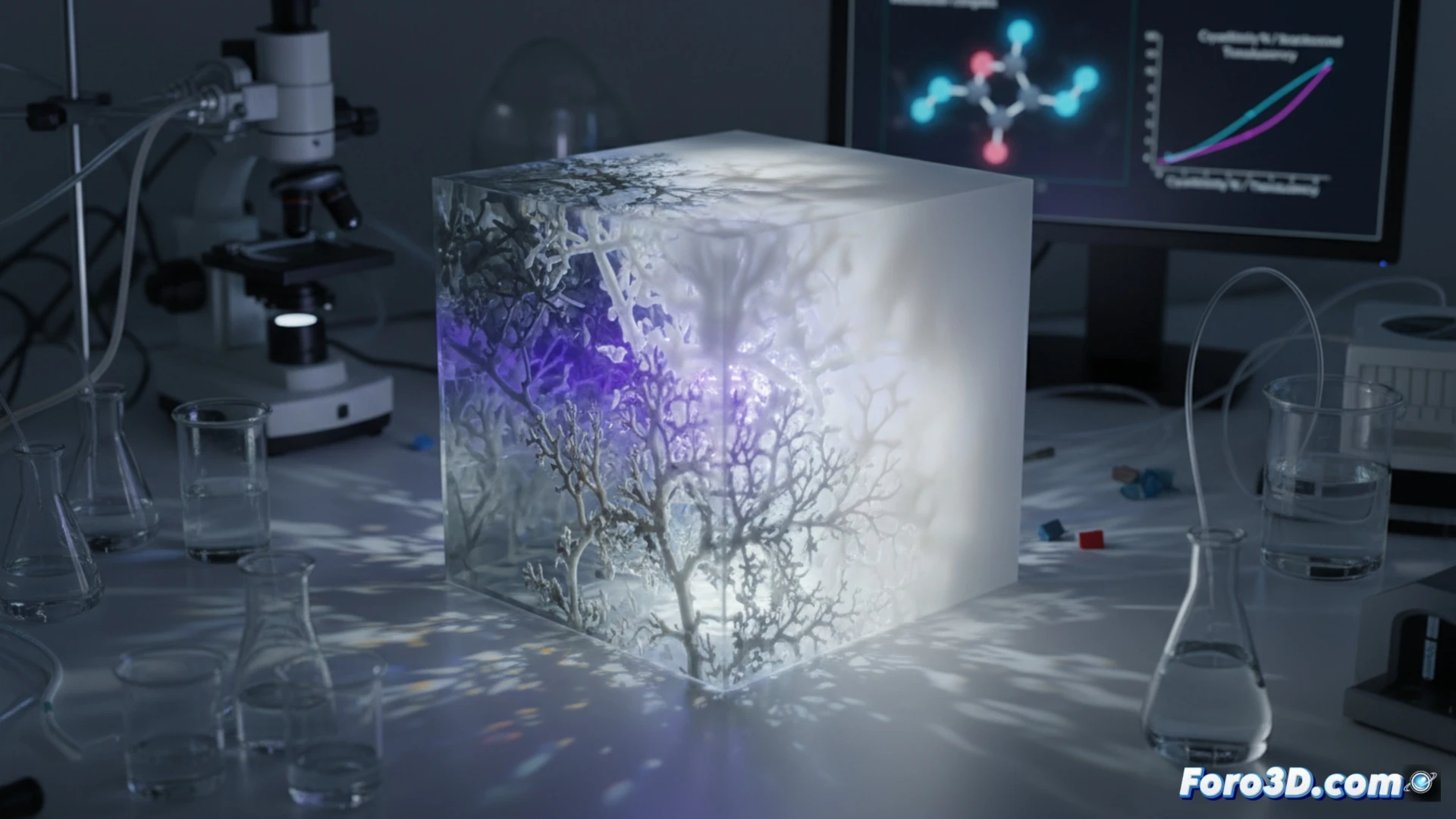
Chemical mechanism: from stereochemistry to macroscopic properties ⚗️
The technique uses a monomer called cis-cyclooctene and a light-sensitive ruthenium initiator. The trick lies in varying the ultraviolet light intensity during polymerization. Higher light intensity causes greater photochemical decomposition of the initiator, which suppresses a process called secondary metathesis. This control over secondary reactions modifies the stereochemistry of the resulting polymer chain, that is, the spatial arrangement of its atoms. It is this stereochemical change that dictates the final crystallinity percentage of the material. Thus, higher light intensity produces a polymer with lower crystallinity and more translucent, while lower intensity results in a more crystalline, rigid, and opaque material.
The future is gradual: multifunctional materials in a single piece 🌈
This finding brings the concept of grayscale printing to the realm of microstructure. Different levels of irradiation translate directly into property gradients within the same structure. This opens doors to manufacturing objects with smooth stiffness transitions, specific zones of high toughness, or combinations of transparency and opacity impossible to achieve with conventional techniques. This spatial control over crystallinity is not just a laboratory achievement; it is a fundamental step toward programmable materials and integrated multifunctional devices, where function arises directly from the printed microstructure.
How does 3D printing with controlled light allow modulating the crystallinity of a polymer in situ, and what implications does this precise control have on the mechanical and functional properties of the final piece?
(P.S.: Visualizing materials at the molecular level is like looking at a sandstorm with a magnifying glass.)