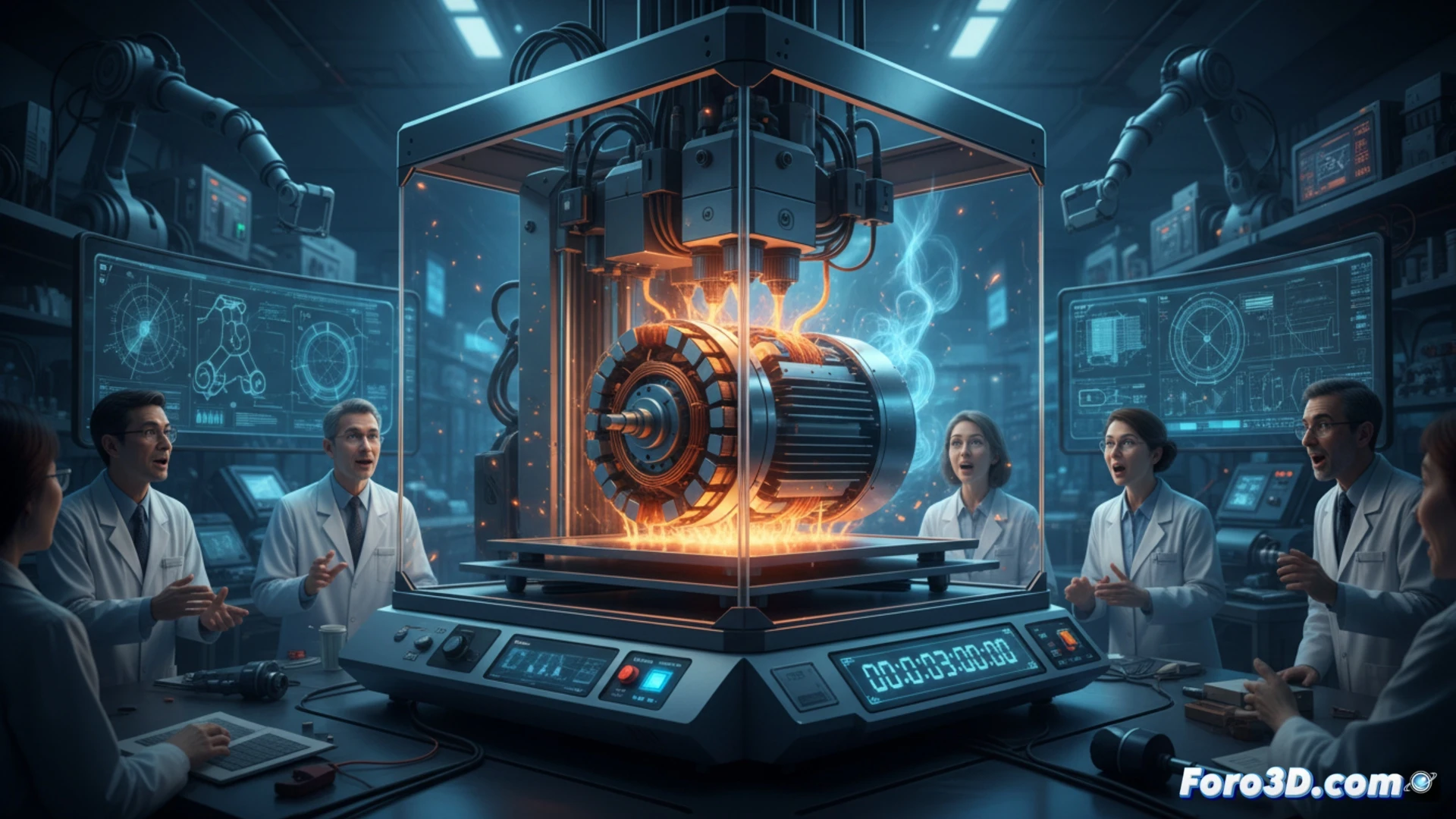
A team of scientists in the United States has set a new record by manufacturing a fully functional electric motor using 3D printing in a record time of three hours. This milestone is not just a demonstration of speed, but tangible proof of the disruptive potential of additive manufacturing for industrial production. It contrasts with traditional timelines of days or weeks, offering significant cost reductions and redefining the limits of rapid manufacturing of complex, ready-to-use components.
Hardware and materials behind the record ⚙️
Achieving this result involves the use of high-performance additive manufacturing equipment, most likely metal 3D printing systems such as DMLS (Direct Metal Laser Sintering) or metal deposition technologies. These systems enable the creation of complex internal geometries, such as cooling channels or stator windings, which would be impossible or extremely costly with traditional machining. The key material is conductive metallic alloys with suitable magnetic properties, processed layer by layer with extreme precision to ensure immediate electromechanical functionality post-printing.
A paradigm shift for professional workflows 🔄
This advance signals a turning point. For engineers and industrial designers, it means the ability to iterate functional prototypes at unprecedented speed, validating designs in hours instead of weeks. Beyond prototyping, it brings additive manufacturing closer to final production of short runs or customized parts in sectors like automotive and aerospace, where agility and topological optimization are crucial. 3D printing hardware thus consolidates as a tool for direct production, not just representation.
Is metal 3D printing the key to on-demand manufacturing and repairing any electric motor in a matter of hours? 🚀
(PS: RAM is never enough, like coffees on a Monday morning)