The boundary between the machine and the living organism blurs with the development of swimmer microrobots manufactured using 3D printing. Inspired by the biomechanics of aquatic beings, these devices demonstrate autonomous and efficient locomotion, challenging our traditional concepts. This advancement, achieved with additive manufacturing techniques, is not only a milestone in bioinspired robotics but also opens up a range of revolutionary applications in hard-to-reach environments.
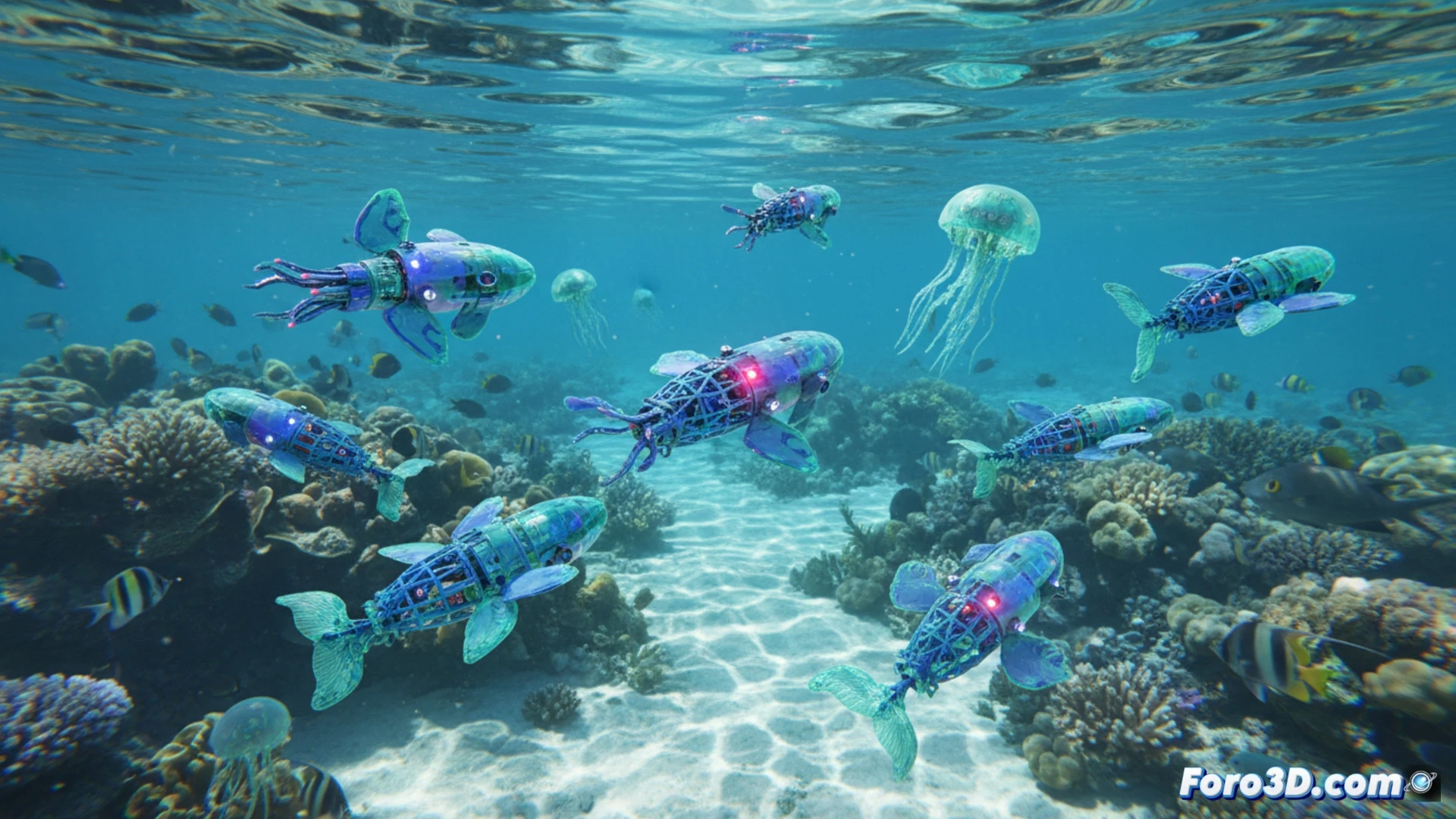
Design, simulation, and additive manufacturing of artificial swimmers 🤖
The core of this achievement lies in an integral workflow that starts from 3D modeling. Researchers design complex geometries inspired by organisms such as bacteria or microfauna, optimizing their hydrodynamics through computer simulations. Once the virtual model is validated, they are manufactured using high-precision 3D printing, employing composite materials or functional polymers that enable movement, often activated by magnetic or chemical fields. This synergy between digital design, simulation, and additive manufacturing is key to replicating organic shapes and their functionality.
Where is the limit? Implications and future of soft robotics 🤔
Beyond the technical advancement, these robots raise profound questions. Their similarity to life forces us to reflect on the definition of the living and the ethical implications of creating such mimetic machines. In practical terms, their future is promising: from targeted drug delivery in medicine to monitoring aquatic ecosystems or inspecting submerged infrastructure, representing the materialization of microscale automation.
How are engineers overcoming the limits of 3D printing at the microscale to create bioinspired swimmer robots with materials and designs that mimic the efficiency of natural aquatic organisms?
(P.S.: Simulating robots is fun, until they decide not to follow your orders.)