Traditional shipbuilding, a process that can take months, has just been challenged by a milestone in additive manufacturing. A team has developed and successfully tested a functional oceanic catamaran, 3D printed in a record time of less than 160 hours. This achievement is not just a demonstration of speed, but tangible proof that large-scale 3D printing with composite materials can produce robust maritime structures capable of facing the open sea. This advance opens the door to faster, more efficient, and customized production in the nautical sector.
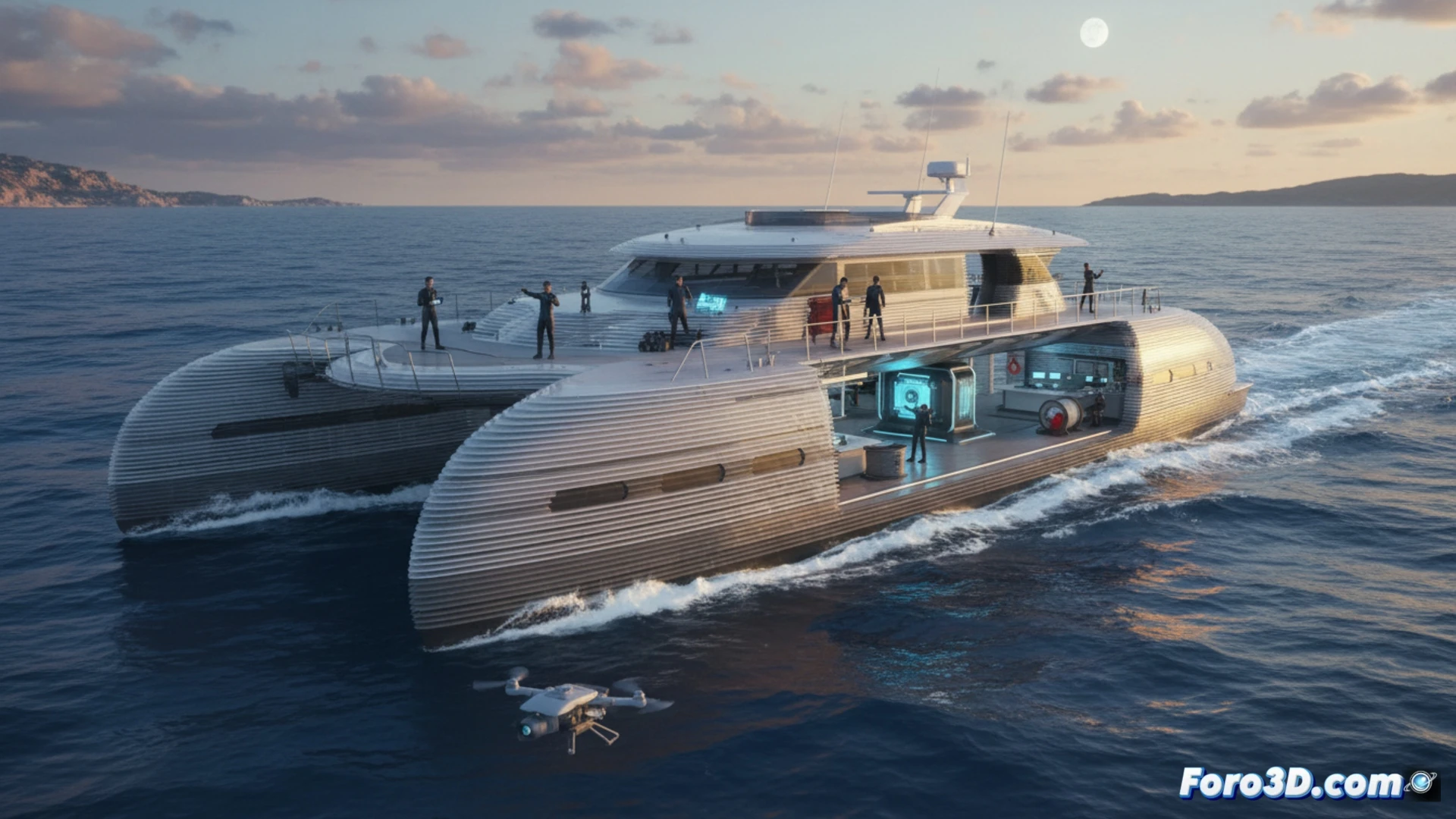
Technical workflow: from digital model to sea 🛠️
The success of the prototype lies in a meticulously optimized workflow. It all began with a 3D model designed specifically for large-scale additive manufacturing, prioritizing structural strength and material efficiency, minimizing supports and optimizing print paths. Composite materials were used, typically fibers reinforced in a polymeric matrix, to ensure rigidity, buoyancy, and resistance to saltwater and UV rays. The printing was carried out on a large-format 3D printer, with parameters calibrated for thick layers without compromising integrity. Post-production, including the assembly of printed parts and surface finishes, was crucial to achieve watertightness and prepare the vessel for its ultimate test: sailing in real conditions.
A new horizon for nautical manufacturing 🌊
This catamaran is more than a prototype; it is a practical demonstration of a paradigm shift. The advantages are clear: extreme reduction in manufacturing timelines, less dependence on expensive molds and intensive labor, and unprecedented design freedom to create hydrodynamically optimized hulls and structures. This could lower costs and enable customization at a previously unthinkable level. The future of boat building, especially for specific models or limited series, could increasingly be in the hands of large-scale 3D printing.
Could large-scale 3D printing redefine the timelines and economics of oceanic vessel construction?
(P.S.: don't forget to level the bed, or your print will look like abstract art)