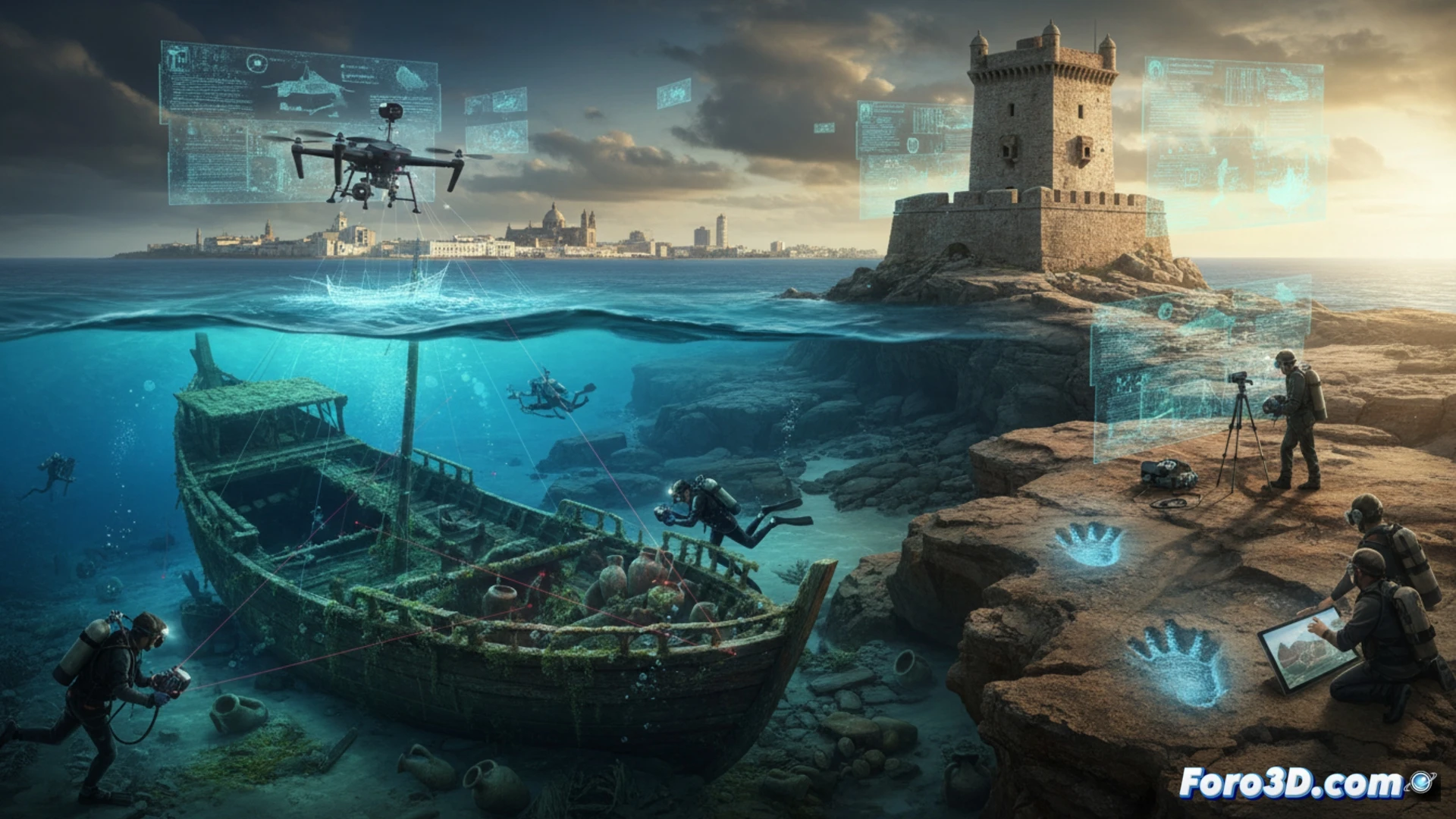
The Underwater Archaeology Center of the Andalusian Institute of Historical Heritage has applied 3D digitization techniques to document and study key findings in the province of Cádiz. Through photogrammetry, they have reconstructed a 1st century AD Roman ship in Camposoto, a 16th-century watchtower in Conil, and Pleistocene fossil footprints in Los Toruños. These digital models are now essential tools for scientific research and public dissemination of heritage.
Methodology and precision of digital documentation 📐
Photogrammetry is established as the premier non-invasive method for archaeological recording. The process involves taking hundreds of overlapping photographs of the object or site from all possible angles. Specialized software processes these images, calculating common points to generate a dense point cloud and, finally, a textured 3D model with high metric precision. This digital replica allows for structural analyses, such as studying the architecture of the Roman ship or the construction technique of the tower, without risk to the originals. Additionally, it serves as a perpetual record against possible deteriorations.
Beyond conservation: research and dissemination 🚀
The true value of these models goes beyond mere preservation. For researchers, they are virtual laboratories where measurements, simulations, and comparative studies can be performed iteratively. For society, they are the gateway to often inaccessible heritage, such as a submerged wreck. These 3D reconstructions facilitate the creation of educational resources, virtual visits, and immersive experiences, democratizing knowledge and promoting the appreciation of historical legacy from a technical and rigorous perspective.
How is 3D photogrammetry revolutionizing the documentation and conservation of underwater heritage in Cádiz?
(P.S.: If you excavate a site and find a USB, don't plug it in: it could be Roman malware.)