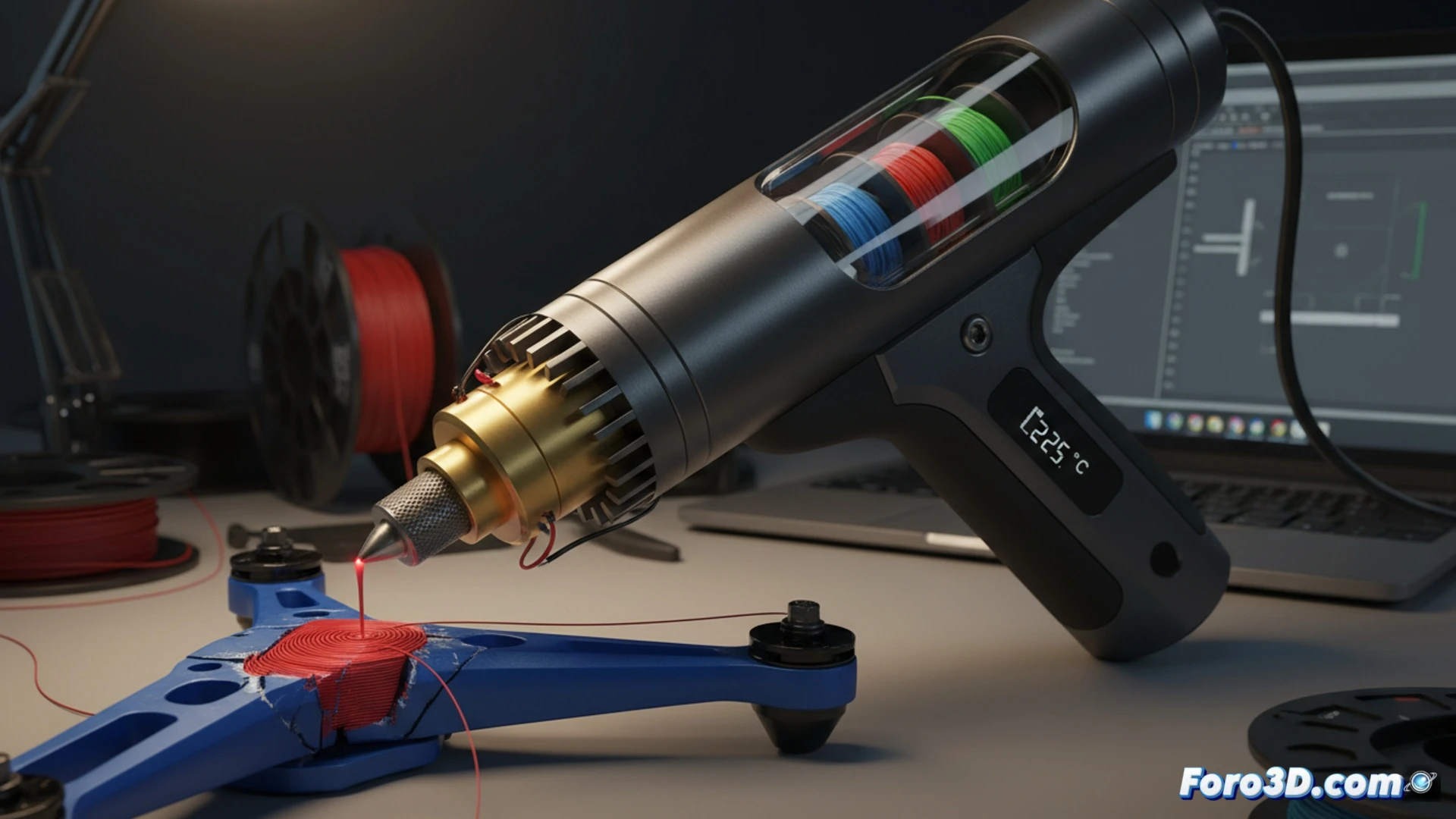
The well-known YouTuber from Proper Printing has revolutionized the concept of the traditional 3D pen. His development abandons proprietary and low-power systems to integrate a standard component from our printers: a complete V6 hotend. This technical decision allows the use of any common FDM filament, operating at the same temperatures and with the same precision. The goal is clear and practical: to offer a robust tool for the effective repair and reinforcement of printed parts with layer defects or breaks, avoiding costly reprints.
Technical advantages of integrating a standard hotend 🔧
The key to this device lies in its total compatibility with the FDM ecosystem. By using a V6 hotend, the pen accepts all types of filaments, from PLA to technical materials like Nylon or PETG, requiring the actual temperatures of each one. This overcomes the main limitation of commercial pens, which usually work with low melting point filaments. Additionally, it allows the use of standard nozzles of different diameters for greater or lesser precision, and its filament cooling and traction system is that of a printer, guaranteeing a constant and controlled flow, essential for solidly welding cracks.
A practical approach for the 3D workshop 🛠️
More than a creative toy, this tool positions itself as maintenance equipment. Its utility for repairing cracked structural parts or joining broken components saves time, filament, and energy. It represents an economical and direct solution, especially for advanced users who already have V6 spares. It does not replace a printer, but it does complement the workshop with professional repair capability, demonstrating that innovation in hardware sometimes lies in reassembling known components to solve everyday problems.
Can a 3D pen equipped with a V6 hotend become the definitive tool for professional repairs in 3D printing? ✨
(PS: If the computer starts smoking when opening Blender, you might need more than a fan and faith)