A new astrophysical theory proposes that a collision between Titan and a lost moon, 400 million years ago, is the key to understanding Saturn's tilt, its young rings, and moons like Hyperion. This complex sequence of events, which includes broken resonances and debris coalescence, can only be explored and validated through advanced computational simulations. Scientific visualization thus becomes the fundamental tool for testing the hypothesis and communicating a dramatic chapter in the history of the solar system.
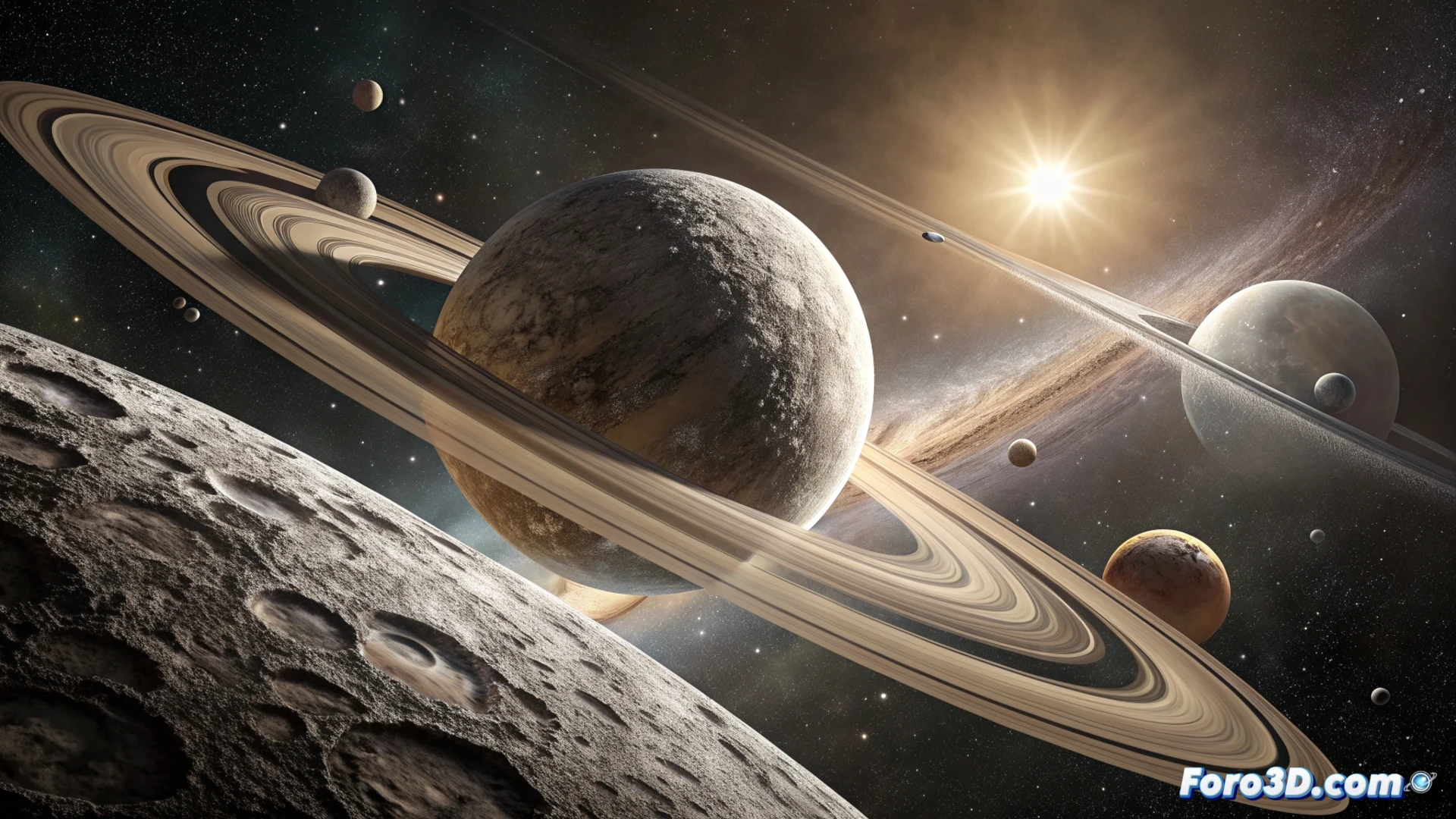
From data to visualization: simulating the collision and its consequences 🧪
Dynamic modeling and 3D simulation tools are the laboratory where this theory comes to life. Researchers input parameters such as masses, velocities, and orbital trajectories to digitally recreate the catastrophic impact. N-body dynamics algorithms calculate how the resonance with Neptune broke, altering Saturn's tilt. Then, gravity coalescence simulations show how debris can form a spongy object like Hyperion. Finally, gravitational destabilization is modeled, which caused the collisions that generated the rings, transforming equations into a sequential and verifiable visual narrative.
Visualization as a bridge between science and understanding 🌉
This case exemplifies how 3D visualization transcends its illustrative role to become an active research methodology. It allows iterating and refining the model of Chrysalis, the lost moon, confronting it with observational data. At the same time, these simulations generate powerful resources for outreach, translating processes of millions of years into intuitive representations. Thus, modeling closes the cycle: it validates the scientific theory and makes it accessible, demonstrating that seeing is believing is, in modern astronomy, seeing to simulate and understand.
How are 3D modeling and computational simulation techniques used to validate the hypothesis of the collision between Titan and a protolunar moon in Saturn's system? 🪐
(P.S.: at Foro3D we know that even manta rays have better social bonds than our polygons)