Intangible cultural heritage, such as legends, faces the risk of being forgotten. The figure of the Trasgo de Potes, a mischievous goblin from the folklore of Liébana, is a perfect example. This article proposes its preservation and dissemination through scientific 3D visualization. A digital model faithful to its ethnographic description can transform an oral story into a tangible educational resource, allowing the study and transmission of this tradition in an innovative and accessible way for new generations.
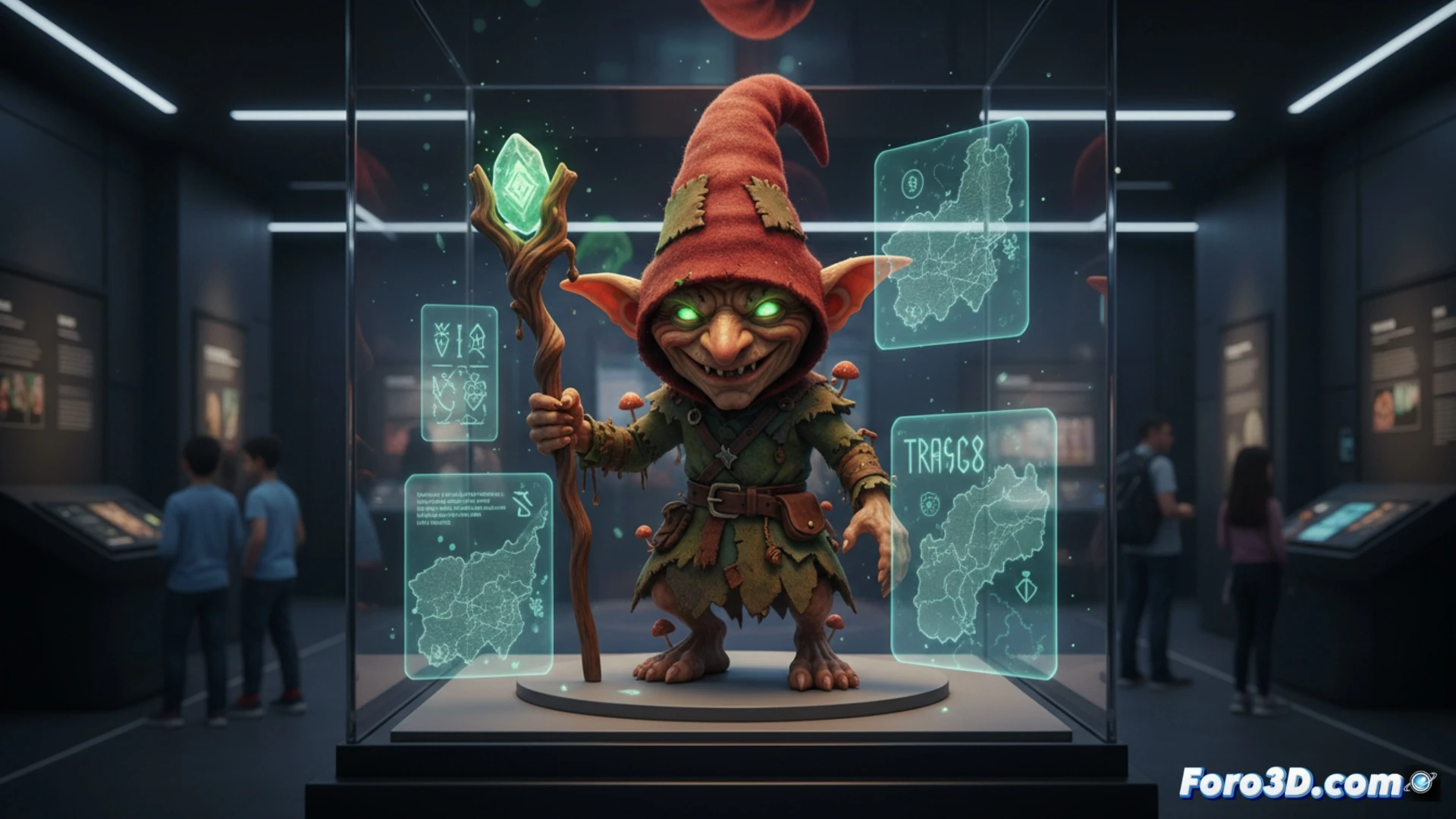
Technical Process: From Ethnographic Description to 3D Asset 🛠️
The process begins with a rigorous analysis of the description: a limping being, with a pierced hand and a mocking attitude. In the concept art phase, credible anatomical proportions are defined, integrating its limp into the kinematics of the digital skeleton. For texturing, references of stone and materials from Liébana farmhouses are studied for its skin and clothes. The scene is completed by modeling an environment of beams and stone, dimly lit, where its characteristic mischief could be animated, such as braiding manes or moving objects, to create an immersive visual narrative.
Beyond the Model: Applications and Digital Preservation 💾
This 3D model transcends the artistic. It becomes a tool for virtual museums, integrable into augmented reality experiences in the Liébana region itself, or in interactive educational resources for classrooms. Scientific visualization applied to folklore not only fixes a canonical image of the creature, but also contextualizes its legend, explaining its role as a domestic parasite within its cultural ecosystem, ensuring that its mocking laughter resonates in the future, not as a nightmare, but as living heritage.
How can 3D modeling and scientific visualization be used to rigorously analyze and disseminate the morphological characteristics and environmental contexts described in folkloric legends, taking the Trasgo de Potes as a case study?
(PD: at Foro3D we know that even manta rays have better social bonds than our polygons)