A recent study has combined observations from the Solar Dynamics Observatory with 3D magnetohydrodynamic simulations to investigate a solar enigma: fast-propagating quasi-periodic oscillations. These perturbations, observed in the corona, travel at thousands of km/s and their origin was unknown. The research demonstrates how computational scientific visualization is key to translating data into physical models that reveal the Sun's hidden mechanisms. 🔭
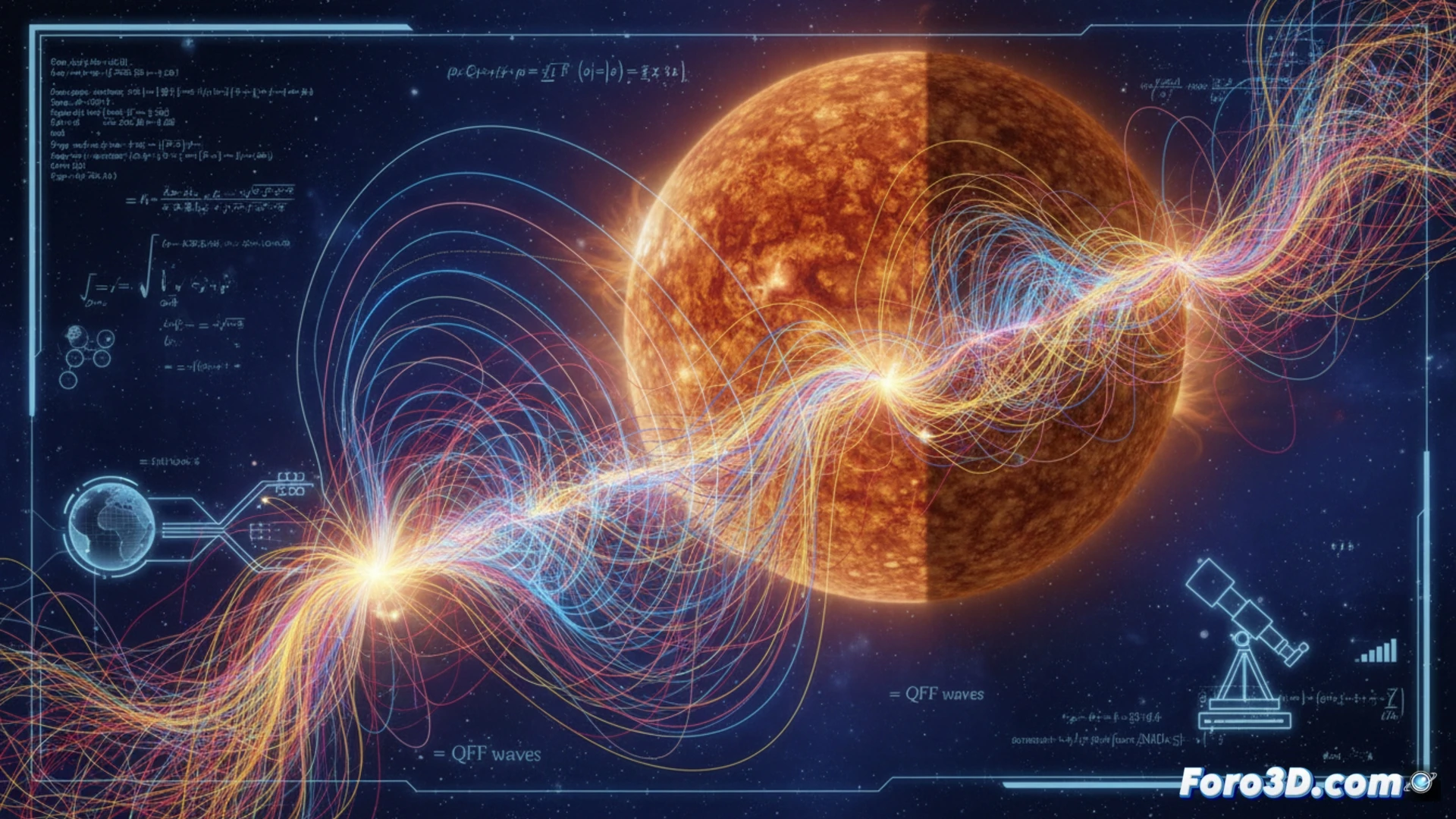
From data to simulation: a computational bridge 🖥️
The process begins with multi-wavelength data from SDO/AIA, which captured QFP waves propagating at 1140-1760 km/s following a solar eruption. A wavelet analysis revealed periodicities of 2-4 minutes, linking them to flare pulsations. Guided by this, the researchers built a realistic 3D model of the corona, including dense magnetic structures of fan loops. By applying periodic drivers that mimic intermittent magnetic reconnection, the MHD simulations successfully reproduced the observed characteristics of the waves, validating the hypothesis.
Visualization as a discovery tool 👁️
The comparison of simulations with and without background coronal structure demonstrated that plasma density profoundly modifies the amplitude and propagation of the detected waves. This indicates that the apparent association of QFPs with specific loops in AIA 171 Å images is a temperature-dependent visibility effect. The study underscores that only realistic 3D models can unravel the true dynamics of complex astrophysical phenomena.
How do 3D magnetohydrodynamic simulations allow correlating the coronal magnetic field structure with the generation and propagation of fast quasi-periodic oscillations (QFPs) observed in solar eruptions?
(P.S.: modeling manta rays is easy, the hard part is making them not look like plastic bags floating)