Additive manufacturing opens a new frontier in the design of functional materials. A team of researchers has created a hybrid foam using 3D printing that combines two polymers with opposite behaviors: one rigid and brittle, and the other flexible and elastic. The internal microstructure, manufactured with millimeter precision, is the key to achieving energy absorption up to ten times higher than that of conventional expanded polystyrene foams, marking a milestone in materials for protection.
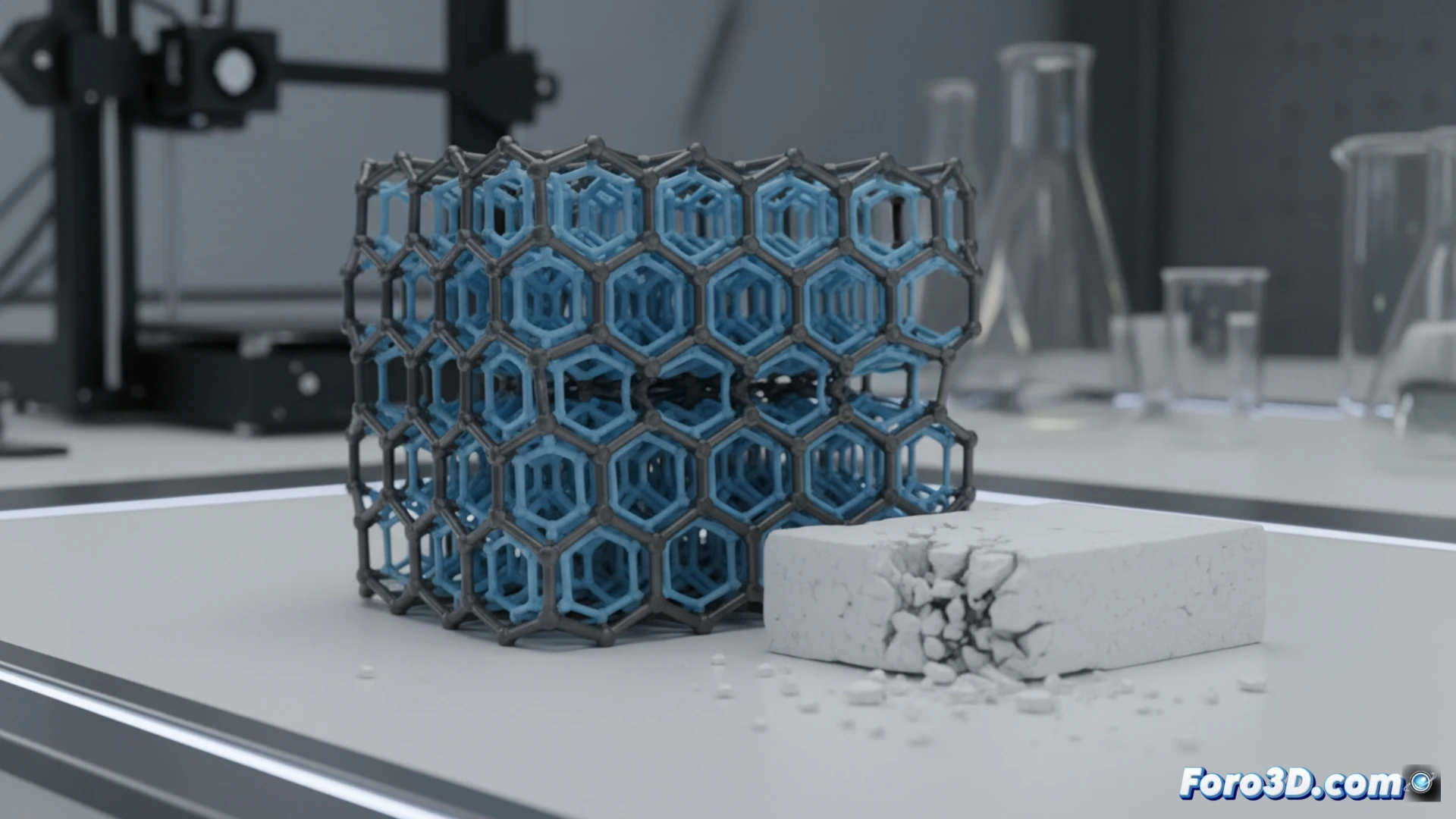
Microstructure designed for controlled sequential deformation 🔬
The high performance does not come from the base materials separately, but from their combined internal architecture. 3D printing allows the fabrication of a microstructure where both components are arranged so that, under impact, they deform in a sequential and controlled manner. First, the rigid polymer fractures in a calculated way, dissipating a large amount of energy. Immediately after, the elastic polymer comes into play, absorbing the remaining force and cushioning the blow. This synergy, impossible to achieve with traditional manufacturing methods, is what multiplies the overall absorption capacity of the composite material.
The future of protection lies in 3D printing 🚀
This advance demonstrates the disruptive potential of additive manufacturing in materials science. It is no longer just about shaping, but about printing mechanical behavior. The leap in properties opens the door to high-value applications in packaging for sensitive components, passive safety elements in automotive, or protective sports equipment, where efficiency in impact absorption is critical. The ability to design and manufacture these hybrid microstructures on demand points the way toward custom materials for specific engineering challenges.
How does the 3D printed microarchitecture of hybrid foams redefine the limits of energy absorption in lightweight materials?
(P.S.: Visualizing materials at the molecular level is like looking at a sandstorm through a magnifying glass.)