The recent arrest in Barcelona of a repeat offender for dozens of burglaries in homes and hotels underscores a recurring forensic challenge: the precise and immutable documentation of the crime scene. In such cases, where details about the modus operandi are crucial, 3D reconstruction techniques emerge as fundamental tools. This article explores how digitizing the scene through laser scanning and photogrammetry transforms police investigations and the presentation of evidence in court.
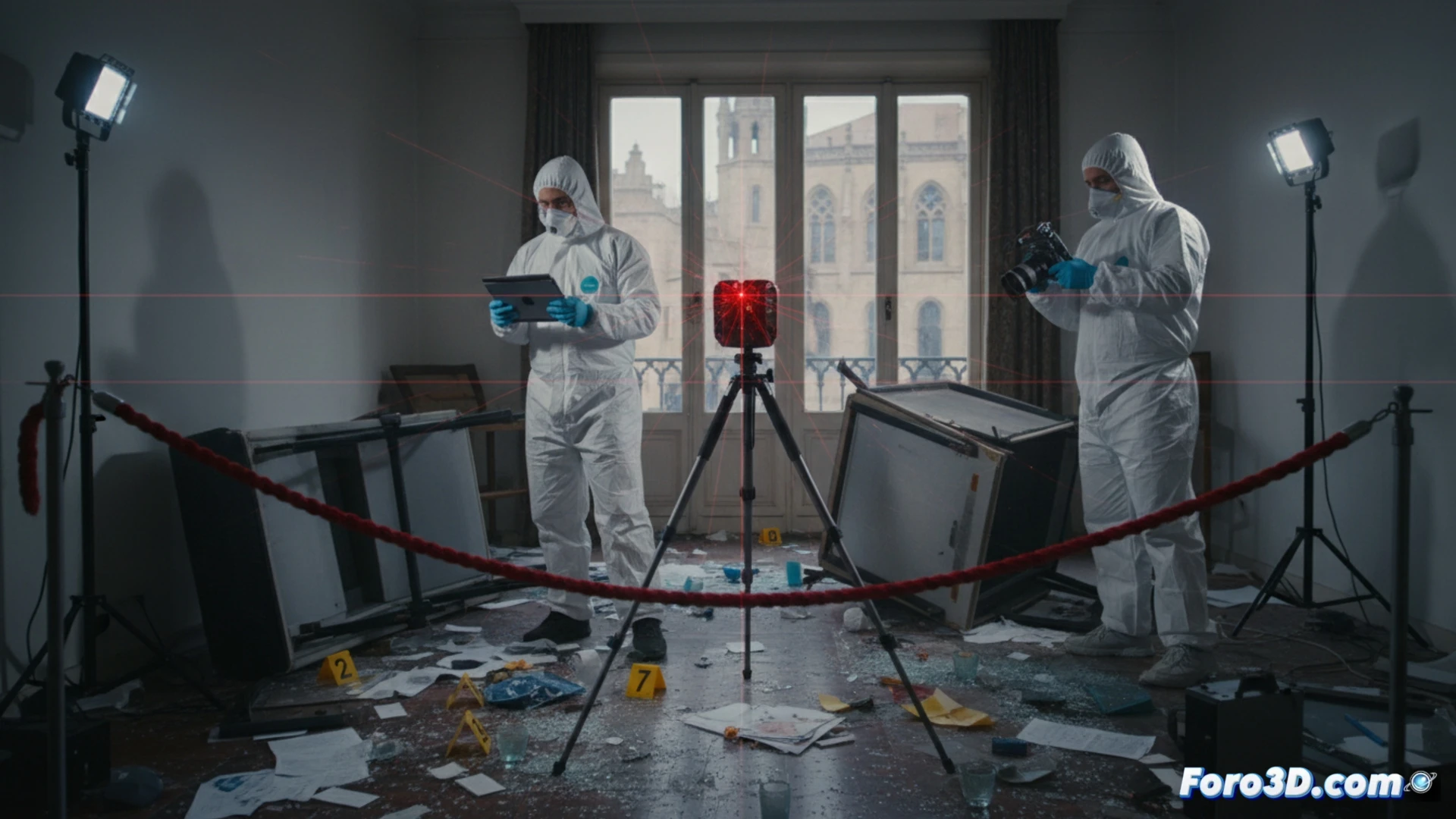
Capture and Analysis Techniques at the Crime Scene 🔍
Documentation begins with data capture. A stationary 3D laser scanner records millions of points from the scene, generating a georeferenced point cloud with millimeter precision. In parallel, photogrammetry, using hundreds of overlapping photographs, builds a photorealistic textured model. In the case of a burglary, this allows digitally preserving the exact state of forced entry points, internal disarray, and possible abandoned tools. Investigators can then analyze, in the interactive 3D model, probable trajectories of the perpetrator, lines of sight, and event sequences, without altering or physically revisiting the location, which is vital in private properties like hotels or homes.
Evidentiary Value and Effectiveness in the Judicial Process ⚖️
The ultimate value of the 3D reconstruction materializes in the courtroom. A navigable model or rendered videos provide the judge and jury with an intuitive understanding of the scene, impossible to achieve with traditional plans and photographs. It becomes an objective and neutral piece of evidence that clarifies testimonies and expert reports. For a case like Barcelona's, with multiple scenes, the technology allows rigorous pattern comparison, strengthening the argument of a common modus operandi and, ultimately, contributing to solid convictions based on incontrovertible digital evidence.
How can forensic 3D documentation transform burglary scene investigations, overcoming the limitations of traditional photography to ensure the integrity of digital evidence in judicial processes?
(P.S.: In scene analysis, every scale witness is an anonymous little hero.)