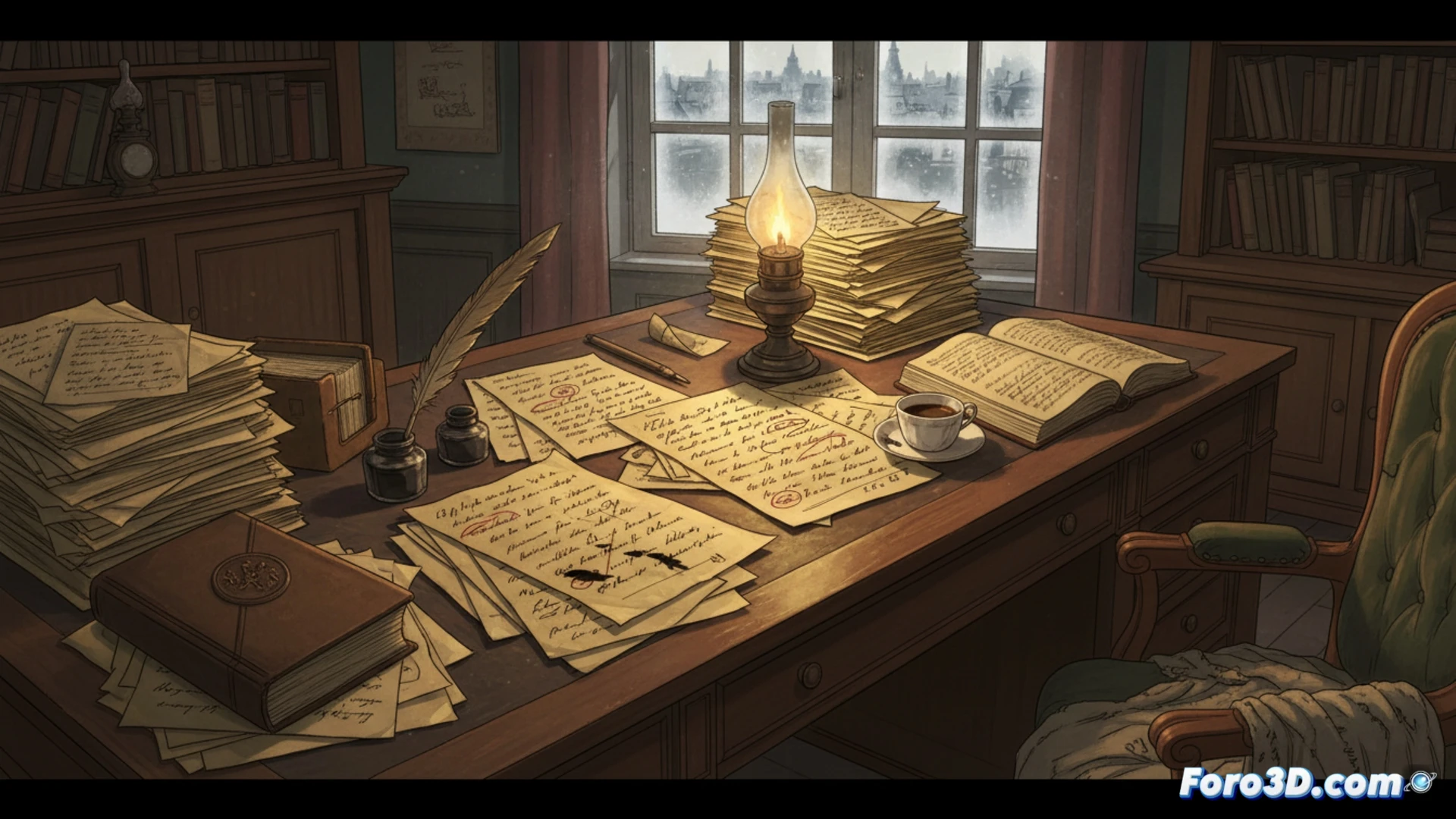
Victor Hugo's original manuscripts and drafts for Les Misérables are a fragile treasure. Their physical preservation is a priority, but studying them involves risks. This is where 3D technology reveals itself as a fundamental tool. Using techniques such as high-resolution photogrammetry or laser scanning, we can create exact digital replicas. This allows researchers from around the world to analyze every annotation, strikethrough, and correction from the literary genius without handling or exposing the originals to light and wear.
3D Capture Techniques and Non-Invasive Analysis of Manuscripts 🔍
The 3D digitization of a historical document goes beyond a simple flat photograph. A structured light 3D scanner or multi-camera photogrammetric rig captures the microscopic topography of each page: the pen indentation, the texture of aged paper, and the overlapping layers of ink. This three-dimensional model can then be processed to enhance details invisible to the human eye. Virtual grazing light filters can be applied to read erased texts or highlight corrections. The result is an enriched digital file that serves both as an immutable heritage backup and as an interactive analysis platform where writing layers can be separated and the creative process reconstructed step by step.
Beyond Preservation: Access and Interactive Legacy 🌐
The true power of these 3D models lies in their ability to democratize access. Institutions can publish models online, allowing anyone to explore Hugo's drafts as if they had them in front of them, zooming in on every detail. This accessibility fosters new research and brings cultural heritage to the public in a deeply immersive way. Thus, 3D technology not only freezes a physical artifact in time but revitalizes its content, ensuring that the creative journey of a monumental work continues to inspire future generations.
How can high-resolution 3D digitization overcome the limitations of flat photography to document and preserve the materiality of the Les Misérables drafts, such as layered corrections, paper textures, and pressure marks, without compromising the physical conservation of the fragile originals?
(P.S.: Virtual restoration is like being a surgeon, but without bloodstains.)