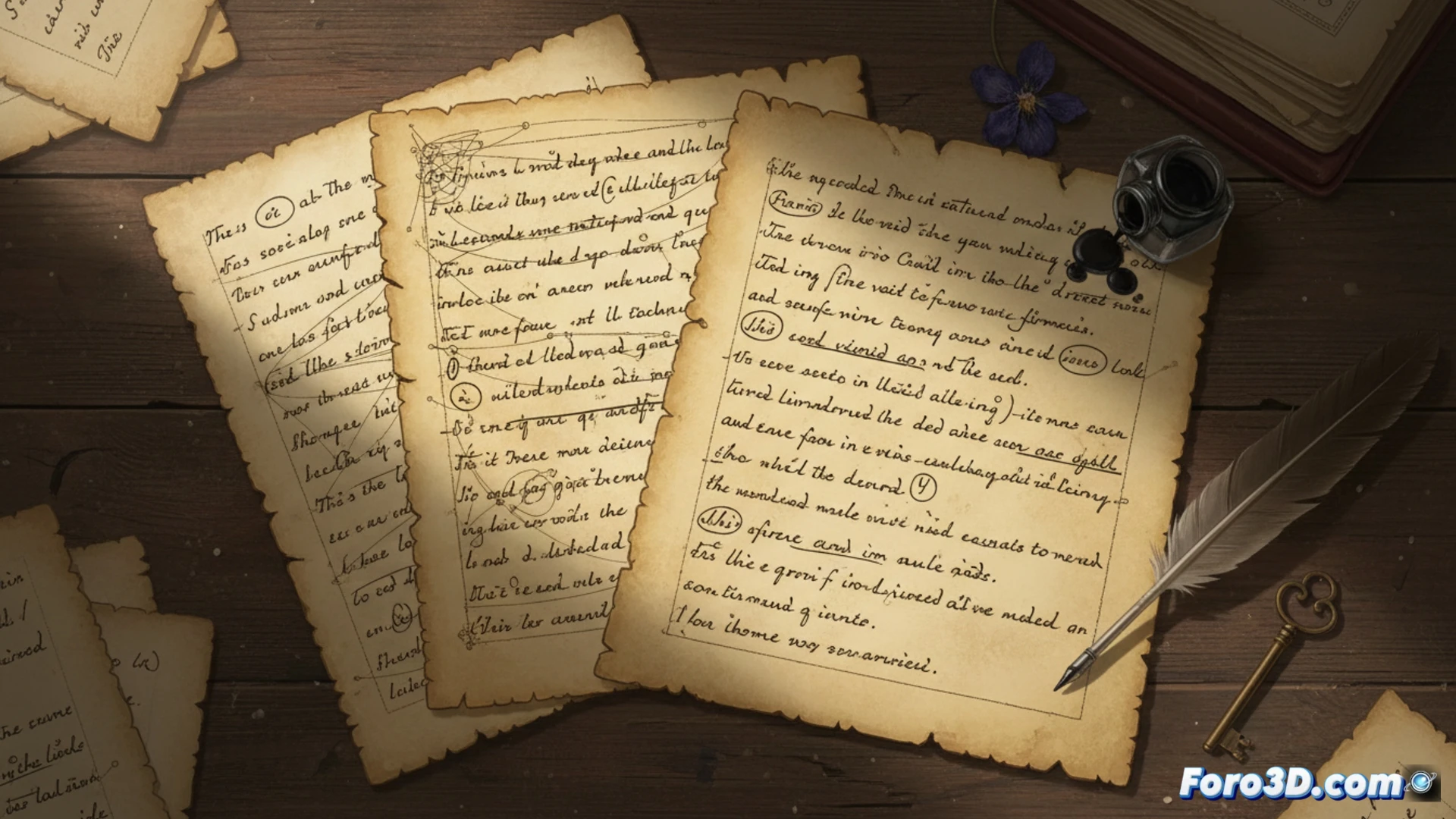
Emily Dickinson's original manuscripts are not just texts; they are physical objects with incalculable heritage value. Their unique structure, with variants, strikethroughs, and marginal annotations, reveals her creative process. In the field of conservation, 3D digitization emerges as a fundamental tool to preserve this materiality in its entirety, capturing every physical detail for future generations and enabling forensic study without risk to the original.
Forensic capture of materiality: beyond the flat image 🔍
Techniques such as high-resolution photogrammetry and 3D laser scanning allow documenting these fragile documents with millimeter precision. It is not just a simple photograph. These technologies generate three-dimensional models that record the topography of the paper, the depth of the ink strokes, deformations, folds, and even the imprints of writing instruments. This digital archive becomes a scientific facsimile, essential for degradation analysis, restoration planning, and creating exact physical replicas for exhibition, reducing handling of the original.
Preserve the gesture, democratize access 🌐
3D digitization transcends physical conservation. By capturing the object in its entirety, it preserves the author's creative gesture, her unique way of inhabiting the page. These interactive models can be shared globally, allowing researchers and the public to study the manuscripts from any angle, with grazing light to see reliefs, in a democratized access that protects the original asset while radically expanding the possibilities for research and cultural outreach.
How can 3D digitization overcome the limitations of traditional 2D photography to document and preserve the subtle material details of Emily Dickinson's manuscripts, such as paper folds, writing pressure marks, or deterioration traces?
(P.S.: Virtual restoration is like being a surgeon, but without bloodstains.)